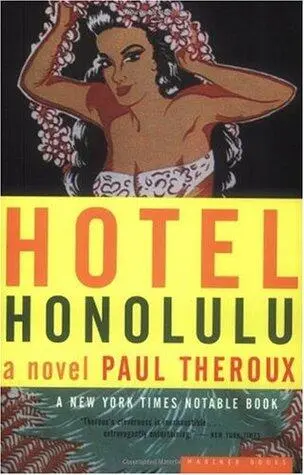
Paul Theroux - Hotel Honolulu
Здесь есть возможность читать онлайн «Paul Theroux - Hotel Honolulu» весь текст электронной книги совершенно бесплатно (целиком полную версию без сокращений). В некоторых случаях можно слушать аудио, скачать через торрент в формате fb2 и присутствует краткое содержание. Год выпуска: 2002, Издательство: Mariner Books, Жанр: Современная проза, на английском языке. Описание произведения, (предисловие) а так же отзывы посетителей доступны на портале библиотеки ЛибКат.
- Название:Hotel Honolulu
- Автор:
- Издательство:Mariner Books
- Жанр:
- Год:2002
- ISBN:нет данных
- Рейтинг книги:4 / 5. Голосов: 1
-
Избранное:Добавить в избранное
- Отзывы:
-
Ваша оценка:
Hotel Honolulu: краткое содержание, описание и аннотация
Предлагаем к чтению аннотацию, описание, краткое содержание или предисловие (зависит от того, что написал сам автор книги «Hotel Honolulu»). Если вы не нашли необходимую информацию о книге — напишите в комментариях, мы постараемся отыскать её.
Hotel Honolulu — читать онлайн бесплатно полную книгу (весь текст) целиком
Ниже представлен текст книги, разбитый по страницам. Система сохранения места последней прочитанной страницы, позволяет с удобством читать онлайн бесплатно книгу «Hotel Honolulu», без необходимости каждый раз заново искать на чём Вы остановились. Поставьте закладку, и сможете в любой момент перейти на страницу, на которой закончили чтение.
Интервал:
Закладка:
Presiding over this time-wasting ceremony, I remembered how the day before, facing just this way, I had seen a woman — the subject of my proposed story — plodding through the lobby with her head down. This woman, who had sadly turned to Rose and snatched her up, was perfect. "Your daughter's got conjunctivitis!" she had said, a sudden and precise diagnosis. I had gotten used to hotel guests making demands, but here was one who offered some shrewd medical advice. She said she knew what she was talking about. Her name was Monica Thrall, and she looked unwell herself. Under the influence of a Henry James story I had just read, I decided to write a short story based on her and, I suppose, the fear of my daughter's falling ill. After the Jesse Shavers interruption I returned to my office and wrote "The Real Thing" in block letters at the top of the page.
Monica Thrall had been furious with me. "How can you treat your daughter this way? If she thinks you don't care about her health, she might do something really terrible. Don't you see that?"
She was so passionate and sad, and her abuse of me so urgent and emotional, I ordered flowers for her. But her anger was the point. The woman with the Jamesian name had descended upon us and made us conscious of our frailty. And she had been right. I got the eye drops and soon Rose stopped rubbing her eyes and smiled more.
"I try deliver the flowers again?" Marlene asked — no knock. I looked up from my blank pad. "Could not deliver yesterday. Was a Do Not Disturb sign on her door."
I nodded for her to complete the errand and thought how I should have just such a warning sign on my door, so I could write my short story about a middle-aged woman from Gary, Indiana, who casually diagnoses a rare illness in another hotel guest and thus saves his life. Had these two strangers not been in the same hotel, the man would have died. Never mind the Do Not Disturb sign — I couldn't even close my office door. I was on duty. Someone might need me.
One of the contradictions of writing a short story in Hawaii — something I had never before attempted — was that I could do it only when I was working. Writing was impossible in the cramped two-room suite I shared upstairs with my wife and child. It annoyed me that while my six-year-old daughter had a desk there, I did not.
The nurse in my story needed a new name and a new hometown. I was so out of practice in writing stories that I could not imagine improving on her reality. There was no better name for her than Monica Thrall, no better hometown than Gary, Indiana. The alternatives I thought of sounded false and fabricated. So I began writing, describing the woman who had seen Rose's eye problem, but in this story I imagined that she would be sitting by the pool and watching a woman in a bikini, and from years of observation would detect on the woman's almost naked body the symptoms of a rare form of melanoma. Or was she in an elevator, diagnosing the other riders?
Seeing Trey approach my office door, looking grim, I slid a sheet of paper over the first sentence of "The Real Thing," as though concealing a love letter to my mistress.
"Boss, we got a problem poolside," Trey said, walking into my office without any hesitation. "A guest upstairs just phoned down that he could see there's some people balling in the pool. They seen his peepee."
"Tell the fornicators in question to stop it."
"I did. They just give me stink-eye."
Sometimes at night there were such complaints, but this was a first for me — a couple screwing in the hotel swimming pool at five-thirty in the afternoon, in broad daylight, in full view of the Happy Hour customers, who seemed to be enjoying the wet spectacle from the Paradise Lost lanai. I recognized the couple, because at check-in they had asked about renting a motorcycle in Honolulu. While Chen made the phone call, the man had shown me some snapshots of his Harley, the way other people flashed pictures of their children. The woman seemed equally proud of the bike. One of those couples, with unimaginative tattoos, eager for attention, now locked together at the deep end, the woman's back against the far corner of the pool, her white legs encircling him in an animal grip, her heels pressing his hairy back. The man's submerged and rotating buttocks glowed plum blue in the cloud-filled water like a monkey's bum.
"I'm afraid I'm going to have to ask you to go inside," I said.
"You got a problem, pal?" The man was obviously drunk. "Stink-eye" said it all.
"Not me. Blame the Board of Health. You're not in compliance with the guidelines. I have to cite you for health code violations." And before he could interrupt me, I said, "Glass beverage containers are forbidden poolside" — a dozen scattered bottles of Corona beer, most of them empty — "and you're not suitably attired. You need bathing suits."
Disconcerted by my obliqueness, the man said, "How can I do this in a bathing suit?"
"Try it upstairs in your room."
My standing there whistling, fully clothed, with my back turned, supervising Trey as he collected the clinking beer bottles, seemed to make the couple self-conscious. They swore and splashed and went away, wrapped in towels, as the Happy Hour customers hooted and whistled.
Back in my office, I resumed my story. The woman, Monica Thrall, came from Gary, where — maybe she was a nurse? — on buses and commuter trains she had developed the habit of diagnosing the other passengers — observing their eyes, the texture of their skin, their tremulous fingers. As this paragraph took shape, the phone rang.
"Doesn't anyone speak English in this hotel?"
"Thanks for your inquiry. I'll have someone in Hospitality help you."
"Hey, I just got a hand job from them and now I'm getting a hand job from you."
The guest, a Mr. Gordie Steen from Orange County, California, was elderly, cranky, and like many other complainers merely wanted a listener to his grievances, which I took to be racist. The ignorant obsession with foreign accents is nearly always racist.
Miss Thrall swept into the hotel elevator and swiftly assessed the other occupants, all of them wearing bathing suits. Because people in elevators do not look each other in the eye, she was able to size them up. One had conjunctivitis, another arthritic hands and deep facial creases from years of smoking. This one panted — terrible circulation. One man's eyes had gone yellow.
"Man want to see you," Marlene said, waving a bouquet of flowers. Before she could finish, the man barged past her, gabbling in fury.
"My fiancee's just been abducted," he said. He was stout, about forty, big and pale, but misshapen, almost lopsided, in a way that suggested weakness in spite of his large size.
"The sign's still up," Marlene said. My head was so full it took me a moment to understand that they were Miss Thrall's flowers, the real Miss T. in the hotel, and the Do Not Disturb sign was still on her doorknob.
Filling my doorway, the big agitated man said, "We're in the bar and she starts talking to this black guy. He's an actor. She's seen him on Oprah. Very articulate. Next thing I know she's gone, and so is he."
"How is that possible?"
"I didn't see them. I was looking at those two bozos fucking in the pool." He chewed his lips, suddenly embarrassed by this crass admission.
"I thought you handled the situation very well. Now will you please get my fiancee out of this guy's room?"
"You could knock."
"There's a sign. Do Not Disturb."
The man was afraid, and who wouldn't be? Jesse Shavers was known for his violent roles. "I'll pinch your fucking head off" was one of his better- known lines. If the man had truly thought his wife was in danger, he would have knocked or called the police. His fear was, of course, that his fiancee was enjoying herself.
Читать дальшеИнтервал:
Закладка:
Похожие книги на «Hotel Honolulu»
Представляем Вашему вниманию похожие книги на «Hotel Honolulu» списком для выбора. Мы отобрали схожую по названию и смыслу литературу в надежде предоставить читателям больше вариантов отыскать новые, интересные, ещё непрочитанные произведения.









Обсуждение, отзывы о книге «Hotel Honolulu» и просто собственные мнения читателей. Оставьте ваши комментарии, напишите, что Вы думаете о произведении, его смысле или главных героях. Укажите что конкретно понравилось, а что нет, и почему Вы так считаете.