Paul Theroux - Hotel Honolulu
Здесь есть возможность читать онлайн «Paul Theroux - Hotel Honolulu» весь текст электронной книги совершенно бесплатно (целиком полную версию без сокращений). В некоторых случаях можно слушать аудио, скачать через торрент в формате fb2 и присутствует краткое содержание. Год выпуска: 2002, Издательство: Mariner Books, Жанр: Современная проза, на английском языке. Описание произведения, (предисловие) а так же отзывы посетителей доступны на портале библиотеки ЛибКат.
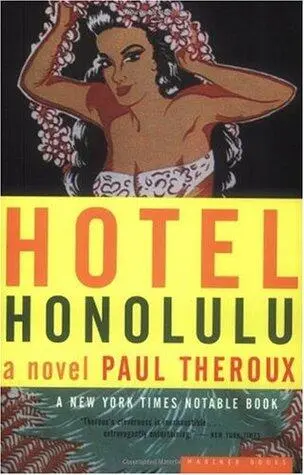
- Название:Hotel Honolulu
- Автор:
- Издательство:Mariner Books
- Жанр:
- Год:2002
- ISBN:нет данных
- Рейтинг книги:4 / 5. Голосов: 1
-
Избранное:Добавить в избранное
- Отзывы:
-
Ваша оценка:
Hotel Honolulu: краткое содержание, описание и аннотация
Предлагаем к чтению аннотацию, описание, краткое содержание или предисловие (зависит от того, что написал сам автор книги «Hotel Honolulu»). Если вы не нашли необходимую информацию о книге — напишите в комментариях, мы постараемся отыскать её.
Hotel Honolulu — читать онлайн бесплатно полную книгу (весь текст) целиком
Ниже представлен текст книги, разбитый по страницам. Система сохранения места последней прочитанной страницы, позволяет с удобством читать онлайн бесплатно книгу «Hotel Honolulu», без необходимости каждый раз заново искать на чём Вы остановились. Поставьте закладку, и сможете в любой момент перейти на страницу, на которой закончили чтение.
Интервал:
Закладка:
"I can't help you," I said. "Marlene here will tell you that we never enter a room where there's a sign up. She's been trying to deliver some flowers for two days to just such a room."
"I gave her a ten-thousand-dollar engagement ring! Tell her I want it back!"
"I'll put Mr. Shavers's message light on," I said. "We can't intrude unless it's an emergency."
"What do you call this?"
"Your fiancee is in another guest's room, probably in bed, probably naked. What do you suppose we call it?"
Perhaps I had gone too far. Squinting with his grief-swollen eyes was the man's way of stopping his tears. He left my office as lopsidedly as he had entered.
Marlene said, "So, what about the flowers?"
"Try again later."
I resumed my story. I wrote four lines: Miss Thrall was still in the elevator, peering at the strange color of the guest's eyes, seeing jaundice, perhaps kidney failure. How I hated to invent.
I got no further. The stink-eye couple I had banished from the pool were now making so much noise in their room that guests down the hall from them were complaining. I put my story away — the two paragraphs, the borrowed title; hardly a story — and went upstairs. There was no sign
on the doorknob of the noisy motorcyclists' room, but something else caught my eye. They were next door to Miss Thrall's room. She had not complained of the noise. Her sign was still hung as Marlene had said, but there was a more telling sign of trouble: two newspapers lay stacked in front of the door. That meant she had not left the room for two days. This, in sunny Honolulu, was unthinkable.
I used my master key and saw her motionless in bed as soon as I entered. She was dead, already ripe. There seemed to be drug paraphernalia on her bedside table. There was no note. Dr. Miyazawa, Buddy's doctor, said she had given herself an overdose of insulin. It was the most efficient way of taking your life. She had to have been a doctor or nurse herself, Doctor Kim was saying in my office, as I put my tiny fragment of a story aside and Wrote my shocking statement for the police.
45 Camera Obscura
The only portrait of Wayne Godbolt that was ever painted by his brother, Will, hung in the Honolulu Academy of Arts for a week before it was removed one morning without explanation. At about the same time, Will flew to Honolulu from his Big Island home and quietly checked into my hotel under an assumed name — strangely enough, his brother's name. I had no idea who these brothers were, but Buddy happened to see Will, and it was he who told me all about them. Their family history was part of the oral tradition of Hawaii.
The sighting of Will at the hotel made me want to see the painting, and it was on that visit to the museum that I discovered it had been removed. A security guard told me that it was being held in a dark room somewhere downtown. "That's appropriate," I said. This man, with the name Balabag on his ID badge, opened his mouth wide, just dropped his jaw, his way of showing incomprehension, something Buddy did all the time. The portrait was called Camera Obscura.
What made the removal shocking was that Wayne had died so recently, and that he and his brother, the photographer and the painter, were so loving toward each other, like twins on a mission. Will's paintings had a fanatical exactitude that was photographic; Wayne's photographs were impressionistic — cloudy, airbrushed, meddled with in the darkroom, with a ghostly and abstract liquefaction.
The painting that had been on view in Honolulu showed Wayne in a darkroom holding his old-fashioned camera. The composition had a scumbled background of glossy maroon-dark paint that was so blistered it made you think of dead beetles and brittle wings. Wayne's eye, just a brush stroke, stared like a camera's lens. An unmade bed, stark as a sacrificial altar, was part of the foreground, but the glossy blistered color dominated. On the Academy wall one day, gone the next. What had happened?
"I'm a vegetarian, he's a cannibal," Will had said of Wayne, the painter brother of the photographer brother. "It's why we're able to love each other."
Will was known on the mainland, and his work sold there; Wayne was not, so his work didn't. That was Hawaii's test of artistic talent and success, though the distance was merciful: because we were in the middle of the ocean, we were unaware of the further fortunes of anyone enjoying celebrity on the mainland. Local people seemed to disappear when they went there, even when they were enjoying great success. Hawaii residents with great reputations on the mainland — W. S. Merwin, Leon Edel — were mostly faceless and unspoken of here. Will Godbolt's paintings were better known in New York than in Honolulu.
The wordy label stuck to the Academy wall explained that a camera was a room as well as a photographer's instrument, and a camera obscura was a simple device for viewing. The label also mentioned the closeness of the two artistic brothers, how they had been raised by their mother in the most fertile part of the Big Island, the slopes of Kamuela. The Godbolts were an old kama'aina missionary family. The mother, Lydia, was a Daughter of Hawaii; the father, Simon, had been killed in the Solomon Islands during World War Two.
The rest I knew. Lydia Godbolt had not remarried. She had raised her children and they had remained her children, had not married, saw her all the time, did portraits of her. Each son's portrait of her was distinctly different, two women entirely. Will used Lydia's own cosmetics on the canvas, lipstick and powder to heighten the facial features, making the portrait an amazing likeness. Wayne's photograph would have been shocking except that the image was almost indistinguishable as a woman and looked like a shattered meringue — just as well, for it depicted his mother in the nude.
The Godbolt brothers still each kept a bedroom in the family house, though for the first twenty years of their lives, until they left home, they shared the same room, on the north side of the house. In that dark room they developed and came of age.
They made many portraits of Lydia, but they boasted of never having portrayed each other.
"No competition!" Will declared. Wayne agreed.
Wayne, the wilder of the two, was a tormentor. When Will had a girlfriend whom he began to call his fiancee, Wayne teased her, teased Will, cried out, "She's hairy! You're a fairy!" Her name was Laura. She winced, anticipating mockery, whenever Wayne opened his mouth. And Wayne mocked. Laura had been in the Peace Corps in the Philippines. "Say 'Rice-a-Roni' in Tagalog!" Then he jeered at her for acting insulted and criticized her for being thin-skinned. "Look at me — I'm harmless!" He so frightened Laura into silence that she stopped making eye contact. Wayne said, "Why are you mute? Being mute is a form of nagging. Silence is aggressive." He kept at her until she cried, and then Will pleaded with him to stop. That night in the dark room, in a knifelike voice, Wayne said, "If you could get rid of her by pulling a plug, would you pull it?"
A luminous life study of the young woman and Will, one of his many self-portraits, hung in Will's studio. Caine and Mabel, Wayne called it. He ridiculed her skinny thighs, his beaky penis. "The bugfucker! Spiderwoman with webbed feet!" Wayne seemed to flap around the studio, his stiff coat flying like big articulated wings. What was most remarkable in this painting was the clotted shade of yellow that made the bodies glow.
The dense sunny color, Will explained, was the sort obtained in India by feeding mangoes to sacred cows and then collecting and evaporating their urine until only a residue like pollen dust remained. This yellow "cow cake" was used for the rich pigment in the holiest temple paintings.
"You've been feeding mangoes to a cow and saving its sheeshee?" Wayne said.
Читать дальшеИнтервал:
Закладка:
Похожие книги на «Hotel Honolulu»
Представляем Вашему вниманию похожие книги на «Hotel Honolulu» списком для выбора. Мы отобрали схожую по названию и смыслу литературу в надежде предоставить читателям больше вариантов отыскать новые, интересные, ещё непрочитанные произведения.






Обсуждение, отзывы о книге «Hotel Honolulu» и просто собственные мнения читателей. Оставьте ваши комментарии, напишите, что Вы думаете о произведении, его смысле или главных героях. Укажите что конкретно понравилось, а что нет, и почему Вы так считаете.