A. AHomes - The Mistress's Daughter
Здесь есть возможность читать онлайн «A. AHomes - The Mistress's Daughter» весь текст электронной книги совершенно бесплатно (целиком полную версию без сокращений). В некоторых случаях можно слушать аудио, скачать через торрент в формате fb2 и присутствует краткое содержание. Год выпуска: 2007, Издательство: Viking Adult, Жанр: Современная проза, Биографии и Мемуары, на английском языке. Описание произведения, (предисловие) а так же отзывы посетителей доступны на портале библиотеки ЛибКат.
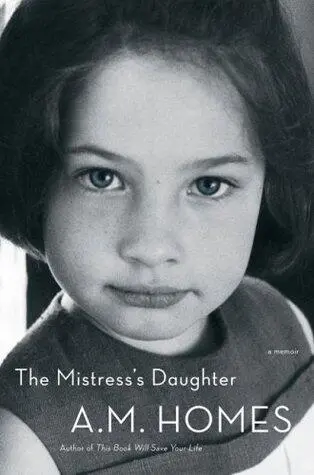
- Название:The Mistress's Daughter
- Автор:
- Издательство:Viking Adult
- Жанр:
- Год:2007
- ISBN:нет данных
- Рейтинг книги:5 / 5. Голосов: 1
-
Избранное:Добавить в избранное
- Отзывы:
-
Ваша оценка:
The Mistress's Daughter: краткое содержание, описание и аннотация
Предлагаем к чтению аннотацию, описание, краткое содержание или предисловие (зависит от того, что написал сам автор книги «The Mistress's Daughter»). Если вы не нашли необходимую информацию о книге — напишите в комментариях, мы постараемся отыскать её.
Before A.M. Homes was born, she was put up for adoption. Her birth mother was a twenty-two- year-old single woman who was having an affair with a much older married man with children of his own.
is the story of what happened when, thirty years later, her birth parents came looking for her.
Homes, renowned for the psychological accuracy and emotional intensity of her storytelling, tells how her birth parents initially made contact with her and what happened afterward (her mother stalked her and appeared unannounced at a reading) and what she was able to reconstruct about the story of their lives and their families. Her birth mother, a complex and lonely woman, never married or had another child, and died of kidney failure in 1998; her birth father, who initially made overtures about inviting her into his family, never did.
Then the story jumps forward several years to when Homes opens the boxes of her mother's memorabilia. She had hoped to find her mother in those boxes, to know her secrets, but no relief came. She became increasingly obsessed with finding out as much as she could about all four parents and their families, hiring researchers and spending hours poring through newspaper morgues, municipal archives and genealogical Web sites. This brave, daring, and funny book is a story about what it means to be adopted, but it is also about identity and how all of us define our sense of self and family.
The Mistress's Daughter — читать онлайн бесплатно полную книгу (весь текст) целиком
Ниже представлен текст книги, разбитый по страницам. Система сохранения места последней прочитанной страницы, позволяет с удобством читать онлайн бесплатно книгу «The Mistress's Daughter», без необходимости каждый раз заново искать на чём Вы остановились. Поставьте закладку, и сможете в любой момент перейти на страницу, на которой закончили чтение.
Интервал:
Закладка:
What becomes clear is that all of this is about narrative — the story told. I can’t escape the oddity of how it happened that I, a person without a past, became a novelist, a storyteller working from my imagination to create lives that never existed. Every family has a story that it tells itself — that it passes on to the children and grandchildren. The story grows over the years, mutates; some parts are sharpened, others dropped, and there is often debate about what really happened. But even with these different sides of the same story, there is still agreement that this is the family story. And in the absence of other narratives it becomes the flagpole that the family hangs its identity from.
As children we are all gullible by nature. It doesn’t occur to us to question the family narrative; we accept it as fact, not recognizing that it is a story, a multilayered collaborative fiction. Think of the variations, the implications in terms of time, place, social status and structure. You are from Topeka and have been for five generations; your grandfather was a preacher, your grandmother half Indian. Or your grandmother is from a small village in Italy; she came here after her entire family was killed in a flood of volcanic ash when Mount Vesuvius erupted. Your mother was married once before and had a child she gave away — somewhere you have a sister. Your mother was out walking one night and someone came up behind her — and the product was you.
I take the elevator to the seventh floor. The smell of stale paper smacks you as soon as the elevator door opens; the hallways are filled with metal shelving units, packed with paper, precariously perched files that are threatening to tumble onto the floor. This is the history of New York, the history of America — and it’s as though I’ve plunged into a Coen brothers movie.
It is a room of tables pushed together into a center square. There are current and not so current newspapers on the table and people sitting around, doing nothing — I am not sure if they work here or are people with nowhere to go. Maybe this is a historical day treatment center; maybe people are doing a certain kind of “time.” The room is absent of air, of the passage of minutes, hours, and years. “Where would I find a divorce from the 1920s?” I ask the entire room. One man perks up. “Might be over here in the card catalog,” he says, nodding toward the corner. There are huge metal cabinets, with cards for each lawsuit filed. Next to the card catalogs there is a large metal locker. Curious, I pry the door open. Old directories sigh and crumbling pages tumble out, dumping what looks like sawdust — or mouse bedding — onto the floor. Quickly I close the door and go back to the card catalogs. Again, I am flying blind, looking for anything and everything under any of the names on my list — Hecht, Bellman, Ballman, Billman.
“What kind of case is this?” I say, showing the man the card for Hecht vs. in RE.
“Oh, that’s going to be interesting,” the clerk tells me. Is he serious, or sarcastic? “The in RE cases usually mean that someone was either a minor or otherwise incompetent to represent themselves.”
Just the phrase, “In Re:,” gets my mind going. I sing to myself, “In Re:, a drop of golden sun.”
“If you want the files you have to fill out a request — the old cases are stored off-site.”
“Great, where’s the form?”
“Sixty Chambers Street. Room 114.”
Sixty Chambers Street is impossible to find, even though it’s supposedly right around the corner. The narrow streets of lower Manhattan are dwarfed by large hulking buildings — some incredibly old, others more modern fortresses. Between the buildings there are police patrolling with machine guns in hand — this is our new world, post 9/11, and we seem to believe that people patrolling with guns makes us safer. There is a prison right there and a woman standing guard outside with a flak jacket and a big gun. “Excuse me, where is 6 °Chambers Street?” She tells me, “I have no idea,” and in a minute I discover that it is just across the street, and I’m thinking it’s a problem that the guard doesn’t know where she is and doesn’t seem to care — especially if she had to tell someone where she was or which way someone went.
The dissonance is shocking — on the outside there is the Jersey wall, men and women with guns, the bright wash of summer light, the incredible baking heat, and inside, the smell of age, of mold and dust and things not touched for fifty years. I am depressed as hell, reminded of how unattached I am, and how crazy it is to do this digging — nobody cares. Whatever I find, it’s only ephemera, the thinnest bits of information. I think of the papers that blew from lower Manhattan into Brooklyn when the World Trade towers fell, burned notes from people’s desks, and how people clung to these scraps as if they held the secrets of the world, of creation.
At 6 °Chambers the guard at the metal detector stops me and I confess that I have tweezers in my bag. He doesn’t care. All he wants to know is, “Do you have a camera on your phone?” No. Inside I file my requests. It’s noon. I am exhausted.
From my apartment I am exchanging e-mails with strangers and with relatives I have known for the whole of my life. I pull the adoptive relations in a little closer. I have the sense of belonging to my adoptive family more than I did as a child — this comes from having shared the experience of growing up within a narrative that, while it is not my own biologically, is now mine socially and culturally. I write to my adoptive maternal relatives in Paris and London. From them I collect tales of Jacob Spitzer’s dairy farm on the Mohawk Trail in North Adams, Massachusetts — the dog, the cow, the horses, Nigger and Dick. There are stories about the children (the great-aunts and-uncles that I grew up with), Lena, Henry, Helen — who died in 1912 of diphtheria at fourteen — Maurice, Samuel, Solomon, (known as Charlie), Harold, Doris, and my beloved grandmother Julia Beatrice.
I collect information about Simon Rosenberg and Sophie Rothman — my adoptive maternal great-grandparents, born in the 1870s in Braila, Romania, a town on the Danube. My grandfather, Bernard, their eldest child, was born there in 1896, and by 1898 the family moved to an apartment at 64 rue Vieille du Temple in the Marais district of Paris. In France they had a successful hat factory and a very large family. My great-aunts and-uncles there include Rachel, who burned to death at three when the children were left home alone and her dress caught fire — my grandfather and his brother tried unsuccessfully to put the fire out. Among the other children were Joffre (who died at six), Raymond, Etienette, Henriette (who lived for six days), Adele, Maurice and Julien (who both died at Auschwitz), Emmanuel (who died of wounds in World War II), and another brother, Leon. In 1972, when my grandfather died in Washington, I got two of his hats, a winter hat and a summer hat. Elegant and understated, he never went out without a hat. At thirteen, I visited Paris and met Adele and Etienette. We went to 64 rue Vieille du Temple — my grandfather’s family name was still on the buzzer, more than fifty years after the fact.
Through my adoptive father, several aunts in Florida, and a cousin ten blocks from me in New York, I cobble together the story of my adoptive paternal grandfather and grandmother — Jacob Homes and Minerva Katz. Throughout my childhood they never spoke of their past — I knew them only as hardworking people with a fondness for cheese Danish and stewed fruit. Jacob Homes (Homelsky) was born in Russia in 1892 and had three sisters and a brother. In 1910 he walked from Russia to Finland and found work on a boat, which landed him first in Canada and then in Philadelphia — where he earned enough to bring his mother and siblings to this country. In 1916 he met Manya Kvasnikaya (Minerva Katz) from Ekaterinoslav, Russia.
Читать дальшеИнтервал:
Закладка:
Похожие книги на «The Mistress's Daughter»
Представляем Вашему вниманию похожие книги на «The Mistress's Daughter» списком для выбора. Мы отобрали схожую по названию и смыслу литературу в надежде предоставить читателям больше вариантов отыскать новые, интересные, ещё непрочитанные произведения.





Обсуждение, отзывы о книге «The Mistress's Daughter» и просто собственные мнения читателей. Оставьте ваши комментарии, напишите, что Вы думаете о произведении, его смысле или главных героях. Укажите что конкретно понравилось, а что нет, и почему Вы так считаете.