A. AHomes - The Mistress's Daughter
Здесь есть возможность читать онлайн «A. AHomes - The Mistress's Daughter» весь текст электронной книги совершенно бесплатно (целиком полную версию без сокращений). В некоторых случаях можно слушать аудио, скачать через торрент в формате fb2 и присутствует краткое содержание. Год выпуска: 2007, Издательство: Viking Adult, Жанр: Современная проза, Биографии и Мемуары, на английском языке. Описание произведения, (предисловие) а так же отзывы посетителей доступны на портале библиотеки ЛибКат.
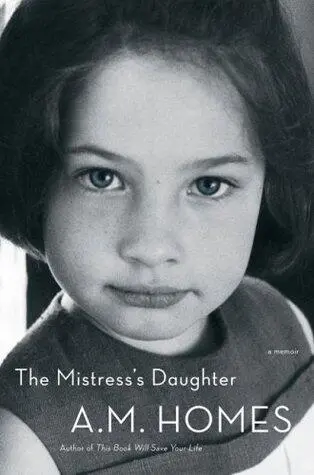
- Название:The Mistress's Daughter
- Автор:
- Издательство:Viking Adult
- Жанр:
- Год:2007
- ISBN:нет данных
- Рейтинг книги:5 / 5. Голосов: 1
-
Избранное:Добавить в избранное
- Отзывы:
-
Ваша оценка:
The Mistress's Daughter: краткое содержание, описание и аннотация
Предлагаем к чтению аннотацию, описание, краткое содержание или предисловие (зависит от того, что написал сам автор книги «The Mistress's Daughter»). Если вы не нашли необходимую информацию о книге — напишите в комментариях, мы постараемся отыскать её.
Before A.M. Homes was born, she was put up for adoption. Her birth mother was a twenty-two- year-old single woman who was having an affair with a much older married man with children of his own.
is the story of what happened when, thirty years later, her birth parents came looking for her.
Homes, renowned for the psychological accuracy and emotional intensity of her storytelling, tells how her birth parents initially made contact with her and what happened afterward (her mother stalked her and appeared unannounced at a reading) and what she was able to reconstruct about the story of their lives and their families. Her birth mother, a complex and lonely woman, never married or had another child, and died of kidney failure in 1998; her birth father, who initially made overtures about inviting her into his family, never did.
Then the story jumps forward several years to when Homes opens the boxes of her mother's memorabilia. She had hoped to find her mother in those boxes, to know her secrets, but no relief came. She became increasingly obsessed with finding out as much as she could about all four parents and their families, hiring researchers and spending hours poring through newspaper morgues, municipal archives and genealogical Web sites. This brave, daring, and funny book is a story about what it means to be adopted, but it is also about identity and how all of us define our sense of self and family.
The Mistress's Daughter — читать онлайн бесплатно полную книгу (весь текст) целиком
Ниже представлен текст книги, разбитый по страницам. Система сохранения места последней прочитанной страницы, позволяет с удобством читать онлайн бесплатно книгу «The Mistress's Daughter», без необходимости каждый раз заново искать на чём Вы остановились. Поставьте закладку, и сможете в любой момент перейти на страницу, на которой закончили чтение.
Интервал:
Закладка:
My assistant reaches someone in New York named Robert Hecht, who is not likely a relative. He tells her that he’s leaving for Paris and I can call him there — I wait a few days and try. A woman answers the phone and explains that he’s now gone back to New York. “What is this in reference to?” she asks and I am on the spot. I make an effort to explain. “I’m not sure he’ll be interested,” she says, “but you might want to e-mail my daughter and plead your case.” She gives me the e-mail address of her daughter, a lawyer in New York. Ruffled by her use of the phrase “plead your case,” I gather my courage and ask, “What’s your name?” “Elizabeth Hecht,” she says, and a chill runs through me. Elizabeth Hecht, that was my name — that was the name on the little bracelet that I wore home from the hospital. All the more odd because my adoptive mother had planned to name me Elizabeth but, when she saw the bracelet, she changed her mind. “Elizabeth Hecht,” she says, and it was the last thing I was expecting. Chemicals of every sort flood my system, telling my brain to hang up, to flee, telling my brain to laugh, telling my brain this is so strange — she’s not really Elizabeth Hecht; she was once Elizabeth Somebody Else and she married Hecht. “You can try my husband,” she says. “He’s back in New York.”
I dial the number in New York; an older man answers and tells me this is not a good time for us to talk. “I’m on my way out.”
The tenor of these conversations makes me wonder who these people are.
I Google Robert Hecht and Elizabeth Hecht and find out that he is a very famous dealer of antiquities and part of an international scandal involving the sale of allegedly stolen Italian artifacts, and as of the end of 2005 was on trial in Rome, along with former Getty Museum curator Marion True, accused of trafficking in ancient art.
As far as I can tell, Robert and Elizabeth Hecht are not my relatives, but again, I find the story fascinating.
One day as I’m going through the Bellman documents, I feel brave and leave a phone message for an Eric Bellman, a therapist in California. I call knowing that somewhere I have a relative named Eric Bellman — son of Richard Bellman and brother of Kristie, who I wrote to after Ellen died and never heard back from. It takes Eric weeks to call back, but it is a match. I’m pleased with my ability to deduce which of the Eric Bellmans in the United States is a biological relative. I tell him about my project, about the dozens of letters sent. I tell him that I’ve heard from a lot of Slyes and Hechts but no Bellmans. He tells me that Bellmans are like that — whatever “that” means — and while we don’t have an enormous amount to discuss, I am glad to have made contact.
What I don’t tell him is that after I decide that he was the Eric Bellman that I was looking for, I Googled his image and then compared the photograph I found online to one of his father taken many years ago. Playing my own version of FBI analyst, I compared their hairlines, their eyebrows, the shape of their chins and concluded that this Eric Bellman was the right Eric Bellman.
In my searching, I find newspaper clips relating to the Hecht family in and around the New York area. Again, I Google and come up with Warren Hecht, a dentist. I call his office. He answers the phone himself, I attempt to explain the project. “Write me a letter,” he says gruffly. “Okay, but can I just ask you a quick question? Are you by any chance related to Arthur, Nathan, and Irving Hecht?” Elated, he repeats the names. “Arthur, Irving, Nathan,” he says. “Yes, Nathan was my father.” “I thought so.” “Who is this?” He asks. We talk excitedly for a few minutes and he proposes that we meet the following Tuesday at 7 A.M. Surprised by his enthusiasm, I agree. It’s as though he’s discovered a long-lost relative — which in fact he has. When Warren asks how I fit in, I tell him that I am the daughter of Norman Hecht but that Norman and my mother weren’t married, so I didn’t grow up with him. That seems to land without much complication. He says how much he’s looking forward to meeting me and we hang up.
The following Tuesday, my phone rings at six-fifteen in the morning. It’s Warren Hecht calling to cancel our meeting. “I’m just too busy,” he says. “I’ll call you in a couple of weeks.” When I push him to find out if he’s really too busy, or if there’s more to it, he seems nervous. I find myself wondering who got to him — who turned off the enthusiasm? Devastated, I let him go — I hadn’t realized how much I was looking forward to meeting him. I wanted to show him what I’d found, his father’s birth certificate, his grandparents’ marriage certificate. I wanted to ask what he knew about his grandparents, his uncles, and so on. After that, I decide to suspend the live interview portion of the adventure at least for now. It’s too much of a setup for rejection and too painful to continually repeat.
I sign up for the National Geographic genealogy project. I pay $100 and scrape the inside of my cheek, twice over a period of twenty-four hours — collecting DNA — and send it off, as if to join the family of man. Online I spot another DNA test that promises to tell me the most likely names of my ancestors. I think about how truly interesting and odd it is that when a woman marries, traditionally she loses her name, becoming absorbed by the husband’s family name — she is in effect lost, evaporated from all records under her maiden name. I finally understand the anger behind feminism — the idea that as a woman you are property to be conveyed between your father and your husband, but never an individual who exists independently. And on the flip side, it is also one of the few ways one can legitimately get lost — no one questions it.
Months later I go online, punch in the ID number that came with my test kit, and am given the information that my DNA belongs to the Haplogroup U, and that yes, like every woman I am descended from “Mitochondrial Eve.” But who was she? Can I look her up on AnyWho.com? Can I write her a letter? From the information provided, I learn very little about my genetic journey. I am given the option of printing out high-resolution documents, including a personalized certificate that says I participated in the Genographic Project, but other than that I feel like I spent $100 to find out what I already know — I am related to everyone.
Among my best online discoveries is Random Acts of Genealogical Kindness, an organization of almost five thousand volunteers who will search for information in their local area — investigate historical records and church documents, trace headstones. Their volunteers are spread throughout the United States, Canada, and forty-four countries — the group averages eighty-two hundred requests a year.
Dipping further into history, I go to 6 °Centre Street in New York City, another of the city’s record offices, and request all files with the relevant surnames.
A week later the New York county clerk calls and leaves a message saying that some of my files have come in and that others cannot be located because they have been destroyed. Downtown I plunge into the labyrinth. Over a high wooden counter the case files are handed to me; they are crisp with age, these brittle documents, the onionskin paper dried out, each piece like a pathologist’s slices of the skin. The pages are typed, the signatures and notations made with an inky black pen. I am pouring quarters into the Xerox machines, hurrying to photograph the faded pages — as though to copy them as quickly as possible before they evaporate, as though taking these poor copies out of the building with me makes them permanent, real, present in this world.
Читать дальшеИнтервал:
Закладка:
Похожие книги на «The Mistress's Daughter»
Представляем Вашему вниманию похожие книги на «The Mistress's Daughter» списком для выбора. Мы отобрали схожую по названию и смыслу литературу в надежде предоставить читателям больше вариантов отыскать новые, интересные, ещё непрочитанные произведения.



Обсуждение, отзывы о книге «The Mistress's Daughter» и просто собственные мнения читателей. Оставьте ваши комментарии, напишите, что Вы думаете о произведении, его смысле или главных героях. Укажите что конкретно понравилось, а что нет, и почему Вы так считаете.