A. AHomes - The Mistress's Daughter
Здесь есть возможность читать онлайн «A. AHomes - The Mistress's Daughter» весь текст электронной книги совершенно бесплатно (целиком полную версию без сокращений). В некоторых случаях можно слушать аудио, скачать через торрент в формате fb2 и присутствует краткое содержание. Год выпуска: 2007, Издательство: Viking Adult, Жанр: Современная проза, Биографии и Мемуары, на английском языке. Описание произведения, (предисловие) а так же отзывы посетителей доступны на портале библиотеки ЛибКат.
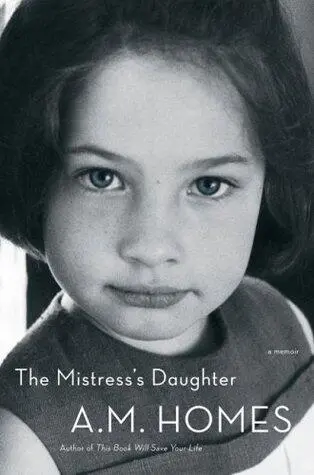
- Название:The Mistress's Daughter
- Автор:
- Издательство:Viking Adult
- Жанр:
- Год:2007
- ISBN:нет данных
- Рейтинг книги:5 / 5. Голосов: 1
-
Избранное:Добавить в избранное
- Отзывы:
-
Ваша оценка:
The Mistress's Daughter: краткое содержание, описание и аннотация
Предлагаем к чтению аннотацию, описание, краткое содержание или предисловие (зависит от того, что написал сам автор книги «The Mistress's Daughter»). Если вы не нашли необходимую информацию о книге — напишите в комментариях, мы постараемся отыскать её.
Before A.M. Homes was born, she was put up for adoption. Her birth mother was a twenty-two- year-old single woman who was having an affair with a much older married man with children of his own.
is the story of what happened when, thirty years later, her birth parents came looking for her.
Homes, renowned for the psychological accuracy and emotional intensity of her storytelling, tells how her birth parents initially made contact with her and what happened afterward (her mother stalked her and appeared unannounced at a reading) and what she was able to reconstruct about the story of their lives and their families. Her birth mother, a complex and lonely woman, never married or had another child, and died of kidney failure in 1998; her birth father, who initially made overtures about inviting her into his family, never did.
Then the story jumps forward several years to when Homes opens the boxes of her mother's memorabilia. She had hoped to find her mother in those boxes, to know her secrets, but no relief came. She became increasingly obsessed with finding out as much as she could about all four parents and their families, hiring researchers and spending hours poring through newspaper morgues, municipal archives and genealogical Web sites. This brave, daring, and funny book is a story about what it means to be adopted, but it is also about identity and how all of us define our sense of self and family.
The Mistress's Daughter — читать онлайн бесплатно полную книгу (весь текст) целиком
Ниже представлен текст книги, разбитый по страницам. Система сохранения места последней прочитанной страницы, позволяет с удобством читать онлайн бесплатно книгу «The Mistress's Daughter», без необходимости каждый раз заново искать на чём Вы остановились. Поставьте закладку, и сможете в любой момент перейти на страницу, на которой закончили чтение.
Интервал:
Закладка:
Minerva, the youngest daughter in a large family, was a late-in-life baby, rejected by her parents and largely raised by her oldest sister. She was educated for two years in a Russian school and then tutored by someone who gave her lessons while she sat atop a pickle barrel at the herring stall her sister ran. At home, Minerva slept above the oven on a bed of straw.
As a young teenager she traveled to the United States with her sister and brother-in-law, and they settled in northern New Jersey. She worked as a cashier in Atlantic City, went to school through sixth grade, and later lived in Philadelphia with a woman who sold goods to immigrants. There Minerva slept on a board over the bathtub.
In Philadelphia, Jacob Homes delivered meat from the butcher to the house where Minerva was living — he liked her because she could read and write. They married; a first son died at birth. In 1918 Joseph Meyer Homes, my adoptive father, was born, followed by five sisters. No one recalls whether Jacob’s father came to this country — but all believe he was killed in an accident, run over by a wagon.
In 1929, when they were living in New Jersey, the family’s butcher shop burned down and they moved to Washington, D.C., where Minerva’s brother lived. In Washington Jacob found a tank in a junk pile, filled it with gasoline, and took it to the farmers’ market — selling gas by the five-gallon bucket to the farmers for their return trips after the market. He progressed to selling gas on the streets for ten cents a gallon and grew the business into the Homes Oil Company.
It was only when I started asking questions about the family history that my adoptive father told me one of the stranger stories of his youth — a moment where his own history collided with a particularly ugly and now forgotten moment in American history. In July 1932, he was working at his father’s gas station on Maryland Avenue in Washington, D.C., when generals Douglas MacArthur and George S. Patton lead four troops of cavalry, four troops of infantry, a mounted machine gun squadron, and six tanks on a mission ordered by President Hoover to run the “Bonus Marchers” out of town. Soldiers on horseback with bayonets chased the Marchers — World War I veterans — out of their makeshift housing. Men and animals came charging right through the gas station. My grandfather grabbed my father and pulled him to safety. The story of my father and the Bonus Marchers — twenty thousand unemployed World War I veterans who marched on Washington, demanding payment of a cash bonus — is one that I hear for the first time when I am forty-four years old. I am thrilled to have it. I feel as though I’m slowly reconstructing an ancient lost tapestry.
At home in New York the electronic dig continues. I hire two researchers to help me — one in New York and one just outside Washington, D.C. We communicate by e-mail only. I tell them about the bits and pieces, the fragments of facts that I’m looking for, and they go in search. I am happy to have more than one mind on this — more than one thought pattern trying to piece the puzzle together.
I am in correspondence with someone living in Israel who may be related to my adopted father’s family in New Brunswick, New Jersey. I am talking with the Reverend John Gray in Ohio, whose interest in genealogy was sparked by the idea that he might be related to his movie hero, Roy Rogers, aka Leonard Franklin Slye. The Reverend Gray sadly reports that he is not related to Roy, but in all likelihood I am — Roy was a Slye from Warwickshire, England, and Ohio. I am exchanging regular e-mails with Linda Reno in St. Mary’s County, Maryland. She is, in fact, a distant relative and has done enormous research charting the Slye family. Each of my correspondents is as nearby as the computer keyboard, and yet as ethereal and vaporous as memory itself. And still and always I feel on the outside. I worry that at any minute I will be busted, and my pen pals will say, You are not part of this family, and you are not entitled to this information. With my chest tight I e-mail Linda Reno confessing my illegitimacy, and when I don’t hear back for two days I am terrified — and then enormously relieved when I do, and her response is warm, genuine, and accepting.
It goes on for months — in waves. I hunt and gather and then, exhausted and often disheartened, I stop and I pull myself together and do it again. I become convinced that I can crack the case of my biological maternal grandmother’s second husband — I have what I am quite sure is a photo of him and my grandmother, on what looks like a New Year’s Eve in the 1950s. I find a lot of Barney Ackermans in Florida; it seems like the kind of place where a Barney Ackerman would retire. I find a scrap of information that seems to indicate there was a Barney Ackerman who died in Canada in the 1990s but I can’t piece it together. When were Barney Ackerman and Clare Kahn Ballman married and divorced? Finally, through the Washington, D.C., researcher there is a crack in the case — she finds the wedding license. They were married September 22, 1950. Ellen would have been twelve years old at the time — vulnerable to this already twice-married stepfather. Another crack in the case brings me his obituary — it lists him as a dry cleaner and says that he was born in Calgary, Alberta, Canada, and died March 28, 1993, at the time of his death married to Jeanne Ackerman of Hebron, Nova Scotia. That makes at least four marriages — with the first divorce in Florida, the second in Reno, the third probably in northern Virginia around 1960. He has one daughter and at the time of his death one granddaughter. Did Ellen know he died — was she relieved? It was never clear to me what Ellen’s relationship to this man was. From what she said to me in phone conversations and from what Norman was later able to add, my sense is that the relationship was at least to a degree sexualized and made her very uncomfortable.
More digging. I find Pearl B. Klein, sister of Bernard Bellman, admitted to the Washington, D.C., bar in 1924 at the same time as her husband, Alfred Klein, who later became chief law officer of the Civil Service Union.
I find Bernard Bellman’s brother John (born Jake) Bellman, whose son Richard became a major figure in the mathematics world, conceiving the idea of “dynamic programming.” Richard taught at Princeton and Stanford and worked for the Rand Corporation and at Los Alamos, while also writing forty books related to mathematical theory. I go back and forth through the material and each time I sift, new crumbs fall out — last names, the married names of sisters, the names of uncles, cousins, locations, each bit a piece of the puzzle.
My search expands. I use Internet search engines such as AnyWho.com to locate addresses for random people named Slye, Bellman, Ballman, Hecht (there’s almost no one named Homes). I write letters explaining that I am a journalist working on a family history project and would like to talk with them. As exciting as it is, I find it difficult to get the letters into the mail, difficult to make the follow-up calls. I want to talk to them, but I worry they won’t want to talk to me — and by the way, what am I going to say if and when they ask me who I am?
I hire a graduate student to help me make the first round of calls, answering any basic questions — establishing that, yes, this is a legitimate research project. I do the follow-up interviews. I speak with two Slyes who happen to be reverends, Harry in Texas and John in Virginia — neither knows the other, but both are incredibly nice, warm, forthcoming, proud of their family. I talk with Chapman Slye, who runs twenty-eight school cafeterias in Fredericksburg, Virginia, and is named after my great-grandfather. Chapman tells me about the family ties to the Eastern Shore of Maryland, about the adventures he had with his grandfather Harry E. “Skipper” Slye Sr., a shipmaster who lived to be 102 years old and guided boats up the Potomac River until he was eighty-five. He also suggests I talk with his mother, widow of Harry E. Slye Jr. I speak with her and numerous other Slye cousins. And when I ask about Georgia Slye Hecht, no one seems to remember much, except that she was “formidable,” “dominant,” and many of them were a little scared of her — especially women marrying into the family. The Slyes I speak with are a lovely, hardworking, earnest, good-natured group, very proud of their family history; but as in many American families, each successive generation seems to move farther from the family seat and is less in touch with its extended family, less aware of the family history. They ask me nothing about how I might be related to the family and when I ask one of them if there was any intermarriage, he tells me that the biggest thing was when Catholics married into the family. There is no sense of there ever having been a Jew among them — no mention of Georgia Slye marrying Irving Hecht — which gives me further insight into my biological father, Norman’s, determination to go out of his way to identify himself as not Jewish. The Reverend Harry L. Slye speaks of family reunions, long ago, when his grandfather, also Harry L. Slye, a prominent Washington, D.C., undertaker, would bring chairs from the funeral parlor out to the family home in the then rural suburbs, and the full extended family, cousins of all ages and generations, would gather, feasting on St. Mary’s County oysters, playing games, and dancing on the lawn.
Читать дальшеИнтервал:
Закладка:
Похожие книги на «The Mistress's Daughter»
Представляем Вашему вниманию похожие книги на «The Mistress's Daughter» списком для выбора. Мы отобрали схожую по названию и смыслу литературу в надежде предоставить читателям больше вариантов отыскать новые, интересные, ещё непрочитанные произведения.






Обсуждение, отзывы о книге «The Mistress's Daughter» и просто собственные мнения читателей. Оставьте ваши комментарии, напишите, что Вы думаете о произведении, его смысле или главных героях. Укажите что конкретно понравилось, а что нет, и почему Вы так считаете.