A. AHomes - The Mistress's Daughter
Здесь есть возможность читать онлайн «A. AHomes - The Mistress's Daughter» весь текст электронной книги совершенно бесплатно (целиком полную версию без сокращений). В некоторых случаях можно слушать аудио, скачать через торрент в формате fb2 и присутствует краткое содержание. Год выпуска: 2007, Издательство: Viking Adult, Жанр: Современная проза, Биографии и Мемуары, на английском языке. Описание произведения, (предисловие) а так же отзывы посетителей доступны на портале библиотеки ЛибКат.
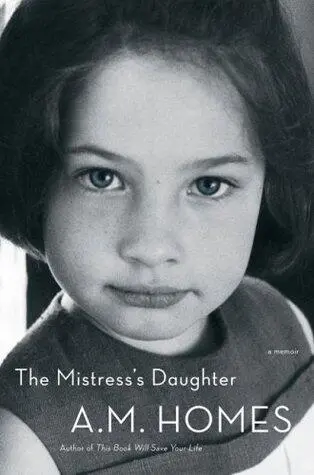
- Название:The Mistress's Daughter
- Автор:
- Издательство:Viking Adult
- Жанр:
- Год:2007
- ISBN:нет данных
- Рейтинг книги:5 / 5. Голосов: 1
-
Избранное:Добавить в избранное
- Отзывы:
-
Ваша оценка:
The Mistress's Daughter: краткое содержание, описание и аннотация
Предлагаем к чтению аннотацию, описание, краткое содержание или предисловие (зависит от того, что написал сам автор книги «The Mistress's Daughter»). Если вы не нашли необходимую информацию о книге — напишите в комментариях, мы постараемся отыскать её.
Before A.M. Homes was born, she was put up for adoption. Her birth mother was a twenty-two- year-old single woman who was having an affair with a much older married man with children of his own.
is the story of what happened when, thirty years later, her birth parents came looking for her.
Homes, renowned for the psychological accuracy and emotional intensity of her storytelling, tells how her birth parents initially made contact with her and what happened afterward (her mother stalked her and appeared unannounced at a reading) and what she was able to reconstruct about the story of their lives and their families. Her birth mother, a complex and lonely woman, never married or had another child, and died of kidney failure in 1998; her birth father, who initially made overtures about inviting her into his family, never did.
Then the story jumps forward several years to when Homes opens the boxes of her mother's memorabilia. She had hoped to find her mother in those boxes, to know her secrets, but no relief came. She became increasingly obsessed with finding out as much as she could about all four parents and their families, hiring researchers and spending hours poring through newspaper morgues, municipal archives and genealogical Web sites. This brave, daring, and funny book is a story about what it means to be adopted, but it is also about identity and how all of us define our sense of self and family.
The Mistress's Daughter — читать онлайн бесплатно полную книгу (весь текст) целиком
Ниже представлен текст книги, разбитый по страницам. Система сохранения места последней прочитанной страницы, позволяет с удобством читать онлайн бесплатно книгу «The Mistress's Daughter», без необходимости каждый раз заново искать на чём Вы остановились. Поставьте закладку, и сможете в любой момент перейти на страницу, на которой закончили чтение.
Интервал:
Закладка:
I examine the cases, having no idea if these people are related to me and to a large degree not caring. Each is a history, a story drawing me in.
Magdaline Bellman vs. William H. Bellman
Action for an absolute divorce alleging: “That defendant on the 14 day of August 1923 at Hollywood Crossing in Cedarhurst Long Island, in the borough of Queens City and State of New York committed adultery with a woman whose name is unknown to the plaintiff…. That the sole issue of said marriage is one child Howard Bellman who was born on the 11th day of February 1913.
The divorce, granted January 30, 1923, stipulates that William H. Bellman was not free to marry again without permission of the court. In January of 1934 William Bellman returns to court, asks for and receives permission to marry.
Did Magdaline Bellman really not know the name of the woman her husband slept with, or is this a way of being polite? Where at Hollywood Crossing did the affair occur — was it a motel? And is the street name Hollywood Crossing not incredibly ironic? Was the unnamed woman William slept with the same woman he married ten years later? What happened to Magdaline and her son, Howard? And are they related to me?
The clerk at 31 Chambers was right — the in RE cases are the most fascinating. The outer folders are stamped in faded large red letters: LUNACY.
B. Kahn vs. In Re: Case 20101 1928
Bernhard Kahn of West 104th Street, born in Russia, aged fifty-four, arrived in the U.S., lived in Chicago and after being in New York six months, on May 19, 1928 was committed to Manhattan State Hospital, Wards Island.
He had been brought to Bellevue from the 10th precinct by ambulance.
Officer stated patient turned on fire hydrant on Lexington Ave; said he wanted to wash down the germs; the city was full of malaria germs and insane germs and the people were all going insane; had thrown away his hat because it was full of germs and bugs — was talkative.
In the presence of the doctors, the patient said:
I went to Cook County hospital — they took so many people from our trade and they tortured and they killed them — In Chicago I was against prohibition — I was against whores — We had had brown taxis and yellow taxis — Three million people tortured me in my city of Chicago — From the psychopathic I came to New York — the Jews are writing about the Hazenz here — then they got the attendants who are insane — three degrees of insanity — there is no such thing as perfect — I admire you — you are perfect.
Was there any one line in particular that sealed his fate?
When I first came across this case, I thought for a moment that this might in fact be the story of my biological mother’s great-grandfather, and in that moment, it seemed to make sense. It still does in some way, except that the dates are way off. In my mind’s eye it was a perfect case, until, of course, a more perfect fit came along — the case of Benedict Kahn.
BENEDICT KAHN, Plaintiff, against JACK ROTHSTONE and JOHN J. GLYNN as administrators with the will annexed of the Estate of ARNOLD ROTHSTEIN, deceased, Defendants.
This case immediately reminds me of a line in Richard Bellman’s autobiography, Eye of the Hurricane , noting that his father’s brother Bernard “Bunny” Bellman “married the boss’s daughter.” For the first time I have a clue about what that might mean — I am thinking this case likely involves my mother’s maternal grandfather, Benedict Kahn, and that it was through Benedict Kahn, that Bernard “Bunny” Bellman learned his trade.
Filed against the estate of the infamous gangster Arnold Rothstein, who was shot on November 4, 1928, the case states that Benedict Kahn and his business associate Harry Langer — who filed a separate case for $76,000—both made loans to Arnold Rothstein that had not been paid back at the time of his death. Benedict Kahn’s affidavit reads:
I am the plaintiff herein. This action is brought to recover $21,000 with interest thereon upon two promissory notes aggregating $19,000 and a check of $2000.
It goes on.
I never gambled with Arnold Rothstein in my lifetime. I never borrowed any money from him. He and I were intimate personal friends, and from time to time he borrowed money from me. He knew I was always possessed of large amounts of cash.
Nowhere in the papers is there any explanation of what business Kahn was in that had him “always possessed of large amounts of cash.” Basically there was no defense for this case because the only option was for the Rothstein estate to prove that this was a gambling debt and therefore not legal or valid.
After much back-and-forth the motion for a judgment is granted, “in favor of the plaintiff for $21,000, together with interest, as demanded in the complaint.”
The fact that the man who appears to be Ellen’s maternal grandfather had the nerve to make a case against the estate of Rothstein, a man described as “the spiritual father of American organized crime,” and a “criminal genius,” tells me that Benedict Kahn must have been someone that both the estate and the court took seriously — but beyond that I find nothing, except the seeds of a strong interest in numbers and gambling that echoed throughout subsequent generations.
And then there is the sad story of the Bellman who got bumped on his head — big time. Here is another Henry — this time Bellman, not Hecht — but for inexplicable reasons, I remain convinced that somewhere I do have a biological relative named Henry.
Henry Bellman vs. In Re: George Bellman vs. Timken Silent Automatic Co.
Henry Bellman, born in Germany in 1902, arriving in New York in 1928, is brought to Bellevue saying he can’t sleep, has a headache, lights are bothering him. In the presence of the doctors, he said:
The way it looks they throw lights, right into my room, and I can’t sleep. I hear them talking. They laugh at me. I moved five times in three or four months. They follow me in the street. They make fun of me. I heard them say c.s. and s.o.b. I don’t know if they want to kill me. They are down here too.
He was committed to Central Islip State Hospital.
George Bellman as guardian for Henry Bellman files a case against the Timken Silent Automatic Co. asking for $150,000 in damages, stating that Henry, never injured or ill, working as a driller for $8.80 a day, was on September 8, 1934, on First Avenue between Ninety-sixth and Ninety-seventh Streets, struck by a truck. The truck, which swerved to avoid a granite block in the roadway, bumped another car into a ditch, and then ran through a barricade, striking Henry Bellman, knocking him unconscious for more than ten minutes. His injuries, initially thought to be mild, became progressive. His condition deteriorated, and in July 1935 Henry began to complain that people were spying on him. The case was filed first by Henry and then by the family — seeking to be able to afford a better-quality care for their brother. It was settled without trial for $27,500, of which $13,750 was paid to the attorney the brother hired before his condition had so deteriorated. The Honorable Edward R. Koch was presiding justice, April 8, 1936. Case file stamped LUNACY.
I can’t help but think about the difficulty of these immigrants’ lives, of Bernhard Kahn and Henry Bellman and thousands of others. They left their homes and families in Europe under what were often pressured and fearful circumstances. With only the belongings they could carry on their backs they set off on a difficult journey to a mythical faraway place, hoping for Utopia, finding instead a foreign language, discrimination, and poor working and living conditions. I am amazed at the resilience and fortitude most immigrants demonstrated and am also surprised that more didn’t simply go mad — there are times I think, how could you not?
Читать дальшеИнтервал:
Закладка:
Похожие книги на «The Mistress's Daughter»
Представляем Вашему вниманию похожие книги на «The Mistress's Daughter» списком для выбора. Мы отобрали схожую по названию и смыслу литературу в надежде предоставить читателям больше вариантов отыскать новые, интересные, ещё непрочитанные произведения.










Обсуждение, отзывы о книге «The Mistress's Daughter» и просто собственные мнения читателей. Оставьте ваши комментарии, напишите, что Вы думаете о произведении, его смысле или главных героях. Укажите что конкретно понравилось, а что нет, и почему Вы так считаете.