A. AHomes - The Mistress's Daughter
Здесь есть возможность читать онлайн «A. AHomes - The Mistress's Daughter» весь текст электронной книги совершенно бесплатно (целиком полную версию без сокращений). В некоторых случаях можно слушать аудио, скачать через торрент в формате fb2 и присутствует краткое содержание. Год выпуска: 2007, Издательство: Viking Adult, Жанр: Современная проза, Биографии и Мемуары, на английском языке. Описание произведения, (предисловие) а так же отзывы посетителей доступны на портале библиотеки ЛибКат.
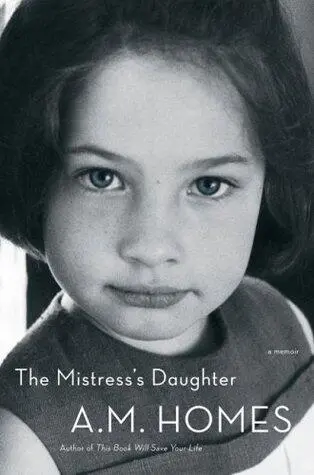
- Название:The Mistress's Daughter
- Автор:
- Издательство:Viking Adult
- Жанр:
- Год:2007
- ISBN:нет данных
- Рейтинг книги:5 / 5. Голосов: 1
-
Избранное:Добавить в избранное
- Отзывы:
-
Ваша оценка:
The Mistress's Daughter: краткое содержание, описание и аннотация
Предлагаем к чтению аннотацию, описание, краткое содержание или предисловие (зависит от того, что написал сам автор книги «The Mistress's Daughter»). Если вы не нашли необходимую информацию о книге — напишите в комментариях, мы постараемся отыскать её.
Before A.M. Homes was born, she was put up for adoption. Her birth mother was a twenty-two- year-old single woman who was having an affair with a much older married man with children of his own.
is the story of what happened when, thirty years later, her birth parents came looking for her.
Homes, renowned for the psychological accuracy and emotional intensity of her storytelling, tells how her birth parents initially made contact with her and what happened afterward (her mother stalked her and appeared unannounced at a reading) and what she was able to reconstruct about the story of their lives and their families. Her birth mother, a complex and lonely woman, never married or had another child, and died of kidney failure in 1998; her birth father, who initially made overtures about inviting her into his family, never did.
Then the story jumps forward several years to when Homes opens the boxes of her mother's memorabilia. She had hoped to find her mother in those boxes, to know her secrets, but no relief came. She became increasingly obsessed with finding out as much as she could about all four parents and their families, hiring researchers and spending hours poring through newspaper morgues, municipal archives and genealogical Web sites. This brave, daring, and funny book is a story about what it means to be adopted, but it is also about identity and how all of us define our sense of self and family.
The Mistress's Daughter — читать онлайн бесплатно полную книгу (весь текст) целиком
Ниже представлен текст книги, разбитый по страницам. Система сохранения места последней прочитанной страницы, позволяет с удобством читать онлайн бесплатно книгу «The Mistress's Daughter», без необходимости каждый раз заново искать на чём Вы остановились. Поставьте закладку, и сможете в любой момент перейти на страницу, на которой закончили чтение.
Интервал:
Закладка:
The desire to know oneself and one’s history is not always equal to the pain the new information causes. At times I have to slow down to accommodate a self that is constantly struggling to catch up, to recalibrate. I go to bed at midnight, and at 2 A.M. find myself at my desk — logging on. In the middle of the day I nap. My brain is constantly reshuffling the files and organizing and accommodating the new information. On the one hand I want to know my history, and on the other it is overwhelming to become aware of so many lives and to realize that most, if not all, of my ancestors are completely ignorant of my history and/or even my existence. There is a part of me that resents how hard I am working to locate information that they have lived with all along — information that is theirs for the asking.
I am looking at the records of the Slyes of St. Mary’s County, who owned other people and who sold or gave them away. I am looking at these early settlers wondering, What were they thinking? Why, having come from such incredible privilege, did they not do more with their lives? They got here first, came with land and labor and power, and what did they end up building for themselves? Why did none become president, or direct a large corporation? Why did they not lay the railroad, or discover electricity? Why did they not start a nonprofit or fund philanthropy? I am frustrated with them for falling through the cracks of history. I think a lot about responsibility — did they take responsibility for who they were and what they did? What quality of people were they? And why does it mean so much to me? Why do I need for them to be good — better than good — need them to be great?
These are my souls.
I go to the New York City Municipal Archives at 31 Chambers Street. To get in, you have to show identification, tell them what you are there for, get a pass, and then go through metal detectors. I am stopped because somewhere in my bag I have a pair of tweezers. I leave the tweezers at the desk. In room 103, I sign in and pay $5 to use the microfilm machines. The people who work there have been there forever — they know the contents of each of the flat metal drawers, they know the Soundex system of organizing information, the difference between a marriage license and a marriage certificate. They know how to dig for buried treasure — but they are cranky about answering questions. It is like a civil servant episode of Taxi , with Danny DeVito playing the hostile clerk behind the counter.
Still, there is an undeniable beauty to the things found in this room — reels and reels of microfilm, images of lives lived long ago, documents writ in an ornate Old World hand of variable legibility. I go through the reels slowly at first, not wanting to fast-forward, not wanting to miss anyone, feeling like each one of them is due a visitor, an appreciation.
The room is full of people each piecing together their private puzzles and the first thing that occurs to me is they’re not all adopted — so what are they looking for? I remind myself that the quest to answer the question Who am I? is not unique to the adoptee. In this room everyone is looking for something that will help them either confirm or deny part of what they believe about themselves. They are looking for backup, support, for definition. They are all deep in it — buried in names, dates, codes — but most are also happy to render assistance. Some volunteer helpful hints, while others tell their stories. I often ask, “How long have you been at it?” “Seven years,” one woman tells me. “It started as a hobby, a birthday present for my husband,” another says. “It started when my father died,” another woman says. “Have you tried the Italians? They keep good records, even on the Jews.”
Another woman leans over and whispers, “Have you been to Salt Lake City?” Salt Lake is “the mountain,” the mecca for genealogical information — home base for the Mormons, who go around the world collecting genealogical data. Every month five to six thousand reels of microfilm are added to their collection. Unbeknownst to much of the general population, the reason the Mormon Church has such wonderful genealogical records is that they’re collecting people — they hope to determine the genealogy of everyone in the world to prepare them for posthumous conversion. Basically they’re making Mormons from the dead — baptism by proxy. They have a purification ritual through which they claim you as their own. There has been outrage from the Jewish community because the Mormons took the information of Holocaust victims — people who were killed because of their religion — and made them Mormons. In 1995 the LDS church said it would honor an agreement to stop the proxy baptisms of Holocaust victims and other deceased Jews, and yet it continues. “And they are making more Mormons every day. I went once for two weeks,” the woman tells me. “It was heaven. Think about it,” she says.
There is the whir of the machines, juxtaposed against the virtual silence in which everyone works — it is difficult to stay focused. Repeatedly and anxiously I lose track of what I am looking for. A guy in a white shirt is hogging the files; he’s got multiple drawers open, his arms filled with reels, and he’s blocking the way. The rule is one reel at a time — take it, look at it, and put it back — which also makes it harder to misfile upon return. “Excuse me,” I say, “it’s one reel at a time.” He ignores me. “Excuse me,” I try again. “Just a minute,” he grumps, digging through a drawer. I push my leg against the drawer, threatening to close it on his hand. “Excuse me — Is your dead person somehow more important than anyone else’s?”
I find marriage certificates for David and Rika Hecht, my paternal great-grandparents, both born in Germany, and with each come the names of their parents, my great-great-grandparents: Nathan Hecht and Regina Grunbaum and Isaac Ehrenreich and Rosa Steigerwald. Within the hour I have birth certificates for Irving (born Isaac), Arthur Samson, and Nathan — my grandfather and great-uncles.
I locate Moriz Billman, born in Gomel, Russia, in 1846, who came into America in 1888 with a second wife and children from two marriages, and who later petitioned to become a citizen of the United States as Morris Bellman of 466 Bergen Street in Brooklyn. I find Billmans who became Bellmans and then Ballmans. I get a copy of the marriage license of my maternal grandfather, Bernard Bellman, to my maternal grandmother, Clara Kahn, and find that Bernard was married before and in 1925 divorced a woman named Margaret R. Bellman. Did his children — my mother and her brother — know? Were there other children from the first marriage? The man at the desk tells me that if I am curious I can look upstairs on the seventh floor — if the divorce was filed in New York City, I might just find it there.
With each name and date comes imagery. I start making mental pictures of who they were — who I might be. I am the granddaughter of an English Southern belle. I am the granddaughter of a Romanian/French immigrant. I am the granddaughter of the Lithuanian farmer girl, the granddaughter of the Russian bookie, the granddaughter of an Irishwoman. I am the adopted daughter of the guidance counselor and the left-wing artist and the biological daughter of the philandering adulterer and the wayward girl, the little girl lost.
I am back in time, wading across a clear running creek. I am a farmer on a plantation, I am captain of a ship. I am the woman in a long white dress, my curly hair high up on my head; I am feeling the heat of summer — the Southern humidity, the thick stagnant afternoon air, the coming of thunderstorms. I am conjuring sea captains and drinking glasses of blood red wine. This is the stuff of poems and fever dreams. I am of a plantation and I can say I knew it all along at some preconscious level. I am imagining the lives of indentured servants and slaves — some of whom had the very same names as the people I am looking for. When were they freed and where did they go?
Читать дальшеИнтервал:
Закладка:
Похожие книги на «The Mistress's Daughter»
Представляем Вашему вниманию похожие книги на «The Mistress's Daughter» списком для выбора. Мы отобрали схожую по названию и смыслу литературу в надежде предоставить читателям больше вариантов отыскать новые, интересные, ещё непрочитанные произведения.





Обсуждение, отзывы о книге «The Mistress's Daughter» и просто собственные мнения читателей. Оставьте ваши комментарии, напишите, что Вы думаете о произведении, его смысле или главных героях. Укажите что конкретно понравилось, а что нет, и почему Вы так считаете.