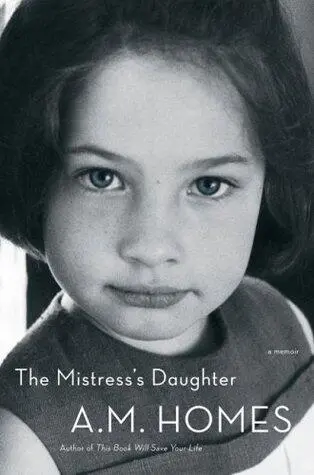
A. AHomes - The Mistress's Daughter
Здесь есть возможность читать онлайн «A. AHomes - The Mistress's Daughter» весь текст электронной книги совершенно бесплатно (целиком полную версию без сокращений). В некоторых случаях можно слушать аудио, скачать через торрент в формате fb2 и присутствует краткое содержание. Год выпуска: 2007, Издательство: Viking Adult, Жанр: Современная проза, Биографии и Мемуары, на английском языке. Описание произведения, (предисловие) а так же отзывы посетителей доступны на портале библиотеки ЛибКат.
- Название:The Mistress's Daughter
- Автор:
- Издательство:Viking Adult
- Жанр:
- Год:2007
- ISBN:нет данных
- Рейтинг книги:5 / 5. Голосов: 1
-
Избранное:Добавить в избранное
- Отзывы:
-
Ваша оценка:
The Mistress's Daughter: краткое содержание, описание и аннотация
Предлагаем к чтению аннотацию, описание, краткое содержание или предисловие (зависит от того, что написал сам автор книги «The Mistress's Daughter»). Если вы не нашли необходимую информацию о книге — напишите в комментариях, мы постараемся отыскать её.
Before A.M. Homes was born, she was put up for adoption. Her birth mother was a twenty-two- year-old single woman who was having an affair with a much older married man with children of his own.
is the story of what happened when, thirty years later, her birth parents came looking for her.
Homes, renowned for the psychological accuracy and emotional intensity of her storytelling, tells how her birth parents initially made contact with her and what happened afterward (her mother stalked her and appeared unannounced at a reading) and what she was able to reconstruct about the story of their lives and their families. Her birth mother, a complex and lonely woman, never married or had another child, and died of kidney failure in 1998; her birth father, who initially made overtures about inviting her into his family, never did.
Then the story jumps forward several years to when Homes opens the boxes of her mother's memorabilia. She had hoped to find her mother in those boxes, to know her secrets, but no relief came. She became increasingly obsessed with finding out as much as she could about all four parents and their families, hiring researchers and spending hours poring through newspaper morgues, municipal archives and genealogical Web sites. This brave, daring, and funny book is a story about what it means to be adopted, but it is also about identity and how all of us define our sense of self and family.
The Mistress's Daughter — читать онлайн бесплатно полную книгу (весь текст) целиком
Ниже представлен текст книги, разбитый по страницам. Система сохранения места последней прочитанной страницы, позволяет с удобством читать онлайн бесплатно книгу «The Mistress's Daughter», без необходимости каждый раз заново искать на чём Вы остановились. Поставьте закладку, и сможете в любой момент перейти на страницу, на которой закончили чтение.
Интервал:
Закладка:
There are no pictures of her at seventeen — the age when my father asked her to marry him. No pictures of her at twenty-two, pregnant with me, no pictures of her in the hospital — holding me, dressing me in my “going-home” outfit. Do those pictures exist, were they in some other box I didn’t find? What did she dress like in the 1950s, when she worked for my father at the Princess Shop? After all, that was the time of the French designer knockoff — Dior’s A-line, Givenchy’s sack, the boxy Chanel jacket, the swing coat, perfect for hiding a pregnancy. Did she like the new “modern” materials, nylon, Crimplene, and Orlon? Did she wear cone bras or all-in-one girdles? Was she the kind of teenager who dressed like an adult, or was she wearing poodle skirts, bobby sox, and going to drive-in movies? What was she thinking? This was the era of atomic anxiety, of Perry Como, Dean Martin, Connie Francis, and the beehive hairdo. It was the time of air-raid sirens and fallout shelters, the Rosenberg electrocutions and the McCarthy hearings. This was Washington, D.C., in the 1950s — and it was prime time for my mother.
I had hoped to find her in these boxes, to find a description of her childhood, the games she had played, clues to her troubled relationship with her mother and what she really knew about her father, her memories, the trinkets that she kept as talismans to protect or guide her. I hoped to have some idea of how she saw herself, what her hopes and dreams had been. I wanted to know her secrets.
I take the empty boxes to the dump, crack them in half, and toss them into the recycling bin — I am sending dead Ellen around once more. Maybe she’ll come back as napkins or paper or some kind of shopping bag. I hurl the old metal file into one of the bins. It lands hard, the sound exploding like a grenade — everyone turns and looks. I shrug. I throw away the old mail, the scraps of paper, the bits and pieces, keeping enough to fill one box — a box to remind me. I put the box in the car and drive it back to New York, where it waits in a corner of my apartment, and then once again gets sent to ministorage.
It is 2005 and all I can think is that this is not how the woman who was so concerned about appearances would want to have been seen, this is not how the woman with thirty-two Chanel lipsticks would want to have been presented — but this is who she is and what she left behind.
Imagining my mother.
I think of my mother and imagine a young woman who hoped for more. I think of my mother and try to inhabit her experience.
In the 1950s ladies still wore hats and gloves and men wore overcoats. Young men and women met at socials, organized dances, chaperoned. The men hoped to go to college; the women hoped.
At Catholic school the nuns told Ellen very little about the birds and the bees and a lot about sin and all that could go wrong. Almost everything already had gone wrong for Ellen, but no one acknowledged that. She was surrounded by people who didn’t want to know, and quickly learned that faith got her nothing — in fact her belief that something would save her got her into trouble. At Catholic school she protected herself by insisting — at least to herself — that she was Jewish. Her mother was Catholic, her father was Jewish, and she always described herself as her father’s little girl.
Pin money. Her mother didn’t have much — whatever she had she got from her new husband, and she didn’t want to share. Ellen got a job working in the dress shop — one night, weekends, and holidays, and a good discount. She liked working, liked acting like a grown-up — helping the ladies with their shopping. They treated her in the motherly sort of way that she wished her own mother would.
Ellen opened a bank account — vowing to save half, or at least part, of what she earned. She had a future. The boss offered her a ride home — she accepted. In the car they talked. Again, her boss offered her a ride home, she accepted, and he asked if she wanted to go out for dinner.
And then again her boss offered her a ride, took her out to dinner, and after dinner they parked the car somewhere where they could talk. She asked him about what he hoped to be, what dreams he had — he found that appealing. He appeared interested in her — she found that appealing. She was practicing on him — being girlish and tempting. He took it as an opportunity. Imagine the fumbling. He wants it but doesn’t want to say what it is; she doesn’t want it but has no idea how to set a limit.
Where did it start — in a car, in a hotel, in the back of the store, in a borrowed place? What did he say to her? Did he believe it himself, did she believe him? How often did it happen? Does he think he’s stealing something — sampling something he shouldn’t? What part of her is his favorite? Imagine her newly formed figure, fresh, tender, perfect. Imagine him. Does she worry about getting pregnant — does she even know how girls get pregnant? Does he worry about it?
This is their courtship; she is waiting, she is waiting for him, she is waiting while he is at work, while he is with his family. While she is waiting she does mischievous things; she tells her friends, she makes sure her mother finds out, she thinks there is cachet in the fact that she is the younger girl of a much older man. She wants something else, something more — more than she wants him — but what she gets is sex, and then he’s gone. He has her in ways his wife would never allow, gets from her things he would otherwise never think to ask.
They go for drinks — martinis, gimlets, or Tom Collinses, mai tais, Singapore slings, and sea breezes. They snack on salty cocktail nuts and have prime rib and salad of iceberg lettuce with Maytag blue cheese dressing.
He offers to set her up in a place of her own — she’s thinking they’re setting up house, he’s thinking it’s a place to be alone with her. She’s thinking it’s a way out, an escape from her mother — and her mother’s husband. She accepts defiantly, half in anger, half wishing her mother could stop her — knowing she will not allow herself to be stopped.
At seventeen she is the boss of herself; she is glad to be getting out from under her mother’s coldness, the years of opposition, out from under the eye and hand of her stepfather.
“He’s nice to me — he cares about me,” she tells her mother.
“He doesn’t care about you — married men don’t care about girls like you,” her mother says.
“He’s getting an apartment for us.”
“He’s never going to leave his wife.”
“He’s going to marry me.”
“He’s already married.”
She starts to pack a suitcase.
“There is something wrong with you,” her mother says.
“You are what’s wrong with me,” Ellen says.
“I would send you to boarding school, but now that you’re ruined the nuns won’t take you — no one wants used goods.”
Her mother grabs the suitcase. “It’s my suitcase, I never said you could use it.”
Ellen gets paper bags, grocery sacks from the kitchen. She packs her clothes in the paper bags. Her mother goes through her dresser drawers throwing things at her. Ellen goes into the attic and finds an old traveling bag that had been her father’s — later she finds a dead mouse in it, a shriveled furry husk. She stuffs her bags with clothing, with the trinkets from the top of her dresser, with the stuffed animals her father gave her long ago. She goes out to the door.
“If you go out that door, don’t think you’re ever coming back,” her mother yells after her.
He is not waiting for her outside — he is afraid of her mother. He is down the street, around the corner. She toddles off, dropping things on the sidewalk as she goes.
The apartment is in a big building on Connecticut Avenue, a small one-bedroom in the back, with a view of another apartment. It is “furnished.”
Читать дальшеИнтервал:
Закладка:
Похожие книги на «The Mistress's Daughter»
Представляем Вашему вниманию похожие книги на «The Mistress's Daughter» списком для выбора. Мы отобрали схожую по названию и смыслу литературу в надежде предоставить читателям больше вариантов отыскать новые, интересные, ещё непрочитанные произведения.











Обсуждение, отзывы о книге «The Mistress's Daughter» и просто собственные мнения читателей. Оставьте ваши комментарии, напишите, что Вы думаете о произведении, его смысле или главных героях. Укажите что конкретно понравилось, а что нет, и почему Вы так считаете.