A. AHomes - The Mistress's Daughter
Здесь есть возможность читать онлайн «A. AHomes - The Mistress's Daughter» весь текст электронной книги совершенно бесплатно (целиком полную версию без сокращений). В некоторых случаях можно слушать аудио, скачать через торрент в формате fb2 и присутствует краткое содержание. Год выпуска: 2007, Издательство: Viking Adult, Жанр: Современная проза, Биографии и Мемуары, на английском языке. Описание произведения, (предисловие) а так же отзывы посетителей доступны на портале библиотеки ЛибКат.
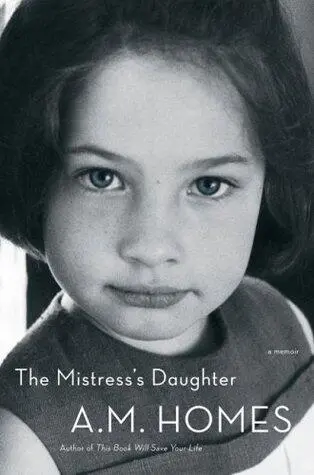
- Название:The Mistress's Daughter
- Автор:
- Издательство:Viking Adult
- Жанр:
- Год:2007
- ISBN:нет данных
- Рейтинг книги:5 / 5. Голосов: 1
-
Избранное:Добавить в избранное
- Отзывы:
-
Ваша оценка:
The Mistress's Daughter: краткое содержание, описание и аннотация
Предлагаем к чтению аннотацию, описание, краткое содержание или предисловие (зависит от того, что написал сам автор книги «The Mistress's Daughter»). Если вы не нашли необходимую информацию о книге — напишите в комментариях, мы постараемся отыскать её.
Before A.M. Homes was born, she was put up for adoption. Her birth mother was a twenty-two- year-old single woman who was having an affair with a much older married man with children of his own.
is the story of what happened when, thirty years later, her birth parents came looking for her.
Homes, renowned for the psychological accuracy and emotional intensity of her storytelling, tells how her birth parents initially made contact with her and what happened afterward (her mother stalked her and appeared unannounced at a reading) and what she was able to reconstruct about the story of their lives and their families. Her birth mother, a complex and lonely woman, never married or had another child, and died of kidney failure in 1998; her birth father, who initially made overtures about inviting her into his family, never did.
Then the story jumps forward several years to when Homes opens the boxes of her mother's memorabilia. She had hoped to find her mother in those boxes, to know her secrets, but no relief came. She became increasingly obsessed with finding out as much as she could about all four parents and their families, hiring researchers and spending hours poring through newspaper morgues, municipal archives and genealogical Web sites. This brave, daring, and funny book is a story about what it means to be adopted, but it is also about identity and how all of us define our sense of self and family.
The Mistress's Daughter — читать онлайн бесплатно полную книгу (весь текст) целиком
Ниже представлен текст книги, разбитый по страницам. Система сохранения места последней прочитанной страницы, позволяет с удобством читать онлайн бесплатно книгу «The Mistress's Daughter», без необходимости каждый раз заново искать на чём Вы остановились. Поставьте закладку, и сможете в любой момент перейти на страницу, на которой закончили чтение.
Интервал:
Закладка:
Did I ever say how precariously positioned I feel — on the edge of the earth, as though my permit could be revoked at any second?
The boxes. I come home from Yaddo and the boxes are in my apartment waiting for me, greeting me, nudging me to remember what I can’t forget. I cannot open the boxes. I am afraid of them, as though they contain something that might hurt me. Peeling the tape off them might unleash a virulent bacteria, just touching them might somehow infect me with her. I live with them like furniture, taking care to steer around them, to not let anything I care about come in contact with them, and then finally, more than nine months later, I put them in storage. I banish the boxes to the netherland of ministorage — before they go I mark them carefully in Sharpie marker on all sides, Dead Ellen 1–4. She put me up for adoption — I’m sending her to ministorage. She will join my tax records, my vinyl record collection, my dot matrix printer, my old typewriter, becoming a piece of my life I am unwilling to entirely unload but that is best kept off-site.
What is the half-life of a toxic box? When will I be ready to look inside — does the potential to rattle and shake lessen over time?
In the spring of 2005 I promise myself to once and for all deal with dead Ellen. I bring the boxes out of suspension, deliver them back to my apartment. Over time they have ripened; there is a certain smell to them — active disintegration. And again they sit, linger, become furniture. I stack things on top of them: suitcases, books, things of great weight. I am covertly holding them closed.
In the fall of 2005, twelve years after she found me, I take the boxes with me to Long Island for a weekend — just me and the four corrugated cardboard containers of dead Ellen. I take the boxes to the same small house where I stood in the yard and listened as my mother told me that my mother was dead. The house, then a rental, now is mine — a piece of something people call home. I take four boxes to the house on Long Island, a safe and controlled place — where like a bomb squad I plan to detonate them. I put the boxes on the kitchen table — my grandmother’s table. There is no escaping them now, no way around it.
I ask my family to stay home. I cannot do this with an audience, I have to be alone, able to sit with whatever I find. I need to not have to explain what can’t be explained — all that I am now of course trying to explain. I sit before the boxes, preparing to take inventory, giddy like a child playing the game of going through the mother’s purse, and then also feeling a more serious weight — I am the guardian, the keeper of what remains, and if I was not able to know her in life, perhaps I can crawl closer in death. Is there such a thing as intimacy after the fact? Will I find her in these boxes, will I know her any better after I am done? There is a piece of me that wishes I had taken more — perhaps if I’d taken ten boxes there’d be more of something, not just more of the same.
Box 1—the item on top is sheet music. “Hail to the Redskins.” I don’t know exactly why I was so surprised that this was the first item — was it because my biological father was a college football player, or that I could all too easily picture the two of them going to Redskins games while his wife was home with the kids? But it was especially interesting in light of other information I discovered: Ellen’s 1971 arrest for gambling — setting up a gaming table in the Sheraton Park Hotel and taking bets during a Cowboys-Redskins game — and an antitrust lawsuit that my father filed against the Redskins and pro football when he wanted to bring a new football team to town and ran into difficulty. And as soon as I see the sheet music, I also see myself at thirteen with braces in my bedroom in my parents’ house in Chevy Chase and my clarinet teacher, Mr. Schreiber, sitting beside me while I honked and screeched, stopping to lick the reed of my rented clarinet, wanting to get it right. Mr. Schreiber was the leader of the Redskins marching band — the Indian chief — who with a long headdress over his thick white hair would lead the band out onto the field at halftime.
Under the sheet music is a faux leather portfolio of photographs. I reflexively take a deep breath — preparing for what comes next — but on account of the dust, I have a coughing fit and have to go get a drink. The photos are the work of Harris & Ewing — the largest photo studio in Washington, photographers of presidents and high society — and apparently several are of my mother as an infant. In the first two portraits she is about four months old — there’s one serious, one smiling — and then she is somewhere near two, in a white dress with a big bow in her hair, white lace-up shoes, delicate and delighted — again and always looking off to the side. And then a little older, maybe three or four, posing with a big beautiful Dalmatian. And again — maybe part of the same shoot — in lederhosen or a pinafore. There is the palpable sense of her as Daddy’s little girl — devilish glimmer in the eye, she is shy and she is charming and she is defiant — and I have the strange sense that she knows more than she is able to fully understand. She is not a baby but a girl, and still and always there is a tentativeness and a need for confirmation — one can see it all. And for me there is a dull familiarity, an inescapable, unnamable relatedness — we do not look alike but in common. There is something similar in the arms, in the cheeks and the eyes — we have the same eyes.
There is a Harris & Ewing portrait of Ellen’s mother — cool, crisp, cold, proud of herself if no one else. The fact that these photos exist at all speaks to a certain kind of prosperity. The average person in the early 1940s did not have portraits taken of themselves and their children. It also reminds me of something Ellen once said to me—“Let’s have our portrait painted.” When she said it, the words seemed to exist in another world. Did she once have her portrait painted? Was it something promised that never happened? There is another photo taken on board a ship by someone else, of Ellen’s mother and a woman I assume is her mother’s mother, Mary Hannan — sometime in the 1930s. And then there is another of Mary Hannan long ago — a youthful, beautiful young woman.
Mixed between the pages there are random snapshots — Ellen playing on the beach, with her brother deep in the background. There is one that I assume is her father and brother in the backyard of their house. And then Ellen at about seven or eight standing outside the house with her brother — he is in his military school uniform, fists clenched at his side, his mother the photographer’s shadow a dark outline on the sidewalk — and by now her father is gone. And then Ellen is on a sofa next to her mother — adolescent, chubby, and excruciatingly uncomfortable. The images are frozen moments of family relation; they are documents taken to serve as proof and memory when there is no longer anyone to tell the story.
Things fall out — dozens of unopened bills with the yellow forwarding stickers from the post office, Notify Sender of New Address. Hers was a life lived in motion, spiraling down, running, barely one step ahead of herself. Envelopes slip to the floor — insurance overdue notice of $530 and another from a collection agency for $13,043.75 due to the office of comptroller of revenue. There is a set of legal papers relating to the reopening of a case filed by a family on behalf of their children to recover damages suffered by lead paint poisoning in buildings owned and managed by the defendants — specifically and especially Ellen Ballman.
There is a letter from Security National Bank: “This is to advise you that because of an unsatisfactory relationship on your account, we must request the account be closed within 15 days of this letter.” There is a commercial gas and electric bill due for over $10,000. And an envelope with an autumn 1995 Mark, Fore & Strike catalog, Fun Casual Clothing Since 1951 . The odor wafting up from the box stings — it’s a little mothball, a little hamster cage, a little asthmatic, and definitely something turned sour. There’s a letter from the Maryland Department of Public Works dated June 6, 1984, a citation for general nuisance, vacant lot conditions, overgrowth of tall weeds and brush, scattered bottles, cans, and paper, a rat running along the front of the lot. The address, 4709 Langedrum Lane, Chevy Chase, Maryland. It is a few miles from where I grew up — and a place not known for rats. There is a notice of cancelation of insurance and another notice for delinquent taxes on a property on Seventh Street in Washington, D.C.
Читать дальшеИнтервал:
Закладка:
Похожие книги на «The Mistress's Daughter»
Представляем Вашему вниманию похожие книги на «The Mistress's Daughter» списком для выбора. Мы отобрали схожую по названию и смыслу литературу в надежде предоставить читателям больше вариантов отыскать новые, интересные, ещё непрочитанные произведения.












Обсуждение, отзывы о книге «The Mistress's Daughter» и просто собственные мнения читателей. Оставьте ваши комментарии, напишите, что Вы думаете о произведении, его смысле или главных героях. Укажите что конкретно понравилось, а что нет, и почему Вы так считаете.