Howard Jacobson - Kalooki Nights
Здесь есть возможность читать онлайн «Howard Jacobson - Kalooki Nights» весь текст электронной книги совершенно бесплатно (целиком полную версию без сокращений). В некоторых случаях можно слушать аудио, скачать через торрент в формате fb2 и присутствует краткое содержание. Год выпуска: 2007, Издательство: Simon & Schuster, Жанр: Современная проза, на английском языке. Описание произведения, (предисловие) а так же отзывы посетителей доступны на портале библиотеки ЛибКат.
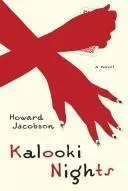
- Название:Kalooki Nights
- Автор:
- Издательство:Simon & Schuster
- Жанр:
- Год:2007
- ISBN:нет данных
- Рейтинг книги:5 / 5. Голосов: 1
-
Избранное:Добавить в избранное
- Отзывы:
-
Ваша оценка:
Kalooki Nights: краткое содержание, описание и аннотация
Предлагаем к чтению аннотацию, описание, краткое содержание или предисловие (зависит от того, что написал сам автор книги «Kalooki Nights»). Если вы не нашли необходимую информацию о книге — напишите в комментариях, мы постараемся отыскать её.
Spanning the decades between World War II and the present day, acclaimed author Howard Jacobson seamlessly weaves together a breath-takingly complex narrative of love, tragedy, redemption, and above all, remarkable humor. Deeply empathetic and audaciously funny, "Kalooki Nights" is a luminous story torn violently between the hope of restoring and rebuilding Jewish life, and the painful burden of memory and loss.
Kalooki Nights — читать онлайн бесплатно полную книгу (весь текст) целиком
Ниже представлен текст книги, разбитый по страницам. Система сохранения места последней прочитанной страницы, позволяет с удобством читать онлайн бесплатно книгу «Kalooki Nights», без необходимости каждый раз заново искать на чём Вы остановились. Поставьте закладку, и сможете в любой момент перейти на страницу, на которой закончили чтение.
Интервал:
Закладка:
‘I understand, Gnädige Frau.’
‘Do you have any questions?’
‘How do I finish the drawing, Gnädige Frau?’
‘You do not. You erase it every night and start again every morning.’
He has another question, if he dare ask it. What if this, his penis, does not rise? Will she not consider it. .?
‘An insult? Yes. No Jew dare look upon German womanhood limp.’
‘But day after day, Gnädige Frau, and while I am concentrating on my drawing. .’
‘Treat me with disrespect and I will shoot you, nicht ?’
Discontentment courses through his body. If they could distil melancholy and inject it into you with a syringe, this is how you would feel. Or if you finally came face to face with Elohim and found him to be common. A Northern German with a snub nose.
It is prosaic to be threatened, and doubly prosaic to be threatened with death by shooting. Is that all?
Will Ilse Koch, too, prove to be an anticlimax? In general the Germans have been a terrible disappointment to the Jews. They have not lived up to Jewish expectation. Such music! Such writing! Such an elaboration of myth! All for this! The great bathos of National Socialism. You would expect that where there is art there is refined imagination. But maybe the imagination is all on the side of those who love the art, not those who make it. So am I, Mendel wonders, going to be Frau Koch’s superior in the refinements of cruelty as well?
His charge is not banality. It is not banal to do what they are doing. This camp is not banal. It is supremely ambitious. The end magnificent in its completeness, outdoing all previous attempts to bend creation to man’s will. No wonder the nation is so enthralled. Forget not knowing. They all know. They can smell exhilaration in the wind. And that isn’t all they can smell.
But the means!
Shoot him, indeed! And then what? A lampshade. Well, that too smacks of grand conception. Take human skin and do so little with it. As insults go, it is magniloquent. But why shoot him when she can have him, as she has her horse, as a live instrument of her desire? Own him, still living, as she owns her property. Make a household object, a utensil, of the living man, not the dead skin. But then he already is her property, is he not? Every Jew in the camp, every gypsy, every communist, is her property. So he must mean something else. Something which demeans with more exactness. He does. He would like to be tiny in her grasp. He would like her to lift him to her lips, like Goya’s Saturn devouring his own progeny, her hands become his ribcage, her eyes wide with forbidden knowledge. He would like her to laugh at his smallness, and then, like the giant, to close her mouth around him. He would like to be her food. Jewish food. He would like to give her kosher pleasure as she rolls him around her mouth, and himself unkosher pleasure as he is swallowed and disappears into her stomach. He would like to hear her moan a little from the inside, first with pleasure, then with grief at what she’s lost.
A voluptuousness that has not occurred to her, and would no doubt shock and appal her, deviant as she is said to be.
He would enjoy that. He would enjoy taking Frau Koch’s breath away.
And he has barely started yet. Hardly put his foot on the first rung of the ladder downwards into hell. Because where everything is permissible. .
Shoot him, indeed!
In a flash, as the melancholy sluices through his body, he understands that she is conventional, a child of a conventional people, and will be bound to disappoint him. Through the blank clouds, Elohim with his snub Schleswig-Holstein nose regards him incuriously. This is no person-to-person accident. It would not have been otherwise had Ilse Koch been a different German woman, and he, Mendel, a different Jewish man. It is a fact of history. Another Jew let down by another German.
His penis falls limp. She strikes him with her whip and he cries out. Not from the pain but from the never-to-besatisfied longing.
SEVEN
Chinese Husband: Honollable wife, I have heard you are
having affair with Jewish man.
Chinese Wife: Honollable husband, I cannot think where
you are getting these bobby meises from.
1
And beyond staring into the end of the world, what did Asher Washinsky do when he realised that Dorothy’s father was German?
He cried.
But he cried only because Dorothy’s father cried first.
And Dorothy?
She of course cried at the sight of them both crying.
Manchester has enjoyed long and noble relations with Germany, both commercial and cultural. Not counting the signed photograph of Frankie Vaughan which stood on Shani’s bedside table, and Geraldo & His Orchestra’s version of ‘By the Sleepy Lagoon’ which it was my mother’s custom to put on the gramophone and play at low volume when people turned up for kalooki, ours wasn’t a musical family; but even we took pride in the Hallé Orchestra without knowing that its founder was born in Hagen, Westphalia, and had briefly been a friend of Wagner’s, before moving to comfier accommodation in Greenheys Lane, in the south of the city, not at all far from where today stands Hillel House, the hall of residence for Jewish students attending Manchester University. That Charles Hallé was able to start and fund an orchestra of the Hallé’s quality was due largely to the enthusiasm, munificence and artistry of the German community with whom he mixed, some of it German Jewish, some of it just German. A similar consideration — the presence of family, good business connections, articulate and convivial company from the homeland (though the city’s Schiller Institute with its skittle alleys and billiard room and gymnasium and male-voice choir was not yet established) — brought Engels to Manchester.
Dorothy’s father was related neither to the Hallés nor the Engels. But he was a Beckman — poorly and distantly related to the Manchester Beckmans, a discreetly high-bourgeois family originally from Düsseldorf which had owned a small engineering factory in Salford since about the time the Hallé played its first Beethoven symphony. A very poor and distant relation, for when he was sent over to meet his Manchester mishpocheh it was in the capacity of driver for one of the junior directors. A hundred years earlier and he would have risen in the firm and looked forward to a still more distant Beckman being sent over from Düsseldorf to drive his car. But this was 1937. Not a good time for a German with little English to be making his way in the world — not this part of the world anyway. When war broke out he was interned in Huyton, a camp on the outskirts of Liverpool, where he learned philosophy and Bible history and a few words of Yiddish from the other internees, most of whom were Jews. It’s feasible, though it was never discussed, that he did a bit of fire-yekelte-ing himself while he was there, in return for Hebrew lessons. Whether or not, he grew proficient in compassion, and by the time he was released in 1944 was a confirmed Judaeophile. Had he been acceptable to a Jewish girl he would have married one. Any one. As an act of atonement partly, for he was ashamed of his country’s crimes and believed that fewer of them would have been committed had he not left it when he did, but also from inclination. He liked how Jewesses looked. When he imagined kissing a Jewess he imagined licking out a jar of damson jam. In the event, all Jewesses being closed to him, he married lime marmalade. The daughter of the respectable working-class family with whom he lodged, who had their own doubts about him as a German, but learned to judge him, in that English way, on his individual merits. Of those, industriousness and honesty — as evidenced by the little notebook he carried to write down every expenditure and debt — and the fact that his trousers always had a perfect crease in them, and that he liked double cuffs on his shirts, and that his fine gold cufflinks had his initials engraved on them — AB — struck them as adequate guarantees that their daughter would be well looked after. And she was. Not provided for to any high degree — Albert Beckman’s Germanness counting against him when it came to driving for anyone not a German, and for anyone who was, come to that, since there were some things, if you were German, you didn’t want to advertise — but cherished and indeed improved. The work he encouraged her to do for Jewish people, for example, was without doubt helpful in balancing their weekly budget, but it was also something he taught her to think of as a mitzvah — not just a good deed but an opportunity for them both to employ a word he ’d originally picked up in Huyton and liked the sound of.
Читать дальшеИнтервал:
Закладка:
Похожие книги на «Kalooki Nights»
Представляем Вашему вниманию похожие книги на «Kalooki Nights» списком для выбора. Мы отобрали схожую по названию и смыслу литературу в надежде предоставить читателям больше вариантов отыскать новые, интересные, ещё непрочитанные произведения.










Обсуждение, отзывы о книге «Kalooki Nights» и просто собственные мнения читателей. Оставьте ваши комментарии, напишите, что Вы думаете о произведении, его смысле или главных героях. Укажите что конкретно понравилось, а что нет, и почему Вы так считаете.