Boualem Sansal - Harraga
Здесь есть возможность читать онлайн «Boualem Sansal - Harraga» весь текст электронной книги совершенно бесплатно (целиком полную версию без сокращений). В некоторых случаях можно слушать аудио, скачать через торрент в формате fb2 и присутствует краткое содержание. Год выпуска: 2014, Издательство: Bloomsbury Publishing, Жанр: Современная проза, на английском языке. Описание произведения, (предисловие) а так же отзывы посетителей доступны на портале библиотеки ЛибКат.
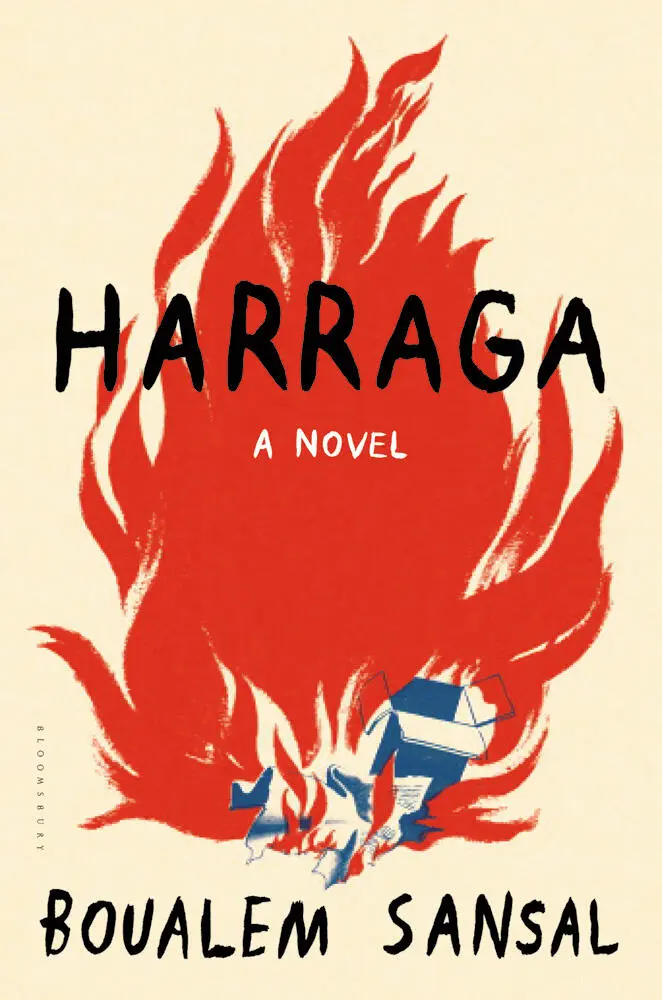
- Название:Harraga
- Автор:
- Издательство:Bloomsbury Publishing
- Жанр:
- Год:2014
- ISBN:нет данных
- Рейтинг книги:3 / 5. Голосов: 1
-
Избранное:Добавить в избранное
- Отзывы:
-
Ваша оценка:
Harraga: краткое содержание, описание и аннотация
Предлагаем к чтению аннотацию, описание, краткое содержание или предисловие (зависит от того, что написал сам автор книги «Harraga»). Если вы не нашли необходимую информацию о книге — напишите в комментариях, мы постараемся отыскать её.
Boualem Sansal creates, in Lamia, an incredible narrator: cultured, caustic, and compassionate, with an ironic contempt for the government, she is utterly convincing. With his deceptively simple story, Sansal delivers a brave indictment of fundamentalism that is also warm and wonderfully humane.
Harraga — читать онлайн бесплатно полную книгу (весь текст) целиком
Ниже представлен текст книги, разбитый по страницам. Система сохранения места последней прочитанной страницы, позволяет с удобством читать онлайн бесплатно книгу «Harraga», без необходимости каждый раз заново искать на чём Вы остановились. Поставьте закладку, и сможете в любой момент перейти на страницу, на которой закончили чтение.
Интервал:
Закладка:
This was the only kind of outing I could come up with so that Chérifa could stretch her legs and get a breath of fresh air.
The third time I mentioned it, she shrugged and went back to painting her toenails. I had suggested she come with me to the town hall where I needed to pick up some form or other that my bosses at the hospital urgently required. At the time, I was annoyed, but when I got back I congratulated her, having just extricated myself, dazed and exhausted, from another preposterous situation.
Solitude can be brutal to those not armed against it. I have learned to make the best of it, I know how to fill my days with nothing, with silence, dreams, trips into the fourth dimension, empty soliloquys, outlandish outbursts and painstaking household tasks. I have active and passive moods and switch between the two as the whim takes me. I have my work, my books, my records, my TV, my illicit satellite dish, my little forays into the hustle and bustle of the capital, and my house which still holds its secrets. I have a window on to time, I know how to navigate its most secret places and drop anchor by its uncertain shores.
Chérifa has nothing; to her, solitude is an emptiness, it is suffering, pain, an incomprehensible abandonment.
What can I do?
She scarcely thanks me when I pamper her, barely notices when I devote my time to her, as far as she is concerned it is completely normal that I should drop everything to attend to her every infantile desire. She is so self-centred!
What to do? I talk to her as much as I can, tell her about my day at the hospital, enliven things with the sort of juicy gossip beloved of housewives. I watch the Egyptian soap operas through her eyes at the risk of my own sanity. I’m attentive to her needs, I allow her to interrupt me, to change the subject — something I loathe — I hang on her every word, I always maintain eye contact. Every time she sulks or throws a tantrum, I offer abject apologies that whittle away at my self-esteem. But still she sees nothing, she’s blind, I am no more than a shadow on the wall, something so familiar it goes unnoticed, a big sister who’s not much to look at, an aunt who’s a little soft in the head, a mother who is a bit embarrassing. I don’t know, perhaps I mean nothing to her, perhaps I’m just an overbearing landlady, an infuriating neighbour. The way she cuts me dead sometimes, the way she says ‘Get off my back!’ would drive even a clapped-out old car round the bend.
When she starts a conversation, I’m so desperately eager to play along it puts her off. Too much fawning unsettles her. She gets angry. I try to patch things up. It ends in tears. Example:
‘It’s raining,’ she says out of the blue.
‘Is it?’
‘Can’t you see it is?’ She’s angry now.
‘I was just wondering if you had noticed.’
‘I’m not blind!’ she screams.
‘Sometimes people don’t really pay attention, we listen without hearing.’
‘I’m not deaf!’
‘I was just saying.’
At this point, she throws whatever she’s holding on the floor and stomps out of the room.
Does she even realise that I love her?
How do you raise a child? The question popped into my head as I was going through a bunch of old recipes I’d collected here and there. Papa and Maman left me a basketful and I accumulated quite a few while I was growing up. Evolution being what it is, and the Muslim world being what it is, I had struggled to understand why girls were put upon while boys were fawned upon and wondered whether the hand of God or the hand of the Devil was at work. I quickly realised that our society does not have ears capable of hearing girls.
What about me, how will I bring up this child? This girl!
With other people’s children, it’s simple: we ignore them, give them a clip round the ear or smile at them as if to say: ‘Carry on like that and you’ll turn out just like your ignoramus of a father or your cack-handed mother.’ Or we find them unbearably cute and let them get away with murder. With other people’s children, we don’t have to worry about feeding them, clothing them, knocking some sense into them. They can be offhandedly loved, affectionately castigated, shamelessly forgotten.
The problem is that Chérifa is neither a child nor a woman. Between the two, it’s difficult to know how to behave — we casually refer to girls of that age as Lolitas, but it brings us no closer to understanding them. Nature is fairly straightforward in its workings, it transforms us from larva to adult after briefly keeping us in a pupa stage there to eliminate our childhood dreams and fashion new ones. Sometimes, the machine unspooling time grinds to a halt and we hesitate as we wait for it to start up again; but I’ve noticed that some people, the foolish ones, cling to old dreams like rotten acorns, while others, the more enlightened, determinedly follow their star even in the blinding glare of noon.
I know I didn’t much enjoy leaving childhood behind, nor do I much like what I see looming on the horizon. The future looks to me too much like ancient history, while the childhood innocence I trail behind me is a terrible handicap in this jungle. In the end, the problem is to decide whether it is better to die at our appointed hour or to live on through our ancestors. At first glance there would seem to be no connection, but I can imagine an explorer finding himself face to face with a sign reading: turn right and you will be eaten alive, turn left and you will be roasted on a spit, straight ahead a boiling cauldron awaits you. Turn back and you will die of starvation.
Enough of these riddles, I have a practical problem I need to resolve. I need to make Chérifa love me, I need to make her understand that I love her, as my own daughter, with all my strength, with all my weakness.
Where is the path?
From one door to the next
Hushed is the silence
The wind has nothing worthwhile to report
The crowd is running on empty
The nightmare draws out its shadow
My heart aches.
To say I love you to the walls
And hearken for an answer
Beggars reason.
Where can it be, the path
Which from the unknown
Will fashion my native soil
My love, my life
And my death?
Suddenly, I have begun to dread coming back to this house. This is new only yesterday I would be halfway home before I’d even left the Hôpital Parnet. In my haste, I would rip my white coat. This house is my haven, my personal history, my life. One question nags at me, unsettles me, slows my pace. It worries me. The answer, I know, will be there when I get home, Chérifa will be slumped in front of the TV, flicking through the channels or counting her toes, or she’ll have taken off without so much as a note — she can’t write, cannot even formulate thought, so alien is writing to her — and yet still I come back here, one moment fretting and fearing the worst and the next hoping for the best, I cling to that thought though it does not seem to put an end to the agonising uncertainty. At times, I walk more slowly, at times more quickly, and here and there in the twisting alleyways that irrigate this city I allow myself to be buttonholed by the women who wait on their doorsteps, I stop and take the time to give them the latest news about their case. They listen to me, beating their breasts or covering their faces with their hands, stammering oh and ah . There are times when I find this gesture infuriating, when I see it as an abdication of responsibility, a thoroughly masculine cowardice; sometimes I browbeat them to the point where I fear for their lives and sometimes my heart bleeds and so I give them news that will have them singing and dancing all night. Dear God, how tenuous their life is, it hangs by a thread, a word, a glimmer, a law. And how absurd my own life.
Читать дальшеИнтервал:
Закладка:
Похожие книги на «Harraga»
Представляем Вашему вниманию похожие книги на «Harraga» списком для выбора. Мы отобрали схожую по названию и смыслу литературу в надежде предоставить читателям больше вариантов отыскать новые, интересные, ещё непрочитанные произведения.








Обсуждение, отзывы о книге «Harraga» и просто собственные мнения читателей. Оставьте ваши комментарии, напишите, что Вы думаете о произведении, его смысле или главных героях. Укажите что конкретно понравилось, а что нет, и почему Вы так считаете.