Boualem Sansal - Harraga
Здесь есть возможность читать онлайн «Boualem Sansal - Harraga» весь текст электронной книги совершенно бесплатно (целиком полную версию без сокращений). В некоторых случаях можно слушать аудио, скачать через торрент в формате fb2 и присутствует краткое содержание. Год выпуска: 2014, Издательство: Bloomsbury Publishing, Жанр: Современная проза, на английском языке. Описание произведения, (предисловие) а так же отзывы посетителей доступны на портале библиотеки ЛибКат.
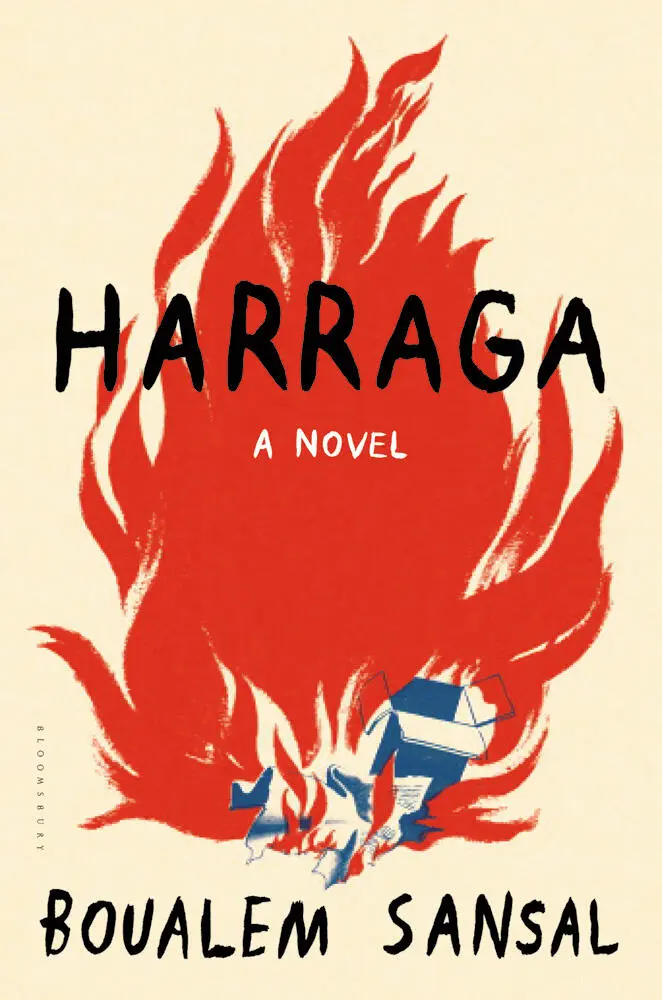
- Название:Harraga
- Автор:
- Издательство:Bloomsbury Publishing
- Жанр:
- Год:2014
- ISBN:нет данных
- Рейтинг книги:3 / 5. Голосов: 1
-
Избранное:Добавить в избранное
- Отзывы:
-
Ваша оценка:
Harraga: краткое содержание, описание и аннотация
Предлагаем к чтению аннотацию, описание, краткое содержание или предисловие (зависит от того, что написал сам автор книги «Harraga»). Если вы не нашли необходимую информацию о книге — напишите в комментариях, мы постараемся отыскать её.
Boualem Sansal creates, in Lamia, an incredible narrator: cultured, caustic, and compassionate, with an ironic contempt for the government, she is utterly convincing. With his deceptively simple story, Sansal delivers a brave indictment of fundamentalism that is also warm and wonderfully humane.
Harraga — читать онлайн бесплатно полную книгу (весь текст) целиком
Ниже представлен текст книги, разбитый по страницам. Система сохранения места последней прочитанной страницы, позволяет с удобством читать онлайн бесплатно книгу «Harraga», без необходимости каждый раз заново искать на чём Вы остановились. Поставьте закладку, и сможете в любой момент перейти на страницу, на которой закончили чтение.
Интервал:
Закладка:
Chérifa falls asleep earlier and earlier. By midnight, she has drifted far away. She’s sleeping for two. I’ve started giving her herbal tea enriched with baby sedative. I continue on my own, as I’ve always done. I potter around the house, tidy up, have a nibble, I read, I think and when my legs or my eyes start to tingle, I curl up in a corner and doze off. I listen to the silent darkness, to the creaking of the house and, high above it all, the ineffable pulse of time. It is a beautiful music, it enfolds me, seeps into my skin, into every molecule, every atom and deep inside me it blossoms as a giant corolla. It comes from so far, and extends so far, that everything becomes hazy, everything stops, and little by little the moment becomes eternity. I don’t move, I don’t breathe, a gentle, preternatural warmth radiates through me. I feel at peace with everything. I am about to sink… I am sinking…
As I teeter on the brink of sleep, a cry goes through my head: I have to contact Chérifa’s parents, to let them know she is all right. How could I not have thought of it before? I spent more than a year with no news of Sofiane and all the while every fibre of my being was waiting: I know their pain, I can feel it. I’ll talk to Chérifa, we’ll do what we have to do.
Another thought occurs to me: we should contact the man in the photo, the minister-for-whatever, make him face up to his responsibilities. I immediately dismiss this thought, the bastard has power, he could have us thrown in jail, have the baby adopted by a tattooed harpy like some chador -wearing Madame Thénardier who would force the child to fetch and carry water and later introduce her to a life of crime. He could have the child taken from its mother, taken from me, he could set the State against us. Dear God, he could mould the babe in his own likeness to become a wheeler-dealer, a crook, a profiteer! There’s no point even considering it, the man doesn’t deserve to live.
And while I’m thinking about such weighty matters, tomorrow afternoon I’ll go and find out what’s happening down at the Association. It’s been a while, maybe they will have news for me.
I don’t hold out much hope, but still I go. When your whole life is measured out by nagging heartache and the same haunting questions, you need some sort of ritual. Where are you, Sofiane? What has become of you? When are you coming home?
The Association offices occupy the ground floor of a city-centre building that in some former life must have been palatial. Half ruined, it still has a certain magnificence, surrounded as it is by buildings wholly ruined. The plaque next to the entrance is inscribed with a name as long as a gibbon’s splayed arm: ‘Algerian Family Crisis Centre for the Location and Rehabilitation of Youth Missing as a result of Clandestine Emigration’ — the AFCCLRYMCE. There is a lot to be said about this splayed gibbon and his murderous missions but I prefer to keep things short and simple: I call it the Disappeared Association. At the bottom of the plaque on the aforementioned sanctuary, it stipulates that the Association is authorised by the Ministry of the Interior. I don’t know whether this stipulation is a requirement or whether in this case it expresses a sort of voluntary allegiance. I’m not about to cast stones, I know that in a criminal State such things are easily confused and if you don’t like it, well, too bad. I found out about the Association through Mourad, who gave me the address. The man’s brain is cluttered with information. I wonder about him sometimes — does he come to the hospital out of the goodness of his heart, or is he working there as a sort of unpaid spy? I can’t help but admire my colleagues, they know everything, always, before anyone else. I don’t know one of them who retreats in the face of complexity. Not a single one. Where do they get such self-confidence? Sometimes I feel like killing one of them, putting a bullet through his forehead just to see that flicker of disbelief, that glint of fear as he faces the unknown; to hear him fall silent as he confronts something beyond his comprehension. Mourad is one of those people who knows everything, I thanked him profusely, I hope he remembers that.
The first time I met the President of the Association, she informed me I was asking all the wrong questions. I was helpless, I was desperate for information, I was bombarding her with queries. What she meant, she explained, was that wittering and whining were useless, I needed to stay calm, to let the experts do their job. As she said this she flashed me the sort of smile reserved for polite little girls and cheerfully strode off, briefcase in hand, phone pressed to her ear, with a sardonic swagger. A modern superwoman in pursuit of glory — even TV commercials don’t feature such airheads any more. I never saw her again, thank God. She’s a show-off, a charlatan, the sort of person who frequents salons, fraternises with the lumpenproletariat who monopolise the upper echelons of government and chairs pointless meetings. Her assistant, a sea lion wallowing in an ocean of files, simultaneously advised me not to give up hope and to prepare myself for the worst. This, she took great pleasure in emphasising, showed dignity and responsibility. She showered me with statistics, with grisly photos and press clippings, she bamboozled me with statements intended to reflect the seriousness of the tragedy. The country is being drained of its young and no one is doing anything about it — this was the gist of what she managed to say.
‘I’m not looking for advice on how to behave,’ I snapped back, ‘I want you to tell me what you plan to do to find my idiot brother!’
‘We have our ways,’ she whispered as though discussing assembling a neutron bomb in front of an audience of illiterates.
How dare she! I swear, I’ll rip the bitch’s heart out!
‘And what precisely are these “ways”?’
She glibly began to reel off the protocol, stabbing the air with her finger.
‘We draw up missing persons’ files… we liaise with the authorities who in turn liaise with the relevant overseas organisations… um… we regularly chase up queries… we have meetings… we draw up a confidential annual report which we submit to the government…’
‘Why the secrecy? A missing person is a missing person, everyone knows that.’
‘Um… actually I said confidential, there’s a difference.’
‘I realise that, but that doesn’t change the fact that a missing person is a missing person.’
‘We… um… we are planning to set up a newsletter to be sent out to family members.’
‘Now that’s a stroke of genius. A newsletter is a brilliant way of keeping patients warm.’
‘I suppose you can think of something better?’ she snapped back, lips pursed.
‘I can actually. Toss a message in a bottle into the sea and go home to bed.’
This outburst calmed me a little. Maybe I should have told her that the only way to truly extricate this country from hell itself would be to toss the government into the sea and the wagging tail of the civil service with it. Then young people wouldn’t dream of taking to the sea any more for fear of meeting them bobbing on the waves. But that’s politics and politics is dangerous, I’m rather attached to my life and to my little job at the Hôpital Parnet. You have to understand that in this Mickey Mouse country, people have every right to complain, but they have no right to complain to the pen-pushers who work for the government. They’re understandably nervous, given that they are constantly plagued by international organisations who want to know why they are cruel, scheming parasites and how so many poor wretches manage to disappear right under the noses of their families, their friends and the powers that be. It’s a valid question, but it’s not the only one that deserves an answer. No one can convince me that the Association aren’t complicit in the whole thing. They act as a screen, they exist so that the administration can sidestep the issue. Who better than a delegation of shrewd women to blindside the bigwigs at the international organisations and force them to admit they were mistaken? These women have a trick or two up their sleeves, they can explain away anything — right down to a concierge’s lumbago — and lay the blame on colonialism, imperialism, Zionism, the IMF and the machinations of You Know Who . What they can’t tell you is how to comfort a decent, upstanding woman.
Читать дальшеИнтервал:
Закладка:
Похожие книги на «Harraga»
Представляем Вашему вниманию похожие книги на «Harraga» списком для выбора. Мы отобрали схожую по названию и смыслу литературу в надежде предоставить читателям больше вариантов отыскать новые, интересные, ещё непрочитанные произведения.









Обсуждение, отзывы о книге «Harraga» и просто собственные мнения читателей. Оставьте ваши комментарии, напишите, что Вы думаете о произведении, его смысле или главных героях. Укажите что конкретно понравилось, а что нет, и почему Вы так считаете.