Reif Larsen - I Am Radar
Здесь есть возможность читать онлайн «Reif Larsen - I Am Radar» весь текст электронной книги совершенно бесплатно (целиком полную версию без сокращений). В некоторых случаях можно слушать аудио, скачать через торрент в формате fb2 и присутствует краткое содержание. Год выпуска: 2015, Издательство: Penguin Press, Жанр: Современная проза, на английском языке. Описание произведения, (предисловие) а так же отзывы посетителей доступны на портале библиотеки ЛибКат.
- Название:I Am Radar
- Автор:
- Издательство:Penguin Press
- Жанр:
- Год:2015
- ISBN:нет данных
- Рейтинг книги:3 / 5. Голосов: 1
-
Избранное:Добавить в избранное
- Отзывы:
-
Ваша оценка:
I Am Radar: краткое содержание, описание и аннотация
Предлагаем к чтению аннотацию, описание, краткое содержание или предисловие (зависит от того, что написал сам автор книги «I Am Radar»). Если вы не нашли необходимую информацию о книге — напишите в комментариях, мы постараемся отыскать её.
I Am Radar Deep in arctic Norway, a cadre of Norwegian schoolteachers is imprisoned during the Second World War. Founding a radical secret society that will hover on the margins of recorded history for decades to come, these schoolteachers steal radioactive material from a hidden Nazi nuclear reactor and use it to stage a surreal art performance on a frozen coastline. This strange society appears again in the aftermath of Cambodia’s murderous Khmer Rouge regime, when another secret performance takes place but goes horrifically wrong. Echoes of this disaster can be heard during the Yugoslavian wars, when an avant-garde puppeteer finds himself trapped inside Belgrade while his brother serves in the genocidal militia that attacks Srebrenica. Decades later, in the war-torn Congo, a disfigured literature professor assembles the largest library in the world even as the country around him collapses. All of these stories are linked by Radar — now a gifted radio operator living in the New Jersey Meadowlands — who struggles with love, a set of hapless parents,and a terrible medical affliction that he has only just begun to comprehend.
I Am Radar — читать онлайн бесплатно полную книгу (весь текст) целиком
Ниже представлен текст книги, разбитый по страницам. Система сохранения места последней прочитанной страницы, позволяет с удобством читать онлайн бесплатно книгу «I Am Radar», без необходимости каждый раз заново искать на чём Вы остановились. Поставьте закладку, и сможете в любой момент перейти на страницу, на которой закончили чтение.
Интервал:
Закладка:
The kettle began to shiver.
“You sure I can’t interest you in some?” said Lars. “I get it from this great little place by the docks in Constable Hook.”
“No, thanks,” said Radar. “Did you say nuclear events? You mean like bombs ?”
“Heavens, no.” Lars laughed. He took out a small French press. “Not bombs— happenings. Movements. Kirk En took place in Poselok, before the war was even finished. This was the whole reason my father was invited up north. It was an installation largely about nuclear fission, but also about longing and witnessing and infinity, I believe, but then, this is just my interpretation. Per, of course, disagrees with me. One of my great regrets is that I never got to see it. They never even took photographs. Can you believe it? All that work, and no evidence of its existence. Sometimes, in my more skeptical moments, I wonder if it even happened. But it must’ve been beautiful — I can picture it in my mind very clearly — a small, isolated island in the Arctic, perhaps twenty meters across. A forgotten shred of land. There’s a chance no human had ever even set foot on the island until they staged this miraculous event. ‘A silent, devastating critique of our obsession with manipulating natura into instruments of mass execution,’ writes Per. I think that’s well put.”
“So what was the event?”
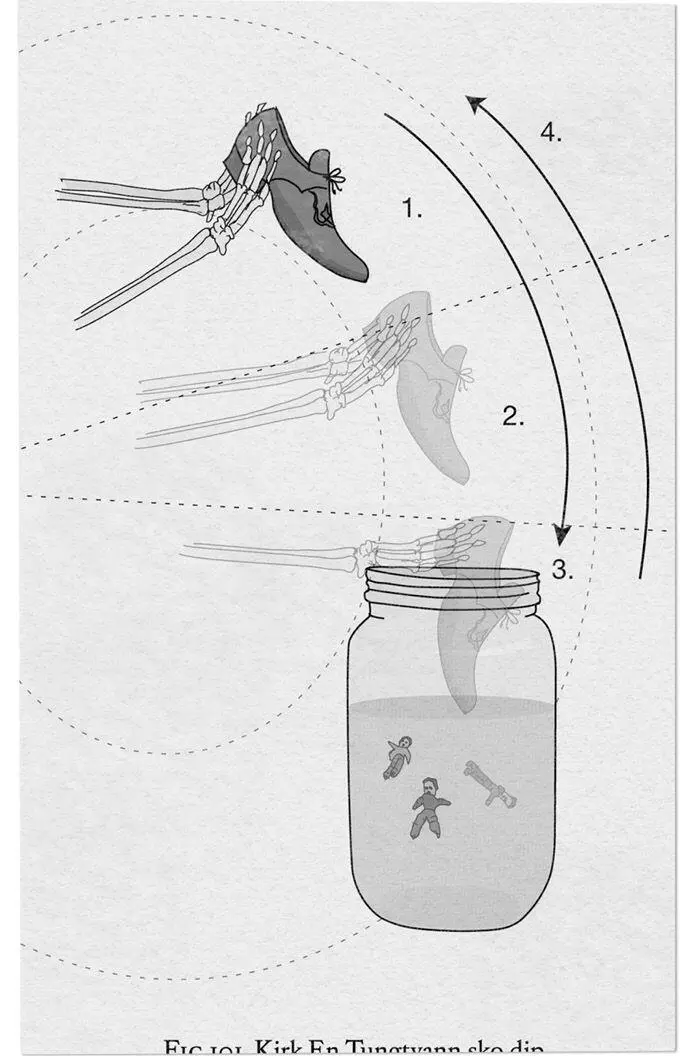
Fig. 3.11. Kirk En Heavy Water Shoe Dip
From Røed-Larsen, P., Spesielle Partikler, p. 154
“No one actually witnessed it, so all we have left is the description,” said Lars, pushing down the plunger of the French press. “Two hundred and thirty-five jars, arranged in a perfect circle. The jars were all filled with heavy water allegedly stolen from the Nazi plant in Vemork. Inside each jar, three tiny dolls are floating. The dolls are designed to have the exact density as the heavy water, and so they appear essentially weightless. And in the middle of the circle, two hundred thirty-five beautiful puppets, made from fox skeletons, mounted on tracks, each with a single shoe cradled in its arms—”
“Wait, I’m sorry — no one ever even saw the show?” said Radar.
Lars smiled. “Apparently two Russian fishermen eventually did discover the installation sometime in the eighties. You can imagine their surprise. Bože moj! ”
Otik snorted. Lars looked over at him.
“What?” said Otik. “It is funny when you speak. Bože moj! You are funny.”
“So,” said Radar. “I don’t mean to be rude. .”
“Please,” said Lars, pouring the coffee into his mug.
“You’re saying your father left his family to put together an installation with jars in the Arctic that no one saw except two Russian fishermen?”
“Forty years later, yes.”
“Forty years later.”
Lars smiled. “When you put it like that, it does sound a bit awful, doesn’t it? But you’ve got to understand that at the time, it was much more serious. It felt like a matter of life and death. They truly believed they were changing the course of history by staging such an event.”
“Of course they were changing history,” said Otik. “It is no doubt.”
“But no one ever saw it!” said Radar.
Otik turned around. “You don’t know anything, do you? You are like little child.”
“Please,” said Lars, holding up his hands. “It’s a fair critique. And it’s a critique that’s been leveled at Kirkenesferda by more than a handful of scholars. Many have called us the worst kind of self-satisfied, pretentious time-wasters — creating our art while others die. Sometimes I harbor these same doubts myself. But then I think back to what Leif said all those years ago: that we were circling around something essential, something far too beautiful to abandon—‘an eternal object,’ he used to call it. He used to say small things affect big things, just as big things affect small things.”
“This is true,” said Otik. “Small and big.”
“Okay,” said Radar, eyeing Otik warily. “So then what happened next?”
“After the war, my father moved back to Oslo with his family for a time. He took up his old position at the university again. He went through his routine, taught his courses, but everyone said he wasn’t the same man. He always had his eyes pointed northward. Per was born in 1952, but even this couldn’t keep him there. My father left maybe three years later for Kirkenes. He couldn’t escape it, I suppose. And he essentially abandoned the family, the toddler, the job, everything. You can imagine the effect this had on Dagna. To be left by the same man twice. She never recovered.”
“So you had a different mother?”
“I did. Her name was Siri. My father met her at the Bjørnens Hule. He had been living up north for ten years or so. This was after they had already staged Kirk To, in 1961. My mother joined them in 1968 or something like this. I’ll have to look at Per’s book. She was the only woman in the camp.”
“Why did she come?”
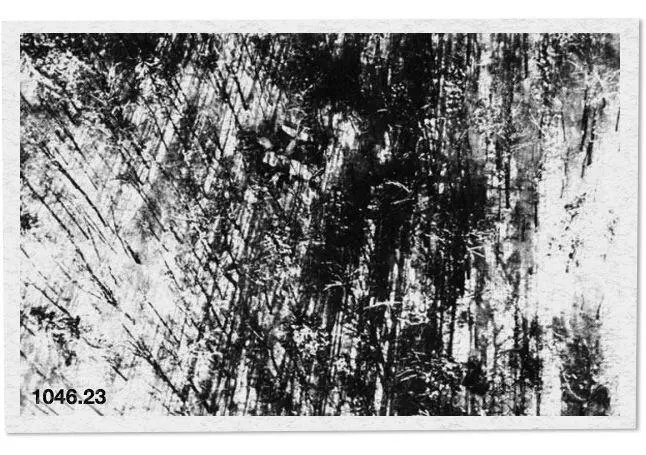
Fig. 3.12. Frame still from Kirk To, Gåselandet
From Røed-Larsen, P., Spesielle Partikler, p. 230
“Oh, I don’t know. She was a hippie. A Norwegian hippie. You know — long dresses, no bra, the whole gambit. But beneath this flower-power routine, she was a fiercely intelligent idealist. She was a set designer. Just brilliant. She had seen the famous nuclear bomb footage of the Gåselandet performance at some drug party in Oslo and decided this was what she wanted to do. And when she showed up at the camp, you can imagine. . There was a kind of brutal competition for her affection among the men. Some of them had not seen a woman in years. And yet it was Jens, the old professor, who won out. I don’t think my father was really even interested in meeting a woman. A part of him was still in love with Dagna, and he must’ve felt great guilt about leaving Kari and Per behind. But Siri was Siri, and he couldn’t resist. I’m glad he didn’t. I wouldn’t be here otherwise.”
“So when did my father come in?”
“Your family visited the Bjørnens Hule in 1979. This was when Kermin first met Leif.”
“Who’s Leif again?”
Lars flipped though the book and pointed to a picture. “Leif Christian-Holtsmark,” he said. “He was one of the founders of Kirkenesferda. Him and Brusa Tofte-Jebsen. And then Brusa left after a disagreement about the group’s future, so really Leif became our spiritual mentor for many years. He was the heart. Leif asked your father to help him out for Kirk Tre, the Cambodia movement in Anlong Veng.”
“Cambodia?”
A weary look came across Lars’s face. “It was the first time they did a movement in a place of active warfare. Everything changed after that.”
“And my father went, too?”
Lars shook his head. “No, thank God. But he made the puppets. They were incredible.”
“Incredible,” Otik agreed. “Most.”
“They had screens for heads. It was very complicated, very time-consuming. They were these fantastic creatures with essentially infinite faces. The puppet could become anything you wanted it to be,” said Lars. “And they were magic. Absolute, utter magic. I wish you could’ve seen them. Some of the most beautiful objects ever made. Here — here’s a drawing from Per’s book. It doesn’t really do it justice.”
Читать дальшеИнтервал:
Закладка:
Похожие книги на «I Am Radar»
Представляем Вашему вниманию похожие книги на «I Am Radar» списком для выбора. Мы отобрали схожую по названию и смыслу литературу в надежде предоставить читателям больше вариантов отыскать новые, интересные, ещё непрочитанные произведения.










Обсуждение, отзывы о книге «I Am Radar» и просто собственные мнения читателей. Оставьте ваши комментарии, напишите, что Вы думаете о произведении, его смысле или главных героях. Укажите что конкретно понравилось, а что нет, и почему Вы так считаете.