Reif Larsen - I Am Radar
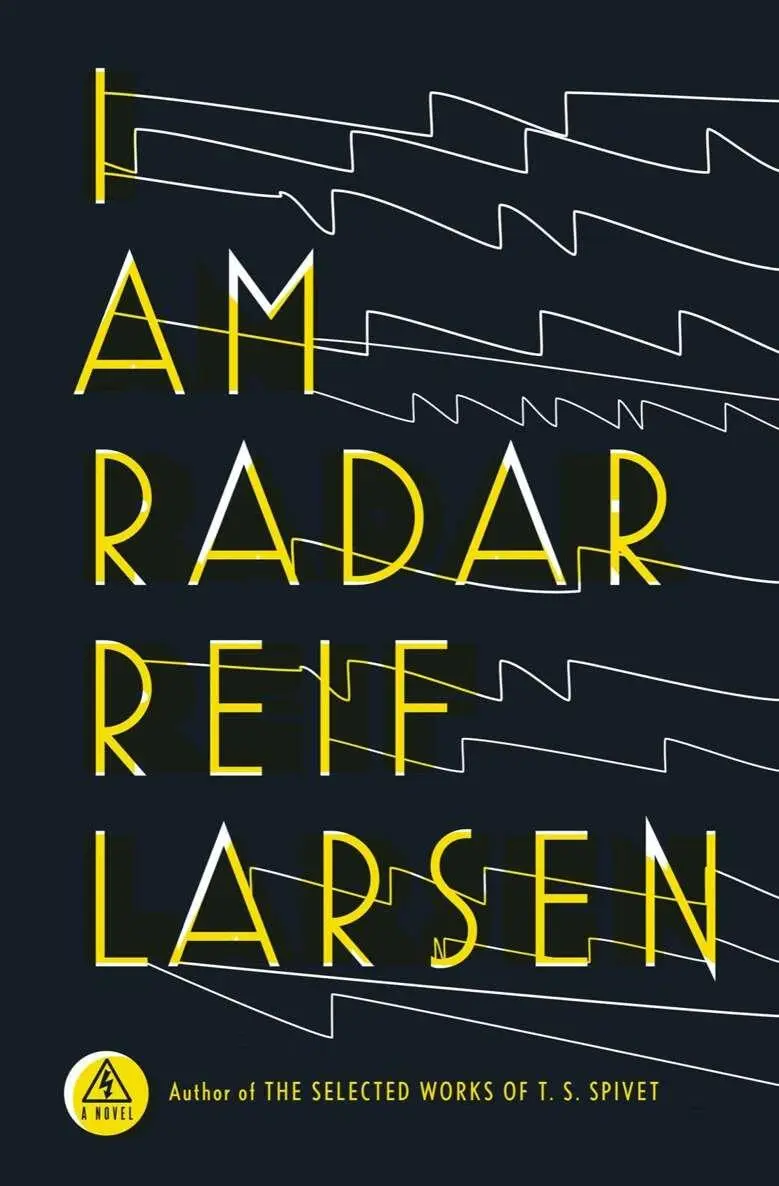
Здесь есть возможность читать онлайн «Reif Larsen - I Am Radar» весь текст электронной книги совершенно бесплатно (целиком полную версию без сокращений). В некоторых случаях можно слушать аудио, скачать через торрент в формате fb2 и присутствует краткое содержание. Год выпуска: 2015, Издательство: Penguin Press, Жанр: Современная проза, на английском языке. Описание произведения, (предисловие) а так же отзывы посетителей доступны на портале библиотеки ЛибКат.
- Название:I Am Radar
- Автор:
- Издательство:Penguin Press
- Жанр:
- Год:2015
- ISBN:нет данных
- Рейтинг книги:3 / 5. Голосов: 1
-
Избранное:Добавить в избранное
- Отзывы:
-
Ваша оценка:
I Am Radar: краткое содержание, описание и аннотация
Предлагаем к чтению аннотацию, описание, краткое содержание или предисловие (зависит от того, что написал сам автор книги «I Am Radar»). Если вы не нашли необходимую информацию о книге — напишите в комментариях, мы постараемся отыскать её.
I Am Radar Deep in arctic Norway, a cadre of Norwegian schoolteachers is imprisoned during the Second World War. Founding a radical secret society that will hover on the margins of recorded history for decades to come, these schoolteachers steal radioactive material from a hidden Nazi nuclear reactor and use it to stage a surreal art performance on a frozen coastline. This strange society appears again in the aftermath of Cambodia’s murderous Khmer Rouge regime, when another secret performance takes place but goes horrifically wrong. Echoes of this disaster can be heard during the Yugoslavian wars, when an avant-garde puppeteer finds himself trapped inside Belgrade while his brother serves in the genocidal militia that attacks Srebrenica. Decades later, in the war-torn Congo, a disfigured literature professor assembles the largest library in the world even as the country around him collapses. All of these stories are linked by Radar — now a gifted radio operator living in the New Jersey Meadowlands — who struggles with love, a set of hapless parents,and a terrible medical affliction that he has only just begun to comprehend.
I Am Radar — читать онлайн бесплатно полную книгу (весь текст) целиком
Ниже представлен текст книги, разбитый по страницам. Система сохранения места последней прочитанной страницы, позволяет с удобством читать онлайн бесплатно книгу «I Am Radar», без необходимости каждый раз заново искать на чём Вы остановились. Поставьте закладку, и сможете в любой момент перейти на страницу, на которой закончили чтение.
Интервал:
Закладка:
He bicycled beneath the ski slope and down into the yawning mouth of the parking garage. Once inside the darkened lot, he saw the blinking lights of a security vehicle coming from the other end. But by this point, he had become a professional at avoiding the Man. He veered sharply to the right and stopped behind a dumpster, breathing hard. The yellow security lights slowly approached, illuminating the cavernous garage in a lazy, sweeping motion. They came up next to him and paused. They must have seen him. He clenched the pedal with his crocodile boot, ready to flee, but then the lights began to move again, fading away into the darkness of the lot. He exhaled.
Where to?
He rooted around in his fanny pack, searching for the scrap of paper with the code on it. He came across the piece of paper with Ana Cristina’s number on it. The sight of those numerals buzzed his wires. How far away she seemed now! He hoped she was still okay, that her mother had not flipped out. He felt a strong urge to see her, to be near her. Soon. But first things first.
After some more rooting, he found what he was looking for:
XANADU P4 D26.
P4 D26? What could it mean? It could be anything, really. He was not a professional code breaker. There were not enough letters to do a letter frequency analysis. He needed some clue, a crib to crack the code.
Dejected, he dismounted his bicycle, swung out the kickstand, and sat down on the ground. He was exhausted. He was exhausted and he was in the middle of a parking garage beneath some abandoned mall, caught on a wild goose chase for a mystery acquaintance of his father’s. It dawned on him that he might in fact be in the completely wrong place, that this Xanadu might not be the Xanadu in the coded message. What then? He had abandoned his mother for nothing. Left her to the wolves as he whiled away the time in a concrete bunker.
He shook his head and looked down at his sad, imperfect body. Who was he kidding? He was still Radar. Just because he now knew the truth of his origins didn’t discount all of his defects. He was still broken.
And that was when he saw it: there, between his legs. In yellow paint.
C21.
For a moment he was confused. And then he realized what it was.
Of course. He looked up and saw a sign hanging above him. PARKING LEVEL 2. It was not some complicated cipher text. Xanadu P4 D26 was a parking space.
Radar jumped back on his bike and took the spiral ramp down and down to the grey semi-darkness of parking level 4, an apparently forgotten domain lit only by the glow of an orange exit sign pointing to nowhere. Well, at least there was that, even if it did point straight at a wall. He had learned not to take illumination for granted anymore.
What could possibly be down here?
Nothing, it seemed. He slowly rode through the empty lot. A. B. C . There were a few lonely traffic cones. A turquoise port-a-john.
He reached section D, a remote corner of the parking lot. 7 8 9 10 11 12. . 22 23. .
He stopped. There, in the dimness, was one of the most peculiar sights he had ever seen.
It was a tiny house . There was no other way to describe it. A single-story house — perhaps ten feet wide, complete with shingled roof, white lace curtains, and gutters — built on top of a small four-wheeled trailer, sitting in the middle of parking space D26. A yellowish glow came from within.
Radar closed his eyes and opened them again. The house was still there. Could it be real? He parked his bike and approached cautiously.
This, he decided, must be his Xanadu.
After a moment’s hesitation, he walked up the three stairs to the front entrance. On the door he spotted a brass plate and the symbol of an eye.

He stood, took a deep breath, and then rapped out his father’s initial: dah di dah ——.
8
Come in!” said a voice.
Radar cautiously opened the door. The house was composed of only a single room. The room looked to be a workshop, much like his father’s radio shack, lit by an overhanging light and filled with all manner of mechanical parts. In contrast to the chaos of his father’s workspace, however, this room was infinitely organized. Hundreds of little wooden drawers lined the walls, the contents of each carefully labeled— eyes, twine, feathers, bones, hex flanges, cross dowels, 2" lite-tooth gears, 1" lite-tooth gears, and on and on. Everything clean, accessible, in its place. A perfectly slim bookshelf in one corner. On the opposite wall, a constellation of tools hanging inside their outlines. It felt as if he were looking at a dictionary of existence, as if this room contained a specimen of everything in the world, like a Noah’s Ark of Man’s March of Progress.
An incredibly tall blond man stood in the middle of the room, his head nearly touching the ceiling. He was surveying what looked to be a multiplicity of bird heads spread out across a worktable. Nearby, a pudgy man with long, greasy hair sat at a workbench, inspecting something under a magnifying glass. Radar recognized him as Otik Mirosavic, one of only a handful of people whom Kermin might’ve called a friend.
A symphony was playing from some hidden radio.
“Shostakovich,” said Radar.
“‘Leningrad,’ number 7,” said the tall man, smiling. “Well spotted.”
“I used to have a goldfish who loved Shostakovich.”
“A discerning beast,” said the tall man, holding out his hand. “You must be Radar.”
He was dressed in a tight-fitting yellow tracksuit that matched the tone and timbre of his wheat-colored hair and beard, both of which were trimmed to the same impossibly short length; it was as if he were wearing the world’s thinnest, fuzziest helmet.
“Yes,” said Radar, shaking the man’s hand. “I’m Kermin’s son.” He said it reflexively but then wondered if it was true.
“Lars Røed-Larsen,” the man said, his tongue curling expertly around the contours of the name.
“Lars Rlood -Larsen?” Radar tried to mimic the articulation.
Lars smiled to indicate that he had gotten it wrong but that he was not going to be a stickler about such things.
Otik looked up from his workbench.
“Hello, Radar,” he said in a thick Balkan accent. “Where is Kermin?”
“I don’t know,” said Radar. “I was going to ask you.”
“I’m afraid we’re a bit in the dark,” said Lars. He scrunched his nose. “Sorry, bad metaphor. We’re as uninformed as you.”
“You don’t have any idea?”
“One could always guess, but—”
“But you knew about the vircator.”
“Of course we knew about vircator,” said Otik. “I designed vircator. I gave him all of these plans. Without me, he would have nothing.”
In truth, Radar had never liked Otik. He and Otik must’ve been about the same age, except Otik looked at least fifty, with a large gut that he did no favors for by wearing ill-fitting, faded Serbian rock T-shirts. His face, flushed from misuse, was long and ugly, and his balding head was accentuated by a crown of oily, chin-length hair. Charlene and Radar used to have a running joke in which they would ask Kermin whether or not Otik had had his heart attack for the day yet.
Otik had immigrated to New Jersey sometime during the war in the 1990s — from exactly where, and under what circumstances, was unclear. It was also unclear what he had done in Serbia, just as it was unclear what he now did in Jersey. He supposedly taught the occasional class at Bergen Community College in computer science and sometimes continental philosophy — these pedagogical ventures inevitably resulting in long rants to Kermin about the idiocy of today’s youth. Sometimes he and Kermin would play dominoes in the backyard and complain about the general disintegration of government, culture, and footwear. Radar had even seen the two of them disappear into the radio shack together, an event whose significance was not lost upon him, considering he had never received a similar invitation. Why did Kermin choose to spend time with Otik rather than his own son? Was it because Otik spoke the mother tongue? Because Otik laughed like a wounded hyena? Because Otik did not remind him of his failed parenting?
Читать дальшеИнтервал:
Закладка:
Похожие книги на «I Am Radar»
Представляем Вашему вниманию похожие книги на «I Am Radar» списком для выбора. Мы отобрали схожую по названию и смыслу литературу в надежде предоставить читателям больше вариантов отыскать новые, интересные, ещё непрочитанные произведения.












Обсуждение, отзывы о книге «I Am Radar» и просто собственные мнения читателей. Оставьте ваши комментарии, напишите, что Вы думаете о произведении, его смысле или главных героях. Укажите что конкретно понравилось, а что нет, и почему Вы так считаете.