Reif Larsen - I Am Radar
Здесь есть возможность читать онлайн «Reif Larsen - I Am Radar» весь текст электронной книги совершенно бесплатно (целиком полную версию без сокращений). В некоторых случаях можно слушать аудио, скачать через торрент в формате fb2 и присутствует краткое содержание. Год выпуска: 2015, Издательство: Penguin Press, Жанр: Современная проза, на английском языке. Описание произведения, (предисловие) а так же отзывы посетителей доступны на портале библиотеки ЛибКат.
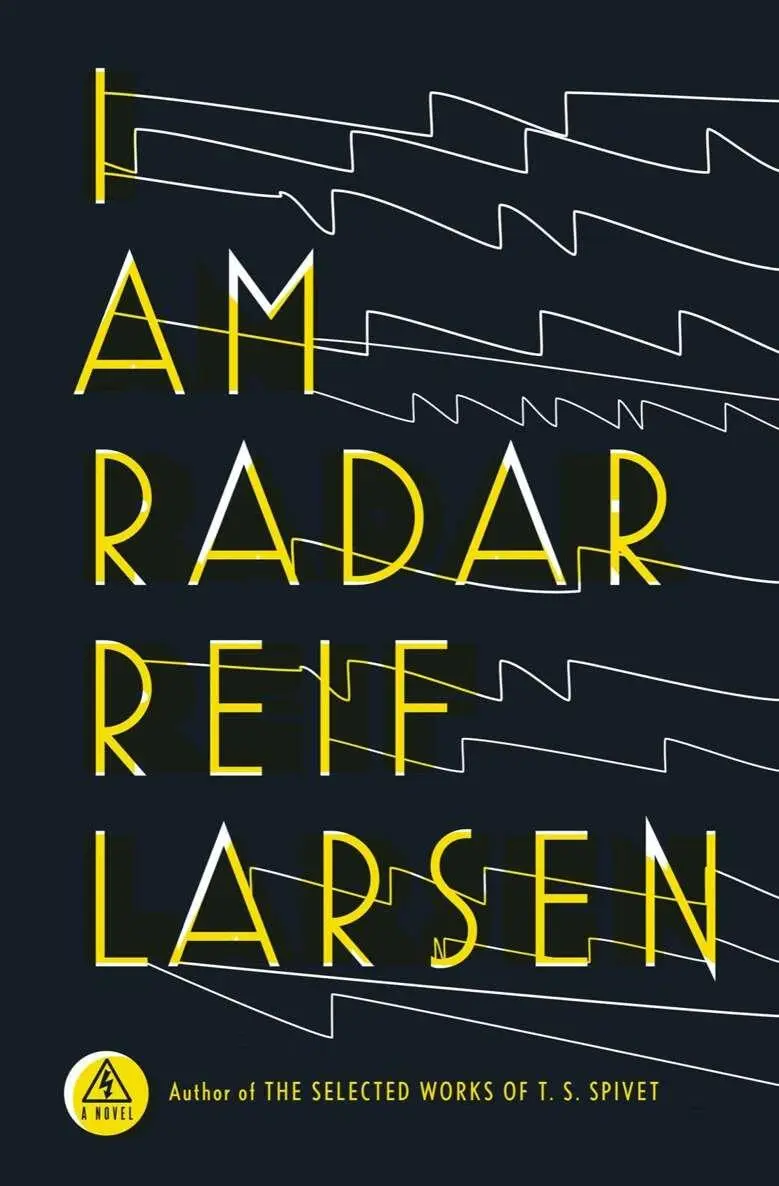
- Название:I Am Radar
- Автор:
- Издательство:Penguin Press
- Жанр:
- Год:2015
- ISBN:нет данных
- Рейтинг книги:3 / 5. Голосов: 1
-
Избранное:Добавить в избранное
- Отзывы:
-
Ваша оценка:
I Am Radar: краткое содержание, описание и аннотация
Предлагаем к чтению аннотацию, описание, краткое содержание или предисловие (зависит от того, что написал сам автор книги «I Am Radar»). Если вы не нашли необходимую информацию о книге — напишите в комментариях, мы постараемся отыскать её.
I Am Radar Deep in arctic Norway, a cadre of Norwegian schoolteachers is imprisoned during the Second World War. Founding a radical secret society that will hover on the margins of recorded history for decades to come, these schoolteachers steal radioactive material from a hidden Nazi nuclear reactor and use it to stage a surreal art performance on a frozen coastline. This strange society appears again in the aftermath of Cambodia’s murderous Khmer Rouge regime, when another secret performance takes place but goes horrifically wrong. Echoes of this disaster can be heard during the Yugoslavian wars, when an avant-garde puppeteer finds himself trapped inside Belgrade while his brother serves in the genocidal militia that attacks Srebrenica. Decades later, in the war-torn Congo, a disfigured literature professor assembles the largest library in the world even as the country around him collapses. All of these stories are linked by Radar — now a gifted radio operator living in the New Jersey Meadowlands — who struggles with love, a set of hapless parents,and a terrible medical affliction that he has only just begun to comprehend.
I Am Radar — читать онлайн бесплатно полную книгу (весь текст) целиком
Ниже представлен текст книги, разбитый по страницам. Система сохранения места последней прочитанной страницы, позволяет с удобством читать онлайн бесплатно книгу «I Am Radar», без необходимости каждый раз заново искать на чём Вы остановились. Поставьте закладку, и сможете в любой момент перейти на страницу, на которой закончили чтение.
Интервал:
Закладка:
“What did you think?” Jean-Baptiste asked after Raksmey had devoured Saul Bellow’s new novel, Henderson the Rain King, in a day.
“Boring,” Raksmey said with a shrug. “Too much talking.”
“Human discourse is important. It cannot all be chasing lions and such.”
“Can I go out and play?”
“Complete your experiments first,” said Jean-Baptiste, shaking his head. “You can make a lion out of words, you know. More powerful than any beast in the jungle.”
“Yes, Papa,” said Raksmey.
The years passed, marked only by the notches in the trees and the cyclical monsoons that broke the heat for three months every year. Eugenia’s vision began to fade and Jean-Baptiste fell and broke his ankle, which slowed him considerably. He and Renoit would limp around the plantation and bicker at each other. In other ways, time stood still at La Seule Vérité, as it always seemed to do. Tofte-Jebsen puts it rather elegantly: “If you stared at a river long enough, you started to believe that the water, and not the earth, was the one true thing” (160).
Much to Jean-Baptiste’s delight, Raksmey began to show a natural inclination for the sciences, moving through advanced textbooks with ease. Their science lessons were conducted in Jean-Baptiste’s basement laboratory, the same laboratory that had housed his many failed experiments. Raksmey, unlike his father — who was impatient and often allowed his mind to wander — was a born experimentalist. The two of them took up Jean-Baptiste’s old radiation research, dusting off the jars of radium, even building a linear particle accelerator that utilized new superconductive technologies Raksmey had discovered in a science journal. While his father had been interested primarily in documenting radiation’s destructive effects, Raksmey became fixated on the beneficial powers of the radiation beam in decreasing tumor size. His methods were much more disciplined than Jean-Baptiste’s — there was always a control, always a second and third retrial, even if the results were favorable. In short, he was not just curious — he was a scientist . After a while, Raksmey was making observations about radiation treatment that Jean-Baptiste had never come close to considering, tuning frequency, wavelength, and fractionation to the specific types of cancerous tissues. Jean-Baptiste noted each of Raksmey’s discoveries in his notebook, and next to one he could not help writing an overeager underline: Ça se passe .
Still, everything that Raksmey did, even if procedurally defined by great discipline, was also inflected by a sleepy indifference, a weary adherence to the rules, as if he were performing for an audience that had not shown up. He would go about his work with quick, precise movements, but there would be no joy on his face, no excitement at the possibility of discovery.
Jean-Baptiste also noticed that Raksmey had a habit of whispering to himself while he worked. Eventually he realized that Raksmey was actually communicating with Rasey, who had not been banished by the blossoming of Raksmey’s intellect, but instead had morphed into a subtle, constant presence, a benign sounding board of knowledge. Watching his son move with equal parts meticulosity and insouciance, Jean-Baptiste found himself oscillating between awe, frustration, and jealousy, as if Raksmey knew a secret that none of them were in on.
“Do you enjoy this?” he finally asked his son one day. Having donned lead smocks, they were exposing a rat’s splenic tumor to radiation from Raksmey’s linear accelerator while modulating the degree of fractionation by quarter steps.
“Enjoy what?” Raksmey asked, intent on aligning the beam.
“The lab? Our work? Science? ”
“What is it, Papa?” Raksmey looked up. “Have I done something wrong?”
“No. You haven’t done anything wrong . I just want to know your desire. What do you want to be?”
“I want to be like you.”
“No, you don’t. You have a much better chance than I do.”
“Chance for what?”
Jean-Baptiste sighed. “Maybe it’s time.”
“Time for what?”
“For you to go away.”
“Away?”
“To school.”
“Are you angry with me, Papa?”
“I fear I can no longer give you what you need.”
“Papa!”
Raksmey ran to his father and hugged him. Their embrace, weighed down by the clumsiness of their lead aprons, felt oddly disembodied. Later, Jean-Baptiste would comb through his notebooks and confirm what he had suspected in that moment: it was the first time he had ever hugged his son. He had no rational explanation for this, only that maintaining the necessary distance between the observer and the observed — the fact that he always carried notebook and pencil in hand so as to be ready to capture life’s spontaneities (like an embrace) in real time — had prevented him from actually embracing his son in real time. He did not note this absence in his notebook.
The rest of that day, Raksmey was unusually quiet, glumly stalking through the house. In the afternoon, Jean-Baptiste saw Tien and Raksmey paddling across the river to their island.
“What did you say to him?” Eugenia signed.
“That it might be time for him to go to school.”
“To school? But you were against sending him to the lycée!”
“Not just any school. To Saigon. To my school. They’ve changed the name to Collège René Descartes, but it’s still the same place.”
“Saigon?” she said aloud. “Is it safe?”
“Of course it’s safe. It’s Saigon.”
“The Americans have moved in.”
“The Americans will make it safe.”
“The French did not make it safe.”
“The French are fools. The Americans are much more practical.”
“You really think they are any different from us?”
Jean-Baptiste, caught in the quicksand of his thoughts, did not respond.
At dinner that night, Raksmey broke his silence.
“I’ll go,” he said. “I want to go.”
Eugenia let her soup spoon clatter into her saucer. She flipped her hands on the edge of the table, palms down, a gesture that could’ve meant “stay,” or “death,” or nothing at all.
“It’s for the best, I think,” said Jean-Baptiste, nodding. “You’ve outgrown us. Sooner than I thought. They have resources that we don’t have here.”
Raksmey was staring at his grandmother, who was staring at her hands.
“Will I make friends?” he asked.
“Of course you’ll make friends,” said Jean-Baptiste. “Everyone makes friends someday.”
“But what if they don’t like me?”
“The only reason they wouldn’t like you is if they’re jealous of you.”
Eugenia abruptly got up from the table and left the room.
“Did I say something?” said Raksmey.
“She’ll miss you. She doesn’t have much in her life, and when you leave she’ll be alone again.”
“You’ll be here.”
“It’s true. Sometimes I forget about me.”
Raksmey was quiet. Then he said: “Tien said the world is a big and small place.”
“Did he?”
“He said as soon as you think you’ve seen everything, you realize there’s much more to see and you’ll never see it all. And as soon as you think you’ll never see anything, you realize everything’s the same,” he paused. “Is that true?”
“Tien can be a wise man when he wants to be,” said Jean-Baptiste.
“But he said he’s never left here. So how does he know all of this?”
6
There were no openings at Collège René Descartes.
“But in the tropics,” writes Tofte-Jebsen, “no never means no” (173). Given Jean-Baptiste’s unique legacy as one of the school’s best pupils, and given his generous offer to fund a new library, the rector was able to make an exception and set aside a place for Raksmey Raksmey de Broglie. (The last name had been added on the forms to gently remind the administration of his heritage.)
Читать дальшеИнтервал:
Закладка:
Похожие книги на «I Am Radar»
Представляем Вашему вниманию похожие книги на «I Am Radar» списком для выбора. Мы отобрали схожую по названию и смыслу литературу в надежде предоставить читателям больше вариантов отыскать новые, интересные, ещё непрочитанные произведения.









Обсуждение, отзывы о книге «I Am Radar» и просто собственные мнения читателей. Оставьте ваши комментарии, напишите, что Вы думаете о произведении, его смысле или главных героях. Укажите что конкретно понравилось, а что нет, и почему Вы так считаете.