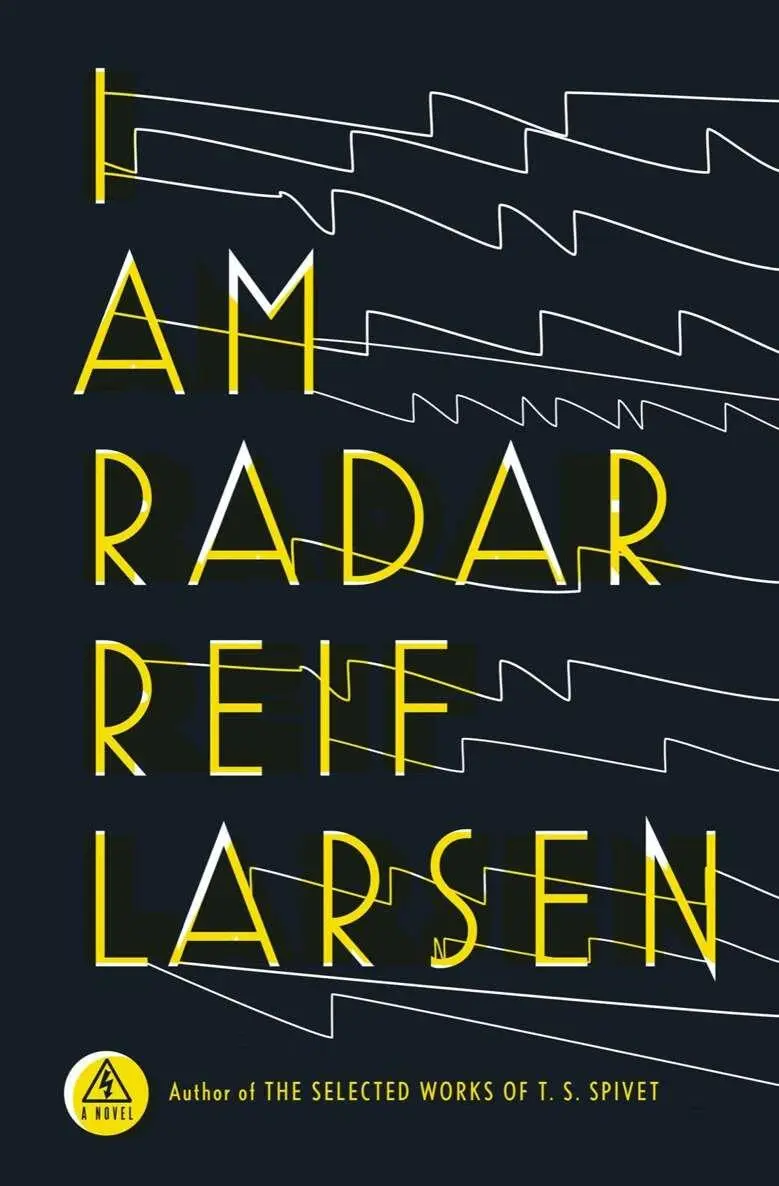
Reif Larsen - I Am Radar
Здесь есть возможность читать онлайн «Reif Larsen - I Am Radar» весь текст электронной книги совершенно бесплатно (целиком полную версию без сокращений). В некоторых случаях можно слушать аудио, скачать через торрент в формате fb2 и присутствует краткое содержание. Год выпуска: 2015, Издательство: Penguin Press, Жанр: Современная проза, на английском языке. Описание произведения, (предисловие) а так же отзывы посетителей доступны на портале библиотеки ЛибКат.
- Название:I Am Radar
- Автор:
- Издательство:Penguin Press
- Жанр:
- Год:2015
- ISBN:нет данных
- Рейтинг книги:3 / 5. Голосов: 1
-
Избранное:Добавить в избранное
- Отзывы:
-
Ваша оценка:
I Am Radar: краткое содержание, описание и аннотация
Предлагаем к чтению аннотацию, описание, краткое содержание или предисловие (зависит от того, что написал сам автор книги «I Am Radar»). Если вы не нашли необходимую информацию о книге — напишите в комментариях, мы постараемся отыскать её.
I Am Radar Deep in arctic Norway, a cadre of Norwegian schoolteachers is imprisoned during the Second World War. Founding a radical secret society that will hover on the margins of recorded history for decades to come, these schoolteachers steal radioactive material from a hidden Nazi nuclear reactor and use it to stage a surreal art performance on a frozen coastline. This strange society appears again in the aftermath of Cambodia’s murderous Khmer Rouge regime, when another secret performance takes place but goes horrifically wrong. Echoes of this disaster can be heard during the Yugoslavian wars, when an avant-garde puppeteer finds himself trapped inside Belgrade while his brother serves in the genocidal militia that attacks Srebrenica. Decades later, in the war-torn Congo, a disfigured literature professor assembles the largest library in the world even as the country around him collapses. All of these stories are linked by Radar — now a gifted radio operator living in the New Jersey Meadowlands — who struggles with love, a set of hapless parents,and a terrible medical affliction that he has only just begun to comprehend.
I Am Radar — читать онлайн бесплатно полную книгу (весь текст) целиком
Ниже представлен текст книги, разбитый по страницам. Система сохранения места последней прочитанной страницы, позволяет с удобством читать онлайн бесплатно книгу «I Am Radar», без необходимости каждый раз заново искать на чём Вы остановились. Поставьте закладку, и сможете в любой момент перейти на страницу, на которой закончили чтение.
Интервал:
Закладка:
“He’s a child! Not an experiment!”
“All children are experiments, whether they like it or not. Most are just very sloppy experiments.”
“You’re a selfish man, Jean-Baptiste!” she signed. “When did you become so egotistic? You were not like this as a boy.”
But the experiment continued. There could be no stopping the experiment. At 3.2 years, Jean-Baptiste noted, Raksmey had developed an imaginary companion, Rasey. Initially Jean-Baptiste thought of informing his son of the nonexistent nature of Rasey, but Eugenia pleaded with him not to. “He doesn’t have anyone else; at least let him have this.”
“But it’s no one! He doesn’t exist!”
“He exists for your son. Who are we to argue? To him, Rasey might be more real than we are.”
And so, real or not, Rasey became part of the household. They even laid out a place at the dinner table for him, making sure never to serve him any vegetables, for apparently Rasey was allergic and could die if he accidentally ate even one. Like Eugenia, Rasey was also deaf; he did not speak, but he could (conveniently) read minds. As they learned from Raksmey, Rasey had a habit of getting into trouble — he would often get lost in the jungle, fight tigers, hop on the backs of eagles, and dive with sharks in the ocean. It was difficult to tell Rasey not to do these things, because he would pretend he couldn’t hear you (which he couldn’t).
“It’s very frustrating,” Raksmey told them. “He’s like a child.”
“Isn’t he a child?” Eugenia asked.
“No,” said Raksmey. “Rasey is forty-seven years old.”
Jean-Baptiste reluctantly recorded Rasey’s many adventures, recounted in exquisite detail by Raksmey, who had realized long ago how to take advantage of having a resident scribe registering his every move. Jean-Baptiste did not like including such fictions, but he came to accept them as psychological data rather than simply fantasies. It was a slippery distinction: everything was data, yet not everything could go into the notebooks.
On one occasion, Raksmey came into his father’s study and pointed to one of the first medical mannequins.
“Who is that?” he asked.
“Well, I suppose. . I suppose that is me,” said Jean-Baptiste. Indeed, there was a distinct resemblance.
“And what are those, Papa?” Raksmey asked, pointing to the shelves of notebooks. There were now hundreds of them, stretching from floor to ceiling, an intimidating fortress of black spines.
“Those are you,” said Jean-Baptiste.
Raksmey seemed content with the answer. “There are many more of me than you, yes?”
When he was not busy with his studies, Raksmey would roam the property, often following Tien around like an obedient dog, watching carefully as he tapped the trees and collected the sap. Tien showed him how to apply just enough pressure to the curved blade with the pad of his thumb to slice through the bark into the soft layer of phloem that lay beneath. A streak of white fluid would appear in the wound and run down the spiral groove.
“The tree must bleed, but not bleed too much,” Tien said, and Raksmey would nod.
Tien even made Raksmey his own little bucket so that he could take part in the collection. Despite his heavy load of latex, Tien always found a way to hold the boy’s hand wherever they went. Jean-Baptiste noted this bond with a touch of envy. Their connection was easy, gentle, unspoken — everything that he and Raksmey were not. Sometimes Jean-Baptiste saw them resting their heads together, talking softly in Khmer.
“What were you two speaking about?” he asked Raksmey once.
“Nothing so important,” said Raksmey. “Tien was telling me stories about the beginning of the world.”
“You know those stories aren’t true.”
“Yes,” Raksmey nodded. “But I didn’t want to make Tien sad.”
When it was too hot to do anything else, he would lie on his back in the river as the women chattered and washed their clothes. There was an old rope swing tied to an ancient bombax tree that allowed him to swoop out and release into the deeper part of the river. He would expunge all breath from his lungs and let himself sink and sink until his face came to rest on the bottom, and sometimes he would even let a bit of mud come in between his lips. A part of him wanted to live down here forever, to never go back up to the world of his father’s constant observation.
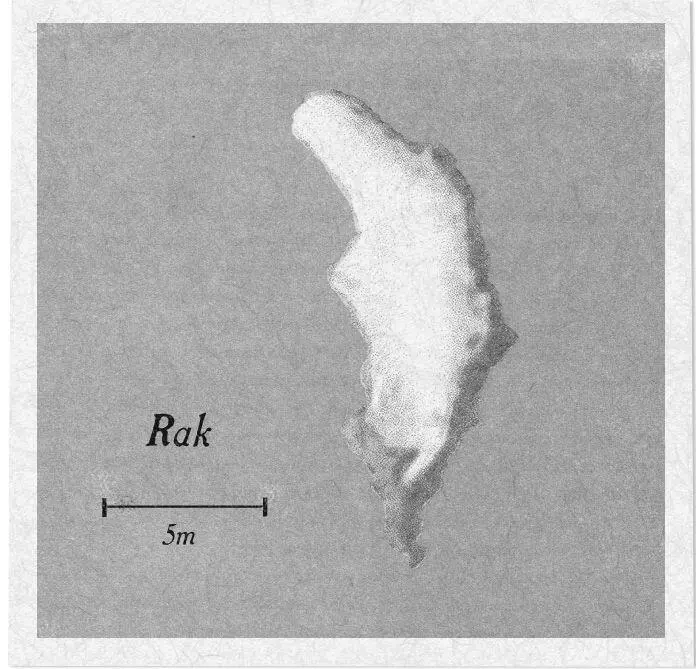
Fig. 4.7. “The Island of Rak”
From Tofte-Jebsen, B., Jeg er Raksmey, p. 153
When Tien was in a good mood, he would take Raksmey across the widest part of the river on a bamboo raft to a thin little island that Raksmey had dubbed Rak — the one place on earth where he could make all the rules. The trouble with making rules was that you then had to follow them. On one of his first visits to the island, Raksmey had decided that only Rak could be spoken on the island of Rak. Rak was a language consisting of just one word— Rak —which stood for everything. At first, this limited their conversations.
“Rak,” said Raksmey.
“Rak,” Tien agreed.
But after a while, a certain freedom and understanding came from such limitations. There was no need for any other word.
“Rak,” said Raksmey.
“Rak,” Tien agreed.
A river carp that Raksmey had named Rak could usually be found lazing in the shallows of this island, pecking at the insects that skittered across the surface of the water. Raksmey sometimes wondered if it was the same fish that he saw each time or whether there were many Raks inhabiting this role. He wondered if this mattered.
When he was not out on the river, Raksmey particularly enjoyed climbing the bony lattice of a strangler fig that had engulfed an old rosewood tree in the lower gardens. Thirty feet off the ground, he would call down to them, “Ha-ha! You can’t get me!”
“We can get you,” Jean-Baptiste said to him from below. “But we’re choosing not to at this very moment.”
“Rak!” Raksmey yelled.
“What did you say?” Jean-Baptiste called.
“I think you may have a little athlete on your hands,” said Renoit, coming up from behind him.
“No,” said Jean-Baptiste, shielding his eyes from the sun. He made a notation in his book. “We do not have a little athlete.”
“He climbs like a monkey.”
“Bodies wither. Intellect persists.”
“All I know is you can’t keep a good man down. If he wants to be a climber, he’ll find a way to be a climber.”
“You’ve no idea what you’re talking about,” said Jean-Baptiste. “Be careful up there, Raksmey!”
“Rasey says he won’t come down,” Raksmey yelled from above. “I must observe him and make sure he doesn’t fall.”
“Rasey does not need to be observed! Come down right now,” Jean-Baptiste called up.
“Or maybe a wrestler?” said Renoit. “The little man would be a son of a bitch to bring down in a match—”
“Claude!” Jean-Baptiste turned upon him. “Don’t joke about this. This isn’t a kind of game. This is my son.”
Renoit held up his hands. “I’m envious of such possibility. To think: a lifetime of mobility. How quickly it fades when that which is dear is stolen from us.” He slapped at his wounded leg. “La liberté est un fugace don.”
Despite Raksmey’s inclination to spend his days in the trees, Jean-Baptiste’s rigorous methods of education had created a brilliant mind. Or rather allowed an already brilliant mind to blossom. By the time he was seven, Raksmey was reading well beyond his age. He, like his father, was a swift reader, who could take in books just as quickly as they were put before him. And yet he appeared indifferent to their contents.
Читать дальшеИнтервал:
Закладка:
Похожие книги на «I Am Radar»
Представляем Вашему вниманию похожие книги на «I Am Radar» списком для выбора. Мы отобрали схожую по названию и смыслу литературу в надежде предоставить читателям больше вариантов отыскать новые, интересные, ещё непрочитанные произведения.











Обсуждение, отзывы о книге «I Am Radar» и просто собственные мнения читателей. Оставьте ваши комментарии, напишите, что Вы думаете о произведении, его смысле или главных героях. Укажите что конкретно понравилось, а что нет, и почему Вы так считаете.