Reif Larsen - I Am Radar
Здесь есть возможность читать онлайн «Reif Larsen - I Am Radar» весь текст электронной книги совершенно бесплатно (целиком полную версию без сокращений). В некоторых случаях можно слушать аудио, скачать через торрент в формате fb2 и присутствует краткое содержание. Год выпуска: 2015, Издательство: Penguin Press, Жанр: Современная проза, на английском языке. Описание произведения, (предисловие) а так же отзывы посетителей доступны на портале библиотеки ЛибКат.
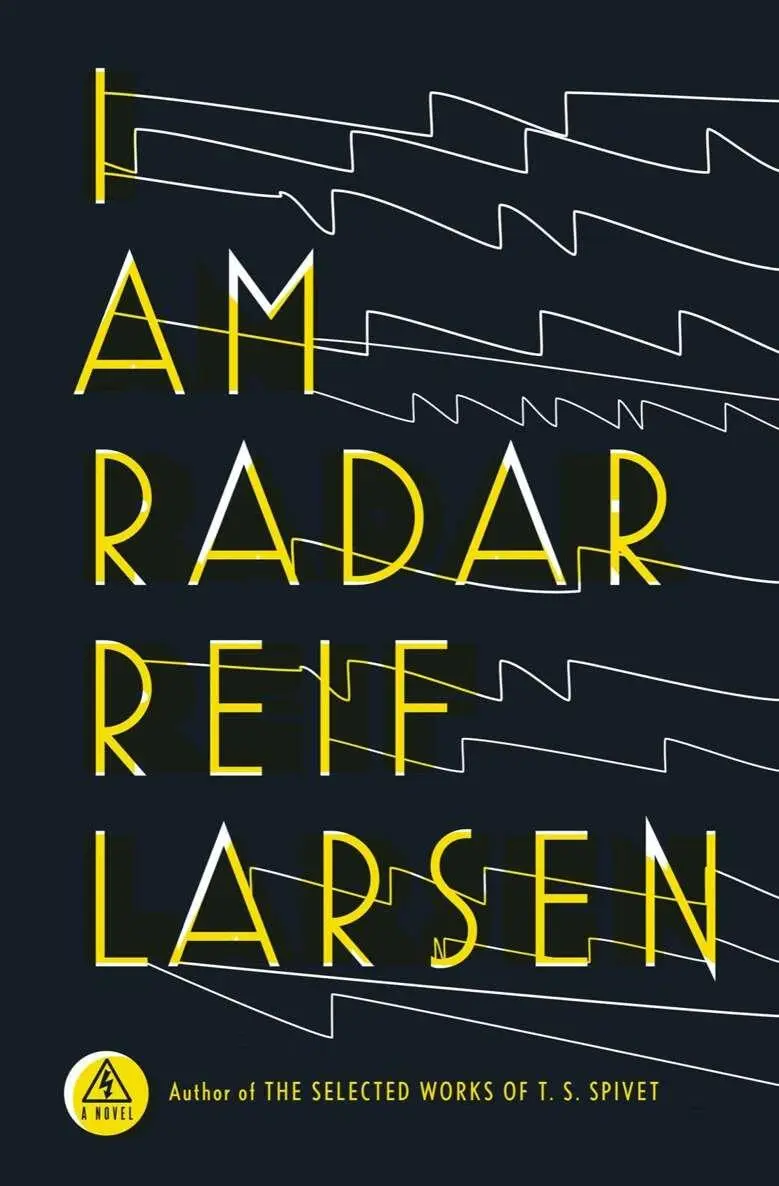
- Название:I Am Radar
- Автор:
- Издательство:Penguin Press
- Жанр:
- Год:2015
- ISBN:нет данных
- Рейтинг книги:3 / 5. Голосов: 1
-
Избранное:Добавить в избранное
- Отзывы:
-
Ваша оценка:
I Am Radar: краткое содержание, описание и аннотация
Предлагаем к чтению аннотацию, описание, краткое содержание или предисловие (зависит от того, что написал сам автор книги «I Am Radar»). Если вы не нашли необходимую информацию о книге — напишите в комментариях, мы постараемся отыскать её.
I Am Radar Deep in arctic Norway, a cadre of Norwegian schoolteachers is imprisoned during the Second World War. Founding a radical secret society that will hover on the margins of recorded history for decades to come, these schoolteachers steal radioactive material from a hidden Nazi nuclear reactor and use it to stage a surreal art performance on a frozen coastline. This strange society appears again in the aftermath of Cambodia’s murderous Khmer Rouge regime, when another secret performance takes place but goes horrifically wrong. Echoes of this disaster can be heard during the Yugoslavian wars, when an avant-garde puppeteer finds himself trapped inside Belgrade while his brother serves in the genocidal militia that attacks Srebrenica. Decades later, in the war-torn Congo, a disfigured literature professor assembles the largest library in the world even as the country around him collapses. All of these stories are linked by Radar — now a gifted radio operator living in the New Jersey Meadowlands — who struggles with love, a set of hapless parents,and a terrible medical affliction that he has only just begun to comprehend.
I Am Radar — читать онлайн бесплатно полную книгу (весь текст) целиком
Ниже представлен текст книги, разбитый по страницам. Система сохранения места последней прочитанной страницы, позволяет с удобством читать онлайн бесплатно книгу «I Am Radar», без необходимости каждый раз заново искать на чём Вы остановились. Поставьте закладку, и сможете в любой момент перейти на страницу, на которой закончили чтение.
Интервал:
Закладка:
— RR’s hair is almost jet black, natural counterclockwise swirl, splotch of lighter hair on the back/left side of his head, about 4 cm down from crown. present since birth.
— food preference (at 1 year) rice w/ pork, bananas, and jackfruit. will refuse water spinach, bok choy, and most greens. (I don’t blame him.)
— a mole. nape of the neck, recent. possibly where the needle went in?
— always sneezes in twos, half-second interval between. never three, like me.
— birthmark on left ankle, just above the talus bone, in the shape of a longtail boat w/ square sail. simple. beautiful. 
— RR can wink his left eye, but not his right, seems to happen more frequently when tired.
— his first word is not a word: a salute, as in “hello” in sign language, which he performs when E. walks into room. she returns the sign, cups hand to face, then rocks, “my lovely son.” he giggles. for him, gestures are words, words are gestures. (131)
At two years, Jean-Baptiste took his son’s measurements with a tailor’s tape:
1. Length: 78cm tall.
2. Weight: 10.3kg.
3. Left pinkie: 2.75cm.
4. Right pinkie: 2.7cm.
5. Penis: 2.1cm.
6. Circumference of head: 53cm.
This last measurement Jean-Baptiste found particularly interesting, for it was slightly above average, which was quite incredible, considering the diminutive size of the boy’s body.
“It’s a good thing. We must put the entire universe inside of it,” Jean-Baptiste said to his mother. “Lemaître says it’s expanding.”
“His head or the universe?” Eugenia signed.
“The mind is the last frontier, Mother.”
“How about we leave his head alone?” she signed. In her language, the sign for head, a sweeping of the pointer finger around the face that ended at the temple, was very similar to the sign for dream, except that the circle moved away from the head, ending with the fingers pointing toward the heavens. Her gesture fell somewhere between the two, an ambiguity that Jean-Baptiste did not ask her to resolve.
“I cannot stop,” he signed. “This is like asking a man to stop breathing.”
Raksmey became trilingual and bimodal: Jean-Baptiste instructed Suong and Tien to address Raksmey in Khmer, while he spoke in French and occasionally English to the child, and Eugenia communicated with him exclusively through sign. By 2.5 years, Raksmey already had a working vocabulary of four hundred fifty words in French, one hundred words in English, at least three hundred signs, and sixty words in Khmer, though this was only an estimate, given that Suong and Tien were less than exact with their observational notes and exit interviews. Raksmey put what he knew to good use: he was already utilizing sophisticated, multi-morphemic constructions (“Tien go to work, he cut the tree when it cold”). Jean-Baptiste noticed that Raksmey had developed a subtle stutter when speaking in French, such that when he would stumble on a word, he would often introduce Eugenia’s sign language to talk around it.
Throughout Raksmey’s fourth year, Jean-Baptiste began to engage him in a series of science experiments usually done only in primary and secondary schools — measuring the point of vaporization, testing Hooke’s law with springs, mapping electrical fields using a voltmeter. In the half hour before lunch, they would go out into the forest and Jean-Baptiste would drill Raksmey on various species of plants in the garden. Together they would do drawings of leaf structure and take rubbings from the bark. Raksmey was left-handed, though Jean-Baptiste purposefully trained him to use both hands during his writing and experiments. He continuously used advanced-level vocabulary around the child and noticed a 15 percent retention and reuse of new terms within a week of their introduction. Soon Raksmey began acquiring vocabulary at an exponential rate, beginning with five to ten words per week and quickly advancing to twenty to twenty-five words per week by year’s end.
Eugenia, at first disapproving of Jean-Baptiste’s neurotic methods, eventually acquiesced. “Thus, they settled into their de facto roles,” writes Tofte-Jebsen. “He became the instructor of the mind, while she became the silent nurturer of the heart” (140).
“You can’t hear sounds?” Raksmey asked her once. It was a watershed, duly recorded in Jean-Baptiste’s notebook. Evidence of a theory of mind: he understood his grandmother as a being unto herself, one who operated under a different set of rules.
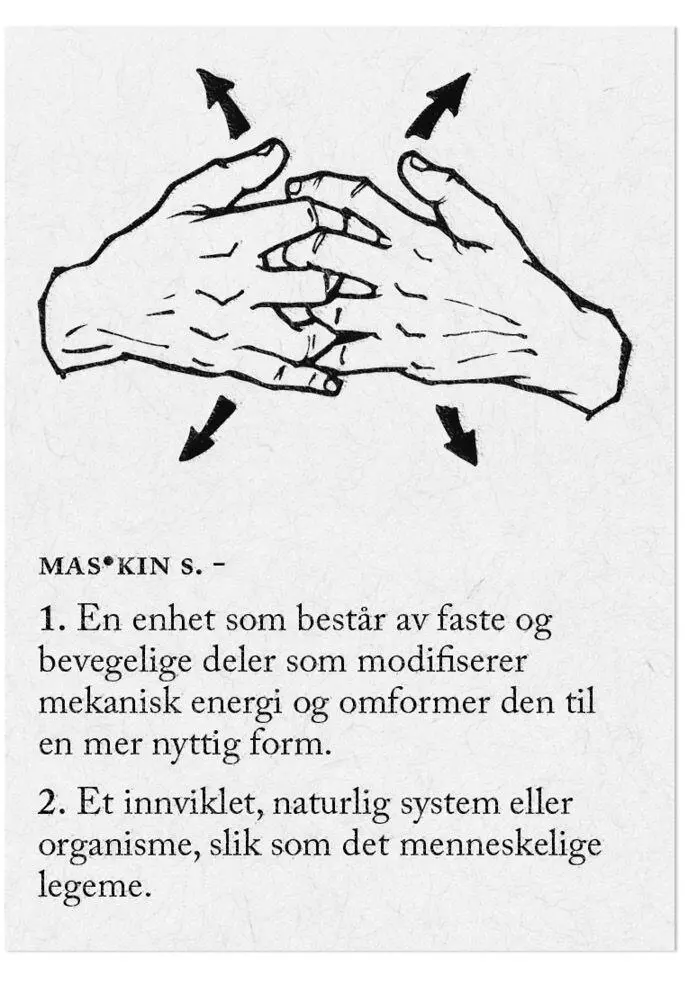
Fig. 4.6. “Sign for Machine”
From Tofte-Jebsen, B., Jeg er Raksmey, p. 149
“No,” she signed. “That’s why I have you.” Thereafter, she and Raksmey played a game in which she asked him, “What do you hear now?” and he would tell her, in sign and spoken words and also movement, like a little play.
“There are machines in the rubber house,” he said, signing the word for machine —interlocked fingers, palms turned to the chest. “They sound like. .” And then he danced up and down with his arms in the air and shook his head back and forth, blubbering air out through his lips.
“Thank you,” she signed, laughing. “I understand now.”
When he was not working with his father or explaining the world of sound to his grandmother, he spent much of his time alone. He had trouble relating to children his own age, and most were not sure how to approach him. He looked like them, but he was clearly not one of them.
One day Raksmey came home crying.
“What is it?” said Jean-Baptiste. “Are you injured?”
“He’s not injured,” Eugenia signed. She got down on one knee. “What did they say?”
Raksmey wiped his eyes. “Prak called me barang .”
“That’s ridiculous,” Jean-Baptiste said as he noted this in his book. “Do you know what this means?”
Raksmey shook his head.
“It’s a butchering of the word français . It’s spoken by people who have no idea what they’re talking about. Barang means anything which is not them. Are you a Frenchman?”
“I don’t know.”
“Of course you aren’t. You’re as Khmer as they are.”
“But he called me that.”
“You must learn not to hear them,” Eugenia signed.
“No,” said Jean-Baptiste. “You must learn why you are right and they are wrong.”
Later that evening, Eugenia brought up the idea of sending him to the regional lycée, which had shut down during the war but had recently been reopened by a pair of American missionaries.
“It might be good for him to be around more children. We don’t want him to grow strange.”
“You don’t understand the project at hand,” Jean-Baptiste signed. “Raksmey’s not going to be just another boy sitting on a mat, repeating his times tables to some Bible-thumping American from Texas. He’s destined to become the most famous person Cambodia has ever produced.”
“He’ll certainly be the most famous person you have ever produced,” she signed, fingers slapping palms.
“I can see your sarcasm, thank you. But we cannot trust his future to a middling lycée in the middle of nowhere. We must control as much of the input as possible. These are the critical years.”
“You’re mad, Jean-Baptiste!” she signed. “You cannot control him like this! Why must you try to control everything?”
“I’m not trying to control everything. Only one thing. And if I can’t determine the outcome. . well, then this is almost as interesting as if I can.”
Читать дальшеИнтервал:
Закладка:
Похожие книги на «I Am Radar»
Представляем Вашему вниманию похожие книги на «I Am Radar» списком для выбора. Мы отобрали схожую по названию и смыслу литературу в надежде предоставить читателям больше вариантов отыскать новые, интересные, ещё непрочитанные произведения.











Обсуждение, отзывы о книге «I Am Radar» и просто собственные мнения читателей. Оставьте ваши комментарии, напишите, что Вы думаете о произведении, его смысле или главных героях. Укажите что конкретно понравилось, а что нет, и почему Вы так считаете.