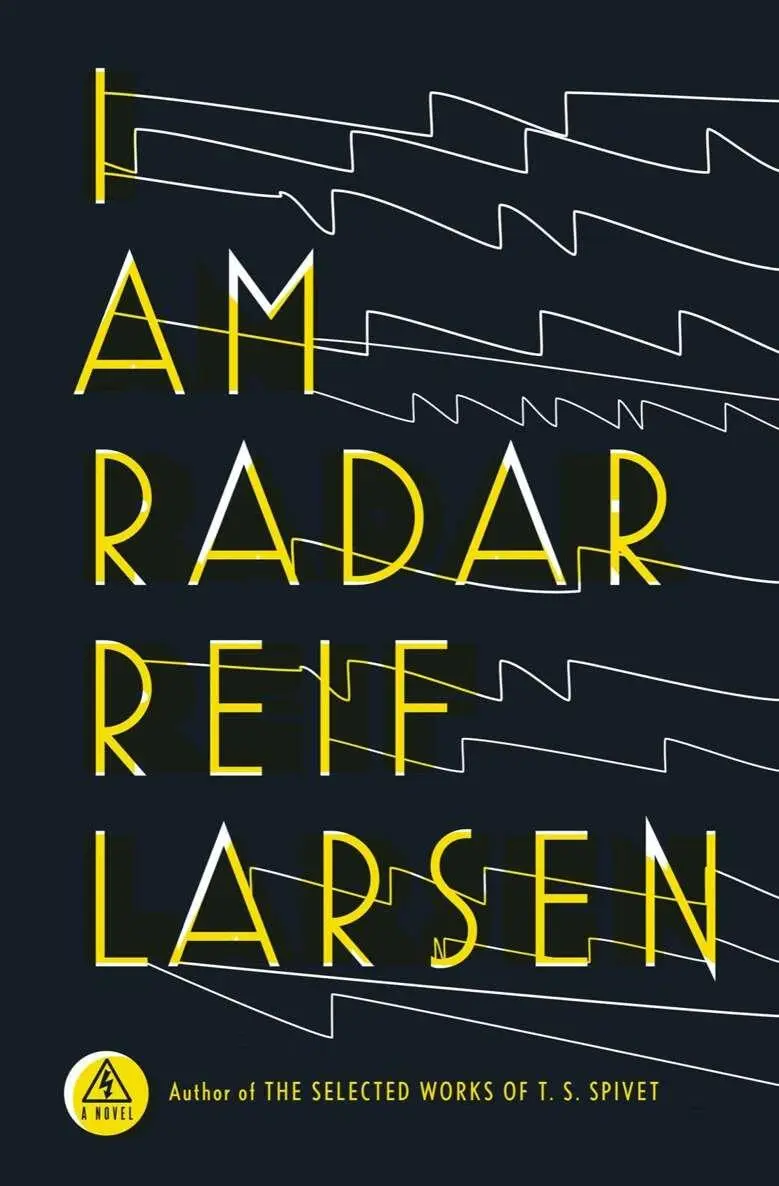
Reif Larsen - I Am Radar
Здесь есть возможность читать онлайн «Reif Larsen - I Am Radar» весь текст электронной книги совершенно бесплатно (целиком полную версию без сокращений). В некоторых случаях можно слушать аудио, скачать через торрент в формате fb2 и присутствует краткое содержание. Год выпуска: 2015, Издательство: Penguin Press, Жанр: Современная проза, на английском языке. Описание произведения, (предисловие) а так же отзывы посетителей доступны на портале библиотеки ЛибКат.
- Название:I Am Radar
- Автор:
- Издательство:Penguin Press
- Жанр:
- Год:2015
- ISBN:нет данных
- Рейтинг книги:3 / 5. Голосов: 1
-
Избранное:Добавить в избранное
- Отзывы:
-
Ваша оценка:
I Am Radar: краткое содержание, описание и аннотация
Предлагаем к чтению аннотацию, описание, краткое содержание или предисловие (зависит от того, что написал сам автор книги «I Am Radar»). Если вы не нашли необходимую информацию о книге — напишите в комментариях, мы постараемся отыскать её.
I Am Radar Deep in arctic Norway, a cadre of Norwegian schoolteachers is imprisoned during the Second World War. Founding a radical secret society that will hover on the margins of recorded history for decades to come, these schoolteachers steal radioactive material from a hidden Nazi nuclear reactor and use it to stage a surreal art performance on a frozen coastline. This strange society appears again in the aftermath of Cambodia’s murderous Khmer Rouge regime, when another secret performance takes place but goes horrifically wrong. Echoes of this disaster can be heard during the Yugoslavian wars, when an avant-garde puppeteer finds himself trapped inside Belgrade while his brother serves in the genocidal militia that attacks Srebrenica. Decades later, in the war-torn Congo, a disfigured literature professor assembles the largest library in the world even as the country around him collapses. All of these stories are linked by Radar — now a gifted radio operator living in the New Jersey Meadowlands — who struggles with love, a set of hapless parents,and a terrible medical affliction that he has only just begun to comprehend.
I Am Radar — читать онлайн бесплатно полную книгу (весь текст) целиком
Ниже представлен текст книги, разбитый по страницам. Система сохранения места последней прочитанной страницы, позволяет с удобством читать онлайн бесплатно книгу «I Am Radar», без необходимости каждый раз заново искать на чём Вы остановились. Поставьте закладку, и сможете в любой момент перейти на страницу, на которой закончили чтение.
Интервал:
Закладка:
The bend in the river persisted. The news whispered up the Mekong was never good, but the remoteness of their location, a result of Henri’s reckless imagination, now insulated them from all conflicts. King Sihanouk was busy negotiating Cambodia’s independence from France and had largely managed to avoid becoming embroiled in the war between the Communist and colonial forces by using a shifting veil of neutrality that had left Phnom Penh’s French population in limbo. There had been whispers of insurgencies — one plantation upstream in Phumi Hang Savat was razed, its owners stabbed and disemboweled, their kidneys reportedly eaten raw by members of the guerrilla army Khmer Issarak.11 This story, told often and in graphic detail, did much to hasten the shuttering of homes along the river as families retreated to the relative safety of Saigon, where they would dream often of the land they had abandoned in the heart of the colony. Once considered too docile to pose any real problems to remote colonial rule, the Cambodians, now led by their young and crafty king, were embracing a new age of self-government. Abroad, potent seeds of malcontent were also being sown: a nascent Khmer Communist movement incubated in Paris, where a handful of Khmer students — including the soft-spoken Saloth Sar, who would later assume the nom de guerre Pol Pot — were beginning to debate how best to graft Marxism onto the slippery landscape of their homeland.
Yet even in this volatile climate of the early 1950s, as the Cold War giants began to take sides in Southeast Asia, as Sihanouk navigated a perilous transition to monarchical rule, as the floods came and went, when everything and nothing seemed possible, Jean-Baptiste did not budge. Occasionally they could hear the rumble of guns in the far distance, and once an Issarak rebel group moved through the plantation in the night and stole some chickens, but in general, the violence did not pierce the sheltered confines of their universe. It was as if that idle bend in the river provided them with an invisible, protective force field.
Still, Jean-Baptiste was not blind to the danger that lurked all around them, and at his mother’s prompting, he broke the silence of the severed telegraph by buying a wireless radio transceiver that he could use to contact Phnom Penh in an emergency, though if they were to be attacked, it was clear no radio would ever save them.
When Raouf the Algerian caretaker left to fight for his homeland in North Africa, Jean-Baptiste brought in Capitaine Claude Renoit to manage the business — or what remained of it. Capitaine Renoit was a war veteran with a bum leg. He meant well but lacked any sense of urgency when it came to the whole enterprise of rubber, and this suited Jean-Baptiste just fine. Operations became haphazard, shipments irregular. Tien and the men still bled the trees and loaded the stacks of latex onto barges, but it was all done out of tradition and not necessity. The center was no longer holding. Maybe the center had never held.
Eugenia, whose health had begun to decline but whose energy had not, spent her days painting the same Paphiopedilum appletonianum orchid plant. She had set up her easel and paints in the old telegraph room, and though Jean-Baptiste thought it ridiculous that she would squeeze herself into the smallest room in the house when they had so much space at their disposal, Eugenia claimed the tightness of the quarters gave her an urgency that she translated onto the canvas. She was prolific in her output: some days she would produce three or four paintings of the flower, all wildly different, all exactly the same. The paintings began accumulating in the warehouse, next to the racks of latex — shelves and shelves of the same blossom, repeated in every imaginable color, its two sagittal petals outstretched in greeting or malice, depending upon the canvas. When he gave a tour of the plantation to the rare visitor, Jean-Baptiste liked to joke to their guests that they were in the business of modern art making, merely amusing themselves now and then with some light rubber production. This was not far from the truth. More than one visitor left with a surreal orchid rendition tucked beneath his arm — whether out of guilt, appreciation, or morbid fascination, it was never clear.
• • •
“I’LL NEED A VAT of rubber,” Jean-Baptiste informed the Capitaine one day. “About seventy-five liters.”
“Seventy-five? That will take a couple of days. . weeks, maybe.”
“Is this not a rubber plantation? Are we not supposed to have rubber in bountiful supply?”
“Well, yes. .” Renoit seemed embarrassed. “We’ll see what we can scare up. May I ask what you will be using it for?”
“To make a rubber mold.”
“Of what?”
“Of myself,” said Jean-Baptiste. “I’m making a dummy. For medical purposes.”
The first rubber mannequins to emerge were white, grotesque beings with elephantine arms and strange leaks spilling from their hips. The clay that Jean-Baptiste was using for a cast could not hold the heated rubber; it seeped and bubbled and broke free from its confines. After this failure, he sent away for a bronzed mold of himself to be made in a navy foundry in Saigon. A month later, he received the molding, along with a note:
Très joli corps. Je l’épouserais volontiers. X
The bronze worked magnificently. He finally managed to find the right mixture of rubber and solution to give the mannequin a lifelike texture. When he made his first fully formed being, it was as if he had given birth. Jean-Baptiste painted the body white, then filled in the details of the face, taking care to get the coloring of the lips just right. For some reason, the lips suggested life more than any other aspect. Once the being had life, he went about giving it death: he painted on the telltale burns and lesions resulting from radiation poisoning. He wrote up a key for the mannequin, explaining each manner of wound, each degree of burn in relation to the amount of radiation exposure. He made four of them, each more convincing than the last, and then sent these radioactive dummies to four of the major French hospitals in the colonies.
“In the event you should have a case of acute radiation syndrome,” he wrote. “These models will instruct you on the symptoms of exposure. They are my gift to your institution.”
He did not have to wait long for a reply. The hospitals wrote back quickly, thanking him for his dummies, effusive about their usefulness. In fact, all four — plus the teaching hospital in Saigon — requested more mannequins, but would he mind not decorating them with any symptoms? The hospitals wanted them for more general purposes, and plain white dummies would suffice.
Jean-Baptiste had found a new calling. The dying plantation briefly came to life again as the source of the region’s rubber medical mannequins. A small force of the workers, including Tien, were trained in casting the mannequins and painting on a face that vaguely resembled a sleepy Jean-Baptiste. Every month, the piles of bone-white bodies were loaded onto a boat that floated down the Mekong with its curious cargo, inspiring strange legends in the villages of a white sorcerer turning men into dolls — particularly after one boat capsized and the dummies were found floating in the river for weeks afterwards. The mannequin trade proved fleeting, however, for soon the hospitals claimed they had enough, that in fact they had too many; they had dummies coming out of the closets, and they were getting in the way of the live patients. Please, they wrote, would he cease and desist his shipments, for the safety of everyone involved? Reluctantly, Jean-Baptiste put the production plans on hold and La Seule Vérité slipped back into its eddy.
Sometimes, in the early evening, before the night grew too thick, Renoit, Eugenia, and Jean-Baptiste would congregate wordlessly in the living room and play a few records on the phonograph. After a few minutes it was always necessary for someone to get up (usually Eugenia, oddly, since she was the only one who could not hear the music) and fan the revolving vinyl so that the record would not warp and melt in the heat. After a while, even she stopped attending to the apparatus, and eventually the records began to melt, one by one, the music evaporating into a nighttime chorus of crickets.
Читать дальшеИнтервал:
Закладка:
Похожие книги на «I Am Radar»
Представляем Вашему вниманию похожие книги на «I Am Radar» списком для выбора. Мы отобрали схожую по названию и смыслу литературу в надежде предоставить читателям больше вариантов отыскать новые, интересные, ещё непрочитанные произведения.












Обсуждение, отзывы о книге «I Am Radar» и просто собственные мнения читателей. Оставьте ваши комментарии, напишите, что Вы думаете о произведении, его смысле или главных героях. Укажите что конкретно понравилось, а что нет, и почему Вы так считаете.