Alberto Moravia - Two Friends
Здесь есть возможность читать онлайн «Alberto Moravia - Two Friends» весь текст электронной книги совершенно бесплатно (целиком полную версию без сокращений). В некоторых случаях можно слушать аудио, скачать через торрент в формате fb2 и присутствует краткое содержание. Год выпуска: 2011, Издательство: Other Press, Жанр: Современная проза, на английском языке. Описание произведения, (предисловие) а так же отзывы посетителей доступны на портале библиотеки ЛибКат.
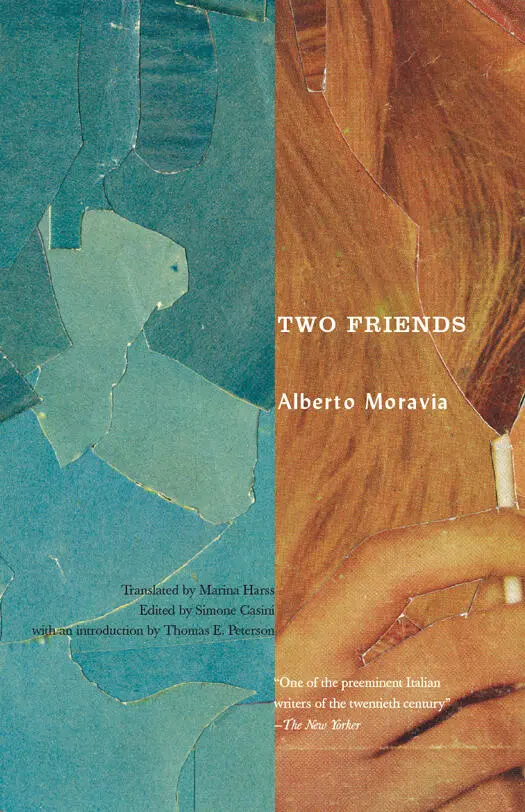
- Название:Two Friends
- Автор:
- Издательство:Other Press
- Жанр:
- Год:2011
- ISBN:нет данных
- Рейтинг книги:3 / 5. Голосов: 1
-
Избранное:Добавить в избранное
- Отзывы:
-
Ваша оценка:
Two Friends: краткое содержание, описание и аннотация
Предлагаем к чтению аннотацию, описание, краткое содержание или предисловие (зависит от того, что написал сам автор книги «Two Friends»). Если вы не нашли необходимую информацию о книге — напишите в комментариях, мы постараемся отыскать её.
Anyone interested in literature will relish the opportunity to watch Moravia at work, tinkering with his story and working at it from three unique perspectives.
Two Friends — читать онлайн бесплатно полную книгу (весь текст) целиком
Ниже представлен текст книги, разбитый по страницам. Система сохранения места последней прочитанной страницы, позволяет с удобством читать онлайн бесплатно книгу «Two Friends», без необходимости каждый раз заново искать на чём Вы остановились. Поставьте закладку, и сможете в любой момент перейти на страницу, на которой закончили чтение.
Интервал:
Закладка:
For a long time, Maurizio drove in silence. They had
141
taken the tree-lined road out of Olevano, shaded by leafy, old plane trees, and now they were descending quickly toward the valley. The town loomed higher and higher above them, with its houses perched on the rocks, their stone sides indistinguishable from the smoky gray hillside, punctuated here and there by bushes of capers and broom. As soon as they were on the open road, Maurizio sped up. The speedometer rose to fifty, then to sixty miles per hour. Sergio did not speak; he was still trying to understand the catastrophe that had befallen him back at Moroni’s provincial manor. Finally, Maurizio asked, “What are you thinking about?”
Sergio struggled to speak. “I was thinking that I should have stayed in Olevano … Why did we leave in such a rush?”
Maurizio answered slowly: “We left because we had no business there … Lalla will marry Moroni, and he’ll love her, just as she said. We were superfluous.”
“I should have insisted,” Sergio said, in a desperate tone; “maybe I could have persuaded her.”
“Yes, but then you would have returned to Rome and life would have gone back to the way it was, and you would have started to hate and despise her once again. She would have left you in any case.”
He was silent for a moment, then added: “It’s better this way … A woman cannot go on forever in a situation like yours … At a certain point the cord breaks … I think it happened at just the right time.”
“But you never loved her,” Sergio said angrily. “I did, and I still do.”
“Nonsense … You never loved her either … You only loved yourself … or rather, you loved the Party, which was just an extension of yourself.”
“That’s not true.”
“Yes it is … You became a Communist because you weren’t strong enough to live on your own merits … And then once you became a Communist, you
142
became disenchanted, because you realized that your weaknesses had not changed. So you tried to prove to yourself that Communism is the most important thing, your raison d’être. You had only one way to prove this to yourself … by sacrificing Lalla on the altar of your political credo. And that’s what you did. Why are you complaining?”
Sergio wanted to say that he was complaining because he felt an acute, powerful, unbearably bitter pain, where just a few hours earlier he had felt security and a conviction of his dominion over Lalla. And that his pain had taken the shape of an unfillable, gaping hole, as if the spot in his heart which until now had been filled by Lalla had suddenly suffered a terrible spasm, revealing its emptiness. But he knew he could not confide in Maurizio. They were not friends. In fact, as Maurizio had said earlier, they were enemies, and there was nothing he could do about it. As if guessing his thoughts, Maurizio added: “You would be less disappointed, or perhaps not at all, if you had a new convert to the cause sitting next to you rather than a complete enemy of your ideas … Isn’t that right?”
Sergio rebelled against Maurizio’s insightful comments. But he knew that his friend was right. He objected: “Even if it were true, I would still love Lalla and be hurt by the idea of losing her … I would still lament my loss.”
“Perhaps, but not the way Moroni laments the death of his wife … If one loves a woman, one must love her as he does … One must love her above all else … What do you think? Lalla left you because she knew that you did not love her more than the Party, and because she knows that Moroni will love her more than anything … Women cannot accept becoming secondary, second fiddle.”
Sergio angrily retorted: “Well, at least you’re satisfied … You think you’ve won the match … You forced me to act dishonorably, you made me lose Lalla, and now you’re feeling triumphant, isn’t that right?”
“Not at all … I’m just as defeated as you are, don’t
143
you see? The victory consisted not in defeating one another but in being loved by Lalla … She is humanity in its rawest state, the masses, the weak, vulnerable flesh that both of us sought to conquer … But we employed arguments that were interesting only to us … Meanwhile, we completely forgot the one true argument: love, affection, respect, passion … It is Moroni’s only argument, and that’s why he won.”
“What does all of this mean?”
“It means,” Maurizio said, once again displaying his pleasant, dreary logic, “that our arguments are interesting only to us, as Communists or anti-Communists … but women — in other words, the people — want to live in peace and to be loved for who they are, to fuck and to be fucked. It means that we are predestined by history to be the cuckolds of humanity … She betrayed us because we did not love her for who she is, without ulterior motives.”
“How clever you are,” Sergio said, sarcastically.
“I’m not philosophizing … I’m just observing reality … I think that when these wars of religion that currently divide the world finally come to an end, someone else will come along and reap the spoils, as the saying goes … People want to be loved for themselves … When they feel used, they only pretend to believe what we say, and then they run off with the first person who really loves them.”
“Do you think Lalla will be happier with Moroni than she would with me or you?”
“Of course … Moroni has a very precise, very neat little story, and Lalla fits into it perfectly: he did not love his wife as he should have, Lalla resembles her, he will love her as he was not able to love his wife … Meanwhile, you were dreaming about the Party, and I had my own cold-blooded business to think of.”
“Such as?”
“Myself, my own precious self … I had myself, and you had your Party … But for Moroni, there is only Lalla.”
He said these words in a calm, definite tone, as the car went faster and faster. The car […]
Version C
[I]
As soon as the war ended, two important events
226
happened in my life. The first was that I joined the Communist Party. I suppose that every man acts for reasons that are both selfish and disinterested. My disinterested reasons for joining the Party — from now on I’ll call it “the Party,” which is how we refer to it — were not very different from those of countless others who took the same step at that moment, whether farmers, factory workers, or people of means. It seems pointless to discuss these reasons, because the story I want to tell is a very personal one, one that will allow me to reveal who I am to the world and to myself. Disinterested reasons, as such, reveal little or nothing about the self. Quite to the contrary, they are the patrimony of all men. Suffice it to say that I joined the Party in good faith, with the requisite sentimental enthusiasm and knowledge of doctrine. As to my selfish reasons, they were many, and now that I examine them, I see that they all lead back to Maurizio and my friendship with him. But let us proceed in an orderly manner; the subject is rich and, in its way, full of surprises. I must proceed carefully, in order of relevance, if I hope to unravel it. So I will go back to the beginning. One of the many things that Maurizio accused me of, in his condescending, sarcastic way, was being an intellectual. He would say: “Intellectuals like you,” or “You’re a typical intellectual,” or even “Oh, you’re nothing but an intellectual.” Maurizio’s attitude was not the only thing that made me hate the word. Like the word “bourgeois” and so many others, its meaning has deteriorated over time, taking on negative connotations that it did not once have. Today it is almost an insult to call someone an intellectual, and there is no one who, hearing himself referred to in this way, does not feel the impulse to protest. But what bothered me the most was to hear Maurizio utter this word. I felt an unjustifiable attraction toward Maurizio and held him, also unjustifiably, in high esteem and wanted to be his friend. I realized that, despite his maliciousness, he was right: I was, without a doubt, what is normally referred to as an intellectual. In other words, I was an educated person
Читать дальшеИнтервал:
Закладка:
Похожие книги на «Two Friends»
Представляем Вашему вниманию похожие книги на «Two Friends» списком для выбора. Мы отобрали схожую по названию и смыслу литературу в надежде предоставить читателям больше вариантов отыскать новые, интересные, ещё непрочитанные произведения.






Обсуждение, отзывы о книге «Two Friends» и просто собственные мнения читателей. Оставьте ваши комментарии, напишите, что Вы думаете о произведении, его смысле или главных героях. Укажите что конкретно понравилось, а что нет, и почему Вы так считаете.