Alberto Moravia - Two Friends
Здесь есть возможность читать онлайн «Alberto Moravia - Two Friends» весь текст электронной книги совершенно бесплатно (целиком полную версию без сокращений). В некоторых случаях можно слушать аудио, скачать через торрент в формате fb2 и присутствует краткое содержание. Год выпуска: 2011, Издательство: Other Press, Жанр: Современная проза, на английском языке. Описание произведения, (предисловие) а так же отзывы посетителей доступны на портале библиотеки ЛибКат.
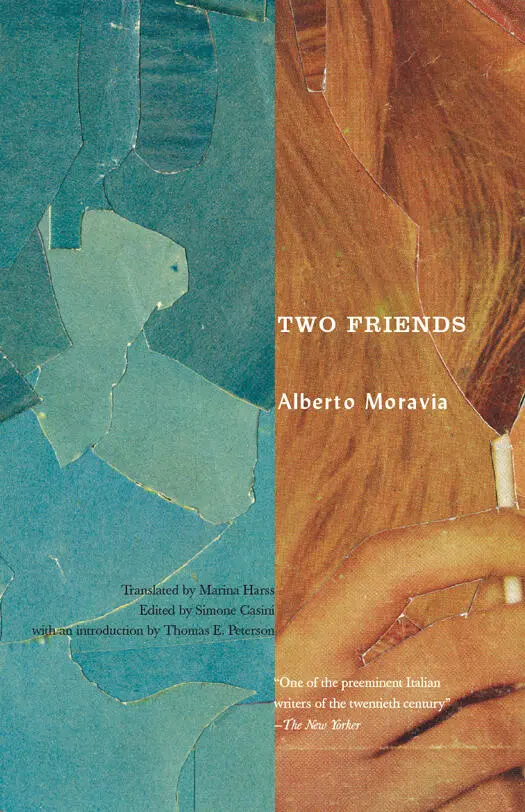
- Название:Two Friends
- Автор:
- Издательство:Other Press
- Жанр:
- Год:2011
- ISBN:нет данных
- Рейтинг книги:3 / 5. Голосов: 1
-
Избранное:Добавить в избранное
- Отзывы:
-
Ваша оценка:
Two Friends: краткое содержание, описание и аннотация
Предлагаем к чтению аннотацию, описание, краткое содержание или предисловие (зависит от того, что написал сам автор книги «Two Friends»). Если вы не нашли необходимую информацию о книге — напишите в комментариях, мы постараемся отыскать её.
Anyone interested in literature will relish the opportunity to watch Moravia at work, tinkering with his story and working at it from three unique perspectives.
Two Friends — читать онлайн бесплатно полную книгу (весь текст) целиком
Ниже представлен текст книги, разбитый по страницам. Система сохранения места последней прочитанной страницы, позволяет с удобством читать онлайн бесплатно книгу «Two Friends», без необходимости каждый раз заново искать на чём Вы остановились. Поставьте закладку, и сможете в любой момент перейти на страницу, на которой закончили чтение.
Интервал:
Закладка:
“Yes,” she admitted, frankly, “because you are ruining our love with your resentment and complications. Why don’t you just relax, Sergio, why don’t you just love me, simply, as Moroni would love a new wife if he had one?” She began to cry and held Sergio’s hand, bringing it to her lips and kissing it repeatedly.
Sergio did not withdraw his hand. “But I do love you.”
“Maybe you do,” she answered, “but you don’t show it. You treat me horribly. That day you were drunk, you made a proposal that I don’t even want to repeat. I haven’t answered you, as you might have noticed … and I’ve been trying to forget it. But you should never have made it, if you love me.”
“What proposal?” Sergio asked, surprised. He did
129
not remember being drunk, and did not understand what she was referring to.
“You said I should become Maurizio’s lover … so that he would join the Communist Party.”
Sergio knew he was blushing. He was annoyed with himself. He said, drily: “I wasn’t drunk … and that proposal was serious. I’m still waiting for your answer.”
“I refuse to answer,” she said, still crying, “and you are a better person than you pretend to be. I truly hope that we will love each other and that our relations will improve. After all, it was all just a question of money. I was unhappy about being so poorly dressed and you were irritated by my complaining. But now you’re making money and you’ve shown your love by giving me money from your advance. My love, if you really love me, why does it displease you so much to show it?”
At first, he did not respond. Then all of a sudden, and almost despite himself, the words poured out: “It was all a lie … It’s not true that I’m writing a screenplay … It’s not true that I’m still expecting a second payment … Do you know who gave me that money?”
She stared at him, her eyes wide open, as if she couldn’t see him: “What do you mean, it’s not true?” She pulled her hand away and touched her own face.
He hesitated, and Lalla said: “Whoever it is, why are you telling me?”
“Because I don’t feel like lying. The truth,” he began, sitting up and looking over at her, “is that Maurizio gave me that money … I went to him to ask for a small loan of twenty-thousand Lire so I could buy you a dress … and he offered me two hundred thousand, saying that it was shameful for a beautiful woman like you to go around so poorly dressed. And I accepted … but I don’t want to brag, he’s the one who gave me the money and suggested the story about the screenplay. You owe your new clothes to him. I don’t make any money and I’m still the same miserable soul I’ve always been.”
Lalla sat motionless, watching him. She seemed almost happy at the revelation: “So Maurizio made up the story about the screenplay …”
“Yes.”
“But why? Wasn’t it simpler to just tell the truth?”
130
“He didn’t want you to know.”
“He loves me too,” she said, in a reflective tone, looking at Sergio. “If he didn’t, he wouldn’t have been so circumspect.” She caressed her dress: “So I owe all of this to Maurizio.”
Sergio remembered what she had said earlier: “I’m a whore … If someone gives me presents and treats me well, I can’t help loving him.” And suddenly he became furious; he was overwhelmed by a wave of contempt and a powerful desire to hurt her. He shouted: “Yes, you owe it all to him! So now you will love him, you can’t help it! You said it yourself, you can’t help loving a man who gives you presents … Go ahead and love him, you whore …” He leaned over and grabbed Lalla’s arm, slapping her several times. He kept repeating “whore,” and striking her again and again. Lalla tried to protect herself, but at the same time she seemed to offer her face for him to slap. After two more blows, she turned away on the pillow. Sergio began to pace up and down.
Lalla continued to cry. Then she got up and stood in front of the mirror on the dresser. Sergio was surprised to see that she did not come to him and try to gain his forgiveness for a crime she had not committed. “The other day,” she began, slowly, “you asked me to do something and I chose to try to forget and never bring up the subject again. But after the way you’ve treated me … I’ve decided that I’m going to go to Maurizio’s room and do as you ask … Afterward, you can make a deal with Maurizio, he can join the Party, or not … but if I go, I won’t come back … Maurizio gave me these clothes, he loves me, he’ll treat me well. Why should I stay with you?” As she said this firmly, she walked toward Maurizio’s door.
Sergio watched her with a bitter feeling of impotence and jealous rage. He wanted to stop her, to tell her that it wasn’t true, that he loved her and did not want her to give herself to Maurizio. But he found that he could not utter a single word. Perhaps Lalla
131
expected, or even hoped, that he would call her back.
So it seemed to him from the lassitude with which she walked toward the door. Sergio swallowed hard but remained silent. Lalla slowly opened the door, and Sergio could hear Maurizio’s surprised voice asking, “Who is it?” The door closed behind her.
Sergio waited a few moments, almost hoping that she would return. Now that Lalla had done what he had asked, he felt an anguish very much like jealousy. It was an acute, impatient anxiety that came in waves, like the edge of a saw against a tree trunk, or a pendulum: for a moment it would become overpowering, then less intense — a kind of torpor, but still painful. Then another pang, like a loud noise ringing out in the silence, or a wisp of fog lifting to reveal a forest; the pain would rise again, and then die down. He realized that perhaps for the first time in his life, and certainly for the first time with Lalla, he was jealous; until then he had considered her a kind of object, contemptible and without value. He was surprised at his emotions, so unlike the pattern of his relations with her. He could not admit to himself that his jealousy was quite natural, almost humiliatingly so. What disturbed him most was the idea of the sexual act, the notion that the most intimate, hidden part of Lalla’s body was now at Maurizio’s disposal, revealed for his pleasure. Like all betrayed husbands and lovers, the furor of his jealousy was focused upon the sexual act, upon the cavity that Lalla would offer up to Maurizio’s sex. This coarse, objective, barbaric fetishism was unpleasant to him, but he could do nothing to control it: the act, the sexual coupling, tormented him. He was like other men: farmers, workmen, the simplest of people. As he lost himself in these reflections and images, he strained to hear what was happening in the next room. As yet, he had heard no sighs, no creaking springs, nor any other sound that might accompany lovemaking. Almost involuntarily, he got up and pulled a revolver from one of the pockets
132
of his overcoat, where he had put it that morning. Like a sleepwalker, he opened the door to Maurizio’s room.
He expected to see them naked on the bed in an embrace. Instead, the room was bathed in a white, tranquil light that streamed in through the window, which was filled with the white afternoon sky. Maurizio sat in his shirtsleeves, completely dressed, on the bed next to the dresser, smoking. He barely raised his eyes toward Sergio as he entered the room. “What’s wrong?” he asked, calmly.
“Lalla’s not here,” Sergio muttered.
“No, clearly, she’s not,” Maurizio answered, simply. “Unless she’s hiding in one of the closets … You may look if you like.” His tone was sarcastic; it was clear from his expression that he knew what had happened between Sergio and Lalla.
Читать дальшеИнтервал:
Закладка:
Похожие книги на «Two Friends»
Представляем Вашему вниманию похожие книги на «Two Friends» списком для выбора. Мы отобрали схожую по названию и смыслу литературу в надежде предоставить читателям больше вариантов отыскать новые, интересные, ещё непрочитанные произведения.





Обсуждение, отзывы о книге «Two Friends» и просто собственные мнения читателей. Оставьте ваши комментарии, напишите, что Вы думаете о произведении, его смысле или главных героях. Укажите что конкретно понравилось, а что нет, и почему Вы так считаете.