Alberto Moravia - Two Friends
Здесь есть возможность читать онлайн «Alberto Moravia - Two Friends» весь текст электронной книги совершенно бесплатно (целиком полную версию без сокращений). В некоторых случаях можно слушать аудио, скачать через торрент в формате fb2 и присутствует краткое содержание. Год выпуска: 2011, Издательство: Other Press, Жанр: Современная проза, на английском языке. Описание произведения, (предисловие) а так же отзывы посетителей доступны на портале библиотеки ЛибКат.
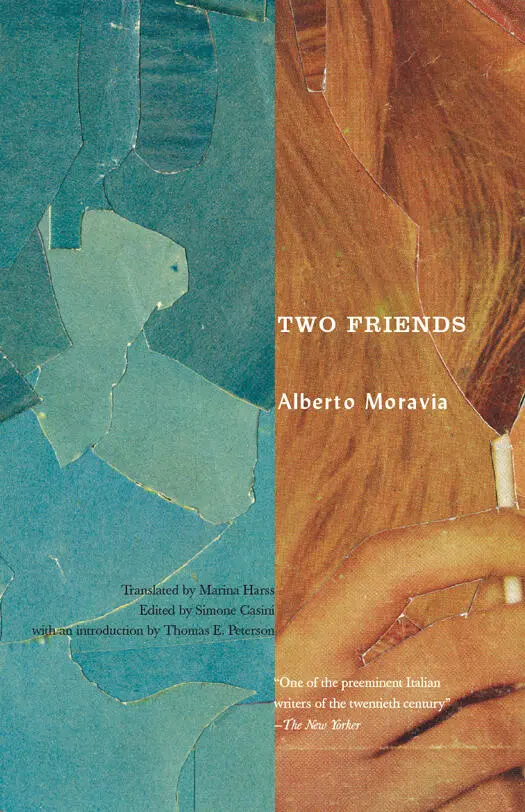
- Название:Two Friends
- Автор:
- Издательство:Other Press
- Жанр:
- Год:2011
- ISBN:нет данных
- Рейтинг книги:3 / 5. Голосов: 1
-
Избранное:Добавить в избранное
- Отзывы:
-
Ваша оценка:
Two Friends: краткое содержание, описание и аннотация
Предлагаем к чтению аннотацию, описание, краткое содержание или предисловие (зависит от того, что написал сам автор книги «Two Friends»). Если вы не нашли необходимую информацию о книге — напишите в комментариях, мы постараемся отыскать её.
Anyone interested in literature will relish the opportunity to watch Moravia at work, tinkering with his story and working at it from three unique perspectives.
Two Friends — читать онлайн бесплатно полную книгу (весь текст) целиком
Ниже представлен текст книги, разбитый по страницам. Система сохранения места последней прочитанной страницы, позволяет с удобством читать онлайн бесплатно книгу «Two Friends», без необходимости каждый раз заново искать на чём Вы остановились. Поставьте закладку, и сможете в любой момент перейти на страницу, на которой закончили чтение.
Интервал:
Закладка:
The topic was so intimate that there was nothing to do but wait for Moroni to go on. After eating a piece of meat, he continued: “For you to understand, I would have to explain many things …”
Lalla said affectionately, “Go ahead, why not?”
The other two also insisted, assuring him that they would not be bored. Moroni was convinced. He drank some more wine and continued: “To explain what I feel, I must say first of all that I still love my wife and that I now realize that I was always in the wrong. But in order to understand this, I must tell you about myself.”
“Go ahead,” Lalla said.
125
Moroni hesitated, then proceeded: “I was born right here in Olevano. My family was large, we were three boys and two girls. We own land and several houses in town. We’re not rich, but well off. No need to describe what my family is like, what would be the point. Let’s just say, they’re typical of their social class and background. As insensitive and unsympathetic as they come.”
He spoke with vehemence. After a short silence, he continued: “My grandfather was a farmer and worked hard to be able to stop laboring in the fields. My father was not wealthy, but he earned his fortune through hard work. They’re farmers. Behind my life of comfort lie centuries of working the land. We all know what such families are like: mean, hard-hearted, stingy, selfish, insensitive, ignorant … You get the idea.”
“That’s not always true,” Maurizio said. “I have known farming families who did not have these defects.”
“Perhaps,” Moroni said quickly, “but my family had all of them and I was no exception. I was mean, hard-hearted, selfish, ignorant … and I continued to be this way for as long as I lived with my family … In other words until the day I got married.”
“What was your wife like?” Lalla asked.
“She was the daughter of a government employee from Rome … well-educated, with a diploma in music. She was studying to be a pianist … Then she gave up music, and for the last few years she stopped playing altogether. But there’s no point in my talking about my wife,” he exclaimed, his voice strained.
“Why?” Sergio asked, surprised.
“Because she’s dead, and telling you what she was like explains nothing … Any woman would have been unhappy with me, that’s the truth … no matter what her origins. Simply because she was a woman, that would have been enough. And it’s true, she was unhappy with me.”
Sergio asked, “But did she love you?”
126
“Yes, of course,” Moroni said, almost offended, “otherwise she wouldn’t have married me … In my coldhearted way, I sometimes accused her of marrying me for my money. But it wasn’t true, and I knew it.”
“Was she poor?” Sergio insisted.
“Very poor,” Moroni said. He was quiet for a moment, and then continued in his strangely afflicted, contrite tone: “When she was alive, I believed that I was in the right … Sometimes I even hated her because I thought she dragged me down … Then, as soon as she died, I realized that I had always been in the wrong, always, every moment of our life together … and I realized that by fighting against my mean-spiritedness, stinginess, and ignorance, she had changed me … I was no longer mean, ignorant, or stingy, or at least I had become less so … But by the time the transformation was complete, she had died, perhaps because she had depleted her strength in her effort to change me … and I was left alone. I realized too late how she needed to be loved. If only I had not been such a monster.”
There was an embarrassing silence. The private subject matter and Moroni’s sincere, emotional tone combined with his strange objectivity and humility had left everyone shamefaced. After a long pause, Lalla asked: “What would you have done if she hadn’t died?”
“But she did die,” Moroni said, bitterly, shaking his head.
“But what if by some miracle she could come back to life?”
Moroni stared at her. “I would treat her differently,” he said, very seriously; “I would shower her with the affection I now feel, too late. Love, passion … She would be the most beloved woman in the world.”
“Are you sure?”
“Yes.”
After another pause, Lalla added: “What a shame that she’s gone. She did not get to reap the benefits of her efforts.”
“It’s true.”
“So now you would truly love her, for the first time,”
127
Lalla insisted as if to convince herself of Moroni’s sincerity and seriousness.
“Yes, I would love her … No one has ever loved a woman as I would love her if she came back to me.”
There was a long silence. Finally Maurizio asked, cautiously: “Why have you told us these intimate things? We barely know each other.”
Moroni’s response was disconcerting in its sincerity: “I told you this story because of the young lady,” he said, looking at Lalla, “because she looks so much like my wife that when I’m with her I can’t help talking about her. Please forgive me … I’ve burdened you with my personal suffering. I’m a bad host.”
Lalla said in a gentle tone: “Not at all. To the contrary, it was very interesting … If we hadn’t talked about this, what would we have talked about? This and that, as they say.”
Lunch was finished. They went to the sitting room, which was decorated in a very similar style to the dining room. A sense of abandonment and widowhood seemed to emanate from the very slipcovers on the furniture. Moroni was contrite and slightly ashamed of what he had revealed at the table. He circled around his guests, showing an almost overwhelming attentiveness, offering coffee, liqueur, and cigarettes, and asking again and again if his guests needed anything. After finishing her coffee, Lalla said, “I think I’ll take a nap. Since we’re not leaving until tomorrow … I think I’d like to lie down for a moment.”
Sergio said that he too would like to lie down. Maurizio took a book from a small bookcase in the sitting room and said he would read. They did not have to ask twice. Attentive, ceremonious, and kind, and still contrite, Moroni led them up to the second floor. There were three rooms, one for Lalla in the middle, with a room on either side for each of the men. Moroni wished them a good rest and went off. Maurizio rushed into his room, book in hand. Lalla pretended to go into her room, and then slipped into Sergio’s through a door connecting the two rooms.
Sergio was lying on one of two large walnut beds.
128
The room was small and filled with large, heavy furniture. Lalla sat down next to him. Raising his head slightly, he saw that she seemed close to tears. After a moment, she took his hand awkwardly. “How do you feel?” she asked.
“Fine.”
“Are you angry with me?” she asked, surprised by his curtness.
“Not in the least.”
As if trying to start a conversation, she said: “I feel so sorry for Moroni … Imagine, after spurning his wife while she was alive, now that she’s gone, he loves her so much … It must be terrible … like what one feels after committing a terrible crime.”
“Yes,” Sergio said, indifferently, “it must be terrible.”
After a moment, she continued: “I’m sure that if he remarries, he will love his wife and be an ideal husband … I’m sure of it.”
“You’re probably right,” Sergio said. Then, after a moment: “He seems set on you … Why don’t you marry him?”
“You must be joking,” she said, adding in a tremulous voice: “Do you know what I was thinking as he spoke? That his experience could be a lesson for anyone … People should love each other when they are together, because afterward it’s too late.”
“You’re saying this for my benefit, of course.”
Читать дальшеИнтервал:
Закладка:
Похожие книги на «Two Friends»
Представляем Вашему вниманию похожие книги на «Two Friends» списком для выбора. Мы отобрали схожую по названию и смыслу литературу в надежде предоставить читателям больше вариантов отыскать новые, интересные, ещё непрочитанные произведения.



Обсуждение, отзывы о книге «Two Friends» и просто собственные мнения читателей. Оставьте ваши комментарии, напишите, что Вы думаете о произведении, его смысле или главных героях. Укажите что конкретно понравилось, а что нет, и почему Вы так считаете.