Alberto Moravia - Two Friends
Здесь есть возможность читать онлайн «Alberto Moravia - Two Friends» весь текст электронной книги совершенно бесплатно (целиком полную версию без сокращений). В некоторых случаях можно слушать аудио, скачать через торрент в формате fb2 и присутствует краткое содержание. Год выпуска: 2011, Издательство: Other Press, Жанр: Современная проза, на английском языке. Описание произведения, (предисловие) а так же отзывы посетителей доступны на портале библиотеки ЛибКат.
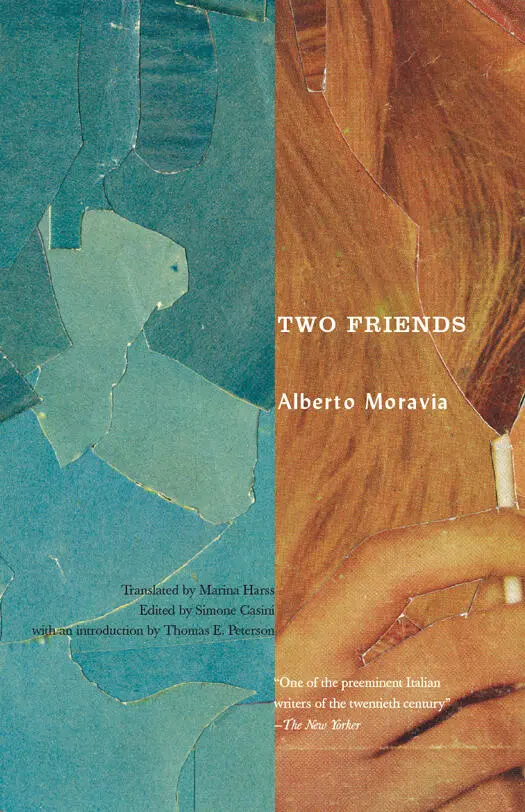
- Название:Two Friends
- Автор:
- Издательство:Other Press
- Жанр:
- Год:2011
- ISBN:нет данных
- Рейтинг книги:3 / 5. Голосов: 1
-
Избранное:Добавить в избранное
- Отзывы:
-
Ваша оценка:
Two Friends: краткое содержание, описание и аннотация
Предлагаем к чтению аннотацию, описание, краткое содержание или предисловие (зависит от того, что написал сам автор книги «Two Friends»). Если вы не нашли необходимую информацию о книге — напишите в комментариях, мы постараемся отыскать её.
Anyone interested in literature will relish the opportunity to watch Moravia at work, tinkering with his story and working at it from three unique perspectives.
Two Friends — читать онлайн бесплатно полную книгу (весь текст) целиком
Ниже представлен текст книги, разбитый по страницам. Система сохранения места последней прочитанной страницы, позволяет с удобством читать онлайн бесплатно книгу «Two Friends», без необходимости каждый раз заново искать на чём Вы остановились. Поставьте закладку, и сможете в любой момент перейти на страницу, на которой закончили чтение.
Интервал:
Закладка:
111
the maid answered, “I don’t know … Wait here a moment and I’ll bring the master of the house.”
She disappeared, and after a few minutes a man appeared; he looked to Sergio like a prosperous farmer or country merchant. “You must be Mr. Sergio,” he said, as soon as he saw him; “come in, come in, we’ve been waiting for you.”
He looked about forty years old, a short man with a large head and a prominent brow, and extremely regular features, almost like a sculpture. His face had a rustic, serious air. His large nose and wide mouth — which curved upward at the corners — seemed to belong on a larger, more vigorous frame. His tousled, messy hair revealed a pale bald spot, and he had a wide, yellowish, hard, and pensive forehead. He introduced himself—“Moroni”—and led Sergio into the other room, the source of the music and voices.
This room, which was rather small and almost empty of furniture except for a few chairs and a sofa in one corner, contained about twenty people. It was filled with smoke, and a record was playing; a few people danced. Sergio spotted Lalla in the arms of a young man with blond hair; he looked like an office worker, with thick glasses. As soon as she saw Sergio she walked up to him and exclaimed, “Sergio, you’re finally here,” embracing him emphatically. Sergio noticed that her breath smelled of alcohol. He took her in his arms and, pretending to dance, maneuvered her into the foyer. After releasing her arm, he asked: “What on earth are you doing here? Who is this Moroni, and who are the rest of these people?”
She laughed: “Moroni is an angel.”
“And you’re drunk,” Sergio said.
“Yes, I’m drunk,” she said, “and you know why? Because our life is depressing … because we’re a pair of sad cases … When I drink, I can forget about it.”
“Who is this Moroni?”
“He’s one of my students,” Lalla answered, slowly. “I’ve mentioned him to you before … one of my English students.”
It was true. He remembered Lalla’s mentioning a certain Moroni, but had forgotten the name. He looked at her: “You didn’t mention this little gathering.”
“I didn’t know about it. He called at the last minute … You were gone … so I came and then I called you.”
“I’m hungry,” Sergio said, firmly; “I haven’t eaten.”
112
“There’s food in the other room,” Lalla said, pointing to a small room off the foyer. As if there was nothing left to say, she turned around and returned to the sitting room.
Sergio went into the little dining room. Lalla was right: there was an abundance of food, and the room was empty. He picked up a plate, served himself some meat and vegetables, and sat down in a corner to eat. He began to feel contempt for Lalla, as if she had somehow become worthless in his eyes. He realized that this feeling was simply part of the preparation for what he was about to do: inform her of Maurizio’s proposition. He felt neither love nor affection for her, only a kind of impatience and incomprehension, as though her thoughts and complexities did not touch him in the least. What bothered him was her vacillating, exalted, inconsistent, irrational, and frivolous attitude toward life. She lived in a state of constant romanticism, based on nothing. In the end, he reflected, he would leave her, even without Maurizio’s intervention. As he sank into these cruel thoughts, Moroni entered the room.
“I see you’ve eaten … Would you like anything else?”
“I would like some wine,” Sergio answered abruptly, without looking up.
Moroni went to the table, poured a glass of wine, and offered it to Sergio. “So, you are Signora Abbiati’s boyfriend.”
Sergio was quietly surprised at the description, but did not comment: “Yes.”
“The young lady,” Moroni continued, with a warm respect in his voice, “tells me that you will be getting married soon.”
Sergio snapped to attention. Not only had he never asked Lalla to marry him, but it had never even occurred to him. And yet Lalla had mentioned marriage to this man who was her student. This proved that marriage was something she hoped for, that their situation made her uncomfortable, and that she would have liked to be his wife. He felt a sudden wave of compassion, mixed with irritation. “Yes, we should,” he answered vaguely.
“Well,” Moroni continued, emphatically, “I must say that it makes me happy to hear it … Miss Lalla is a lovely girl, sweet, genuine, and intelligent. She
113
will,” he added, “be a lovely bride.”
Sergio started at the word “bride,” with its old-fashioned, provincial air. Moroni continued: “I would like to be one of your witnesses. I’ve known Miss Lalla for over a year and I feel great affection for her … Please remember.”
As he said this, his voice quivered. Sergio looked up and answered as kindly as he could: “Thank you … As soon as we’ve set the date we’ll let you know, of course.”
Moroni seemed to be in the mood to trade confidences: “Do you know why I like her so much? I lost my wife, and Miss Lalla resembles her … I lost her when she was still young, more or less Miss Lalla’s age … The resemblance is quite strong … See for yourself.” He pulled out his wallet and removed a photograph, which he handed to Sergio. It was an old ID photo of Moroni’s late wife. The face — which was all one could see — looked as if it had been touched by death. One could barely make out the features. Sergio noted a slight resemblance, especially in the irregularity of the face, the large forehead, small nose, and wide mouth. But little else. He returned the photograph to Moroni: “It’s true, there is a certain resemblance.”
“You see?” Moroni said. “It is truly extraordinary … I find it very moving,” he added, touching his face and looking, as he said, quite moved. Sergio peered up at him but said nothing. He had finished eating. Finally, he stood up, leaving his plate and glass on the table. Moroni rushed over: “I’m so sorry … I’m a bit upset; you see my wife was everything to me.”
Sergio poured himself another glass of wine, in silence. “I would love to invite you to the country,” Moroni added, “I have a little house in Olevano …”
“We would love to,” Sergio said, firmly, and headed toward the living room.
Lalla was dancing with a young man with a great
114
mop of brown hair and thick glasses. Sergio noticed that she seemed very drunk: she shifted her feet clumsily and grasped her partner tightly, her hips moving awkwardly like an animal whose lower limbs have been affected by a strange paralysis. He sat in a corner, trying not to look at her: seeing her move so clumsily and with so little grace made him feel a wave of contempt and almost hatred, as toward something vile and almost worthless. After the song ended Lalla did not leave her partner; the two stood side by side in the middle of the room, talking. Then the dancing began again; there were more couples now, and Sergio saw that her shaggy-haired partner was casually leading Lalla toward another room, through a half-open door. They twisted and turned awhile longer near the door, after which the dancer lightly pushed the door open with the same hand he used to encircle Lalla’s waist, and they disappeared into the next room. The door, which the man had pushed from inside the room, was now in its original position, slightly ajar, and no one had noticed their disappearance. For a moment, Sergio did nothing as feelings of rage and jealousy washed over him. Finally, he pushed through the throng of dancers and opened the door to the other room. He stood in the doorway.
As he had suspected, they were no longer dancing. The room contained a bed, an armoire, and a few other pieces of furniture. There were coats and hats everywhere. Lalla was sitting on the bed with her back to the door, struggling clumsily in the arms of the shaggy-haired man. She did not seem to be fighting very hard; one of her shoulders was already exposed and her blouse was sliding down her arm. The young man was insistently trying to twist her head so that their lips met. Lalla was still struggling, but just as Sergio came into the room she was beginning to put up less of a fight. Sergio went around to the bed and violently yanked the shoulder that was still covered. “Get up. Let’s go,” he growled.
Читать дальшеИнтервал:
Закладка:
Похожие книги на «Two Friends»
Представляем Вашему вниманию похожие книги на «Two Friends» списком для выбора. Мы отобрали схожую по названию и смыслу литературу в надежде предоставить читателям больше вариантов отыскать новые, интересные, ещё непрочитанные произведения.




Обсуждение, отзывы о книге «Two Friends» и просто собственные мнения читателей. Оставьте ваши комментарии, напишите, что Вы думаете о произведении, его смысле или главных героях. Укажите что конкретно понравилось, а что нет, и почему Вы так считаете.