Alberto Moravia - Two Friends
Здесь есть возможность читать онлайн «Alberto Moravia - Two Friends» весь текст электронной книги совершенно бесплатно (целиком полную версию без сокращений). В некоторых случаях можно слушать аудио, скачать через торрент в формате fb2 и присутствует краткое содержание. Год выпуска: 2011, Издательство: Other Press, Жанр: Современная проза, на английском языке. Описание произведения, (предисловие) а так же отзывы посетителей доступны на портале библиотеки ЛибКат.
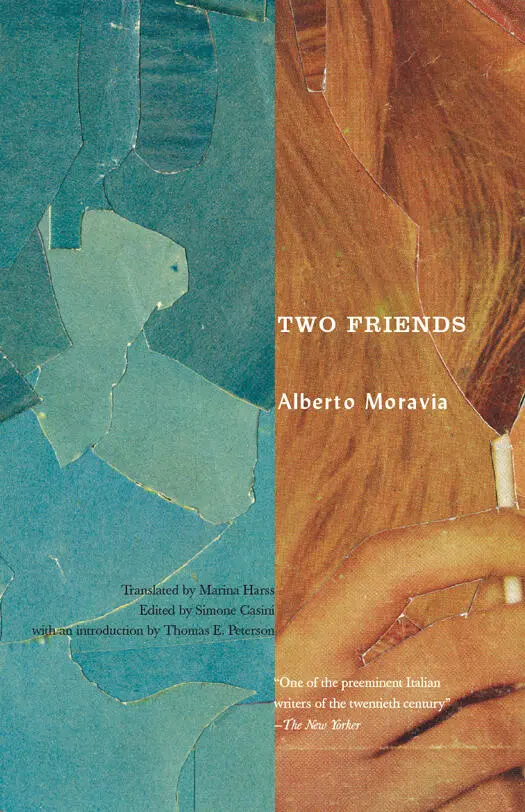
- Название:Two Friends
- Автор:
- Издательство:Other Press
- Жанр:
- Год:2011
- ISBN:нет данных
- Рейтинг книги:3 / 5. Голосов: 1
-
Избранное:Добавить в избранное
- Отзывы:
-
Ваша оценка:
Two Friends: краткое содержание, описание и аннотация
Предлагаем к чтению аннотацию, описание, краткое содержание или предисловие (зависит от того, что написал сам автор книги «Two Friends»). Если вы не нашли необходимую информацию о книге — напишите в комментариях, мы постараемся отыскать её.
Anyone interested in literature will relish the opportunity to watch Moravia at work, tinkering with his story and working at it from three unique perspectives.
Two Friends — читать онлайн бесплатно полную книгу (весь текст) целиком
Ниже представлен текст книги, разбитый по страницам. Система сохранения места последней прочитанной страницы, позволяет с удобством читать онлайн бесплатно книгу «Two Friends», без необходимости каждый раз заново искать на чём Вы остановились. Поставьте закладку, и сможете в любой момент перейти на страницу, на которой закончили чтение.
Интервал:
Закладка:
They drove for a long time through the countryside in the warm spring sun. After they passed Zagarolo and were driving through terraced hills and small forests, the car suddenly came to a stop. “Something must be wrong with the motor,” Maurizio said; “this damned car is always breaking down.” He got out and invited the others to do so as well. While Maurizio peered at the motor, Sergio and Lalla began to walk down the empty, sunny road.
It was a beautiful day. Lalla pointed out a few tiny white clouds, clearly delineated against the pure, luminous blue sky. Sergio suddenly turned to her: “Why did you tell Moroni that we were getting married this year?”
“How do you know?”
“He told me.”
120
“I know we’ll probably never get married, but I love you … Perhaps you won’t understand this, but a woman always hopes to marry the man who loves her. I’m a woman just like any other. I would like to be your wife.”
“But I don’t want to be your husband,” he said, harshly.
Without seeming to notice his tone, she took his arm. “Let me at least have my illusions … Why are you so cruel? What have I done to you?”
“Nothing.”
“You see? So why not just let me say whatever I like? Another person might say that they hope to win the lotto, and I say that I would like to marry you … What harm is there? There was a good reason for me to say it.”
“What was that?”
“Moroni is in love with me. He says that I look exactly like his dead wife. He has asked me to marry him several times. So, just to shut him up, I told him we were engaged.”
Sergio said nothing.
“Sergio, why are you always so cruel with me? I had started to hope, these last few days after you gave me all these gifts … but now you’ve reverted to your cruel ways.”
Maurizio called out: “Shall we go?”
“Let’s go back,” Sergio said; “we can discuss this later.” Lalla followed him in silence.
They were not far from Olevano; the town was visible on the horizon, at the summit of a rocky hill. When they reached it, they caught a glimpse of a man leaning against the parapet of a bridge over a small stream, beneath the shade of a leafy tree. He walked toward them, indicating that they should stop. It was Moroni. He went over to the car, exclaiming, in his loud, boisterous voice: “Welcome! Welcome to my town, signorina. ” He stepped onto the running board of the car and guided them toward his home, which was built on a terrace cut into the hill, below street level. The car descended a narrow road with vineyards on either side and finally came to a stop in a courtyard in front of the simple, square façade of a white three-story house with green shutters. Moroni helped
121
Lalla out of the car. When they had all emerged, he asked: “No bags?”
“Why should we have bags with us?” Sergio asked.
“I was hoping you would stay today and tomorrow, Sunday, and perhaps even Monday,” Moroni said, clearly disconcerted. Lalla laughed: “It’s true, he told me, but I forgot.”
Sergio was intensely irritated, though he was unsure why. The place was pleasant, and he was tired of the city. The idea of spending three days in the country pleased him. Furiously, he turned to Lalla: “You only think about clothes. You forget everything else.”
“Don’t worry,” Maurizio said in a conciliatory tone, “Moroni can give us some soap … We’ll make the best of it. Perhaps we could even stay tomorrow night as well.” Lalla did not seem happy about this solution, but did not contradict him. They followed Moroni into the house.
It was lunchtime, and Moroni invited them into the dining room without delay. Even though the house was bathed in sunlight because of its position on the side of a hill overlooking a vast, sun-baked valley, it was still cold inside, as country houses with no other heating but a fireplace tend to be. A chaste, stale smell of dusty worm-eaten furniture and simple cooking filled the shady rooms, decorated in a heavy, rustic style tinged with bourgeois pretensions. The house had been built in the nineteenth century, Moroni explained, and no changes had been made since then. This was obvious from the large, dark furniture and the heavy drapes, the oval mirrors framed in walnut, the chairs upholstered in ribbed fabric. Their little group sat down at the dining table, and a servant — a local peasant woman with red cheeks and frizzy hair — carried in an enormous platter of pasta. There were several carafes of wine on the table, enough for a much larger group to become drunk. Everything was abundant, heavy, and countrified. They ate in an uncomfortable silence. Maurizio,
123
who seemed to be in a good mood, served himself an ostentatiously large portion, but Sergio and Lalla barely touched their food. Sergio was still annoyed about the suitcases, and Lalla explained that pasta was fattening and that she had to “watch her figure.” Their host, who had served himself a large portion, observed: “I had forgotten that women today never eat pasta. Of course, my wife ate everything.”
“When did she pass away?” Sergio asked, almost distractedly.
Moroni looked at Sergio. “Less than a year ago,” he answered simply.
“Oh, so it’s still very recent.”
“Yes,” Moroni said, putting down his fork and looking straight ahead. “Very recent … and nothing has changed,” he sighed, adding: “If it were just the house, that would not be a problem … but nothing has changed in me either. Everything has stayed exactly the same.” He seemed upset as he said this, and did not pick up his fork again. But it was also clear that he did not mind discussing his pain, and even that he needed to discuss it. Sergio asked: “What do you mean when you say that nothing has changed?”
“Nothing,” he repeated, looking unhappy. “A deep love like the one I felt for Laura does not go away from one day to the next … I feel that something which occupied an enormous place in my life has disappeared, but at the same time I’m living as if it were still here.”
“You and your wife had a good marriage,” Maurizio said, looking up at him.
Moroni shook his head. “Quite to the contrary.” He began to eat again, and then pushed away his plate and poured himself a glass of wine. “We didn’t get along at all … Laura was a difficult woman … or perhaps I was the difficult one … Our life together, at least while she was alive, felt like a torment.”
Sergio, who had not expected this response and had until then taken Moroni for a typical inconsolable widower, began to pay closer attention. Maurizio
124
asked: “Why didn’t you get along?”
The peasant woman returned with clean plates. Moroni drank some more wine and then dried his mouth. “Why? It would take too long to explain … but we just didn’t see eye to eye … We fought almost every day. If I said white, she said black, and vice versa.” Moroni looked at each of his guests in turn. “You won’t believe me, but many times I wished, not that she would die, but that she would go away and leave me to my own devices.”
“Well,” Sergio said, with a slightly mocking tone, “that’s what happened … You should be glad.”
“I imagined,” Moroni continued, without acknowledging Sergio’s interruption, “that once she was gone, or dead, I would feel as if a great weight had been lifted and I had recovered the freedom to do whatever I wanted. I imagined that day as the most beautiful day of my life. But instead …”
“Instead?” Maurizio asked.
“Nothing … Not only did I not feel liberated, but I realized that I loved her and that I couldn’t live without her.” Moroni made a desperate gesture with his hand and then served himself some meat from the platter the servant had brought in.
Читать дальшеИнтервал:
Закладка:
Похожие книги на «Two Friends»
Представляем Вашему вниманию похожие книги на «Two Friends» списком для выбора. Мы отобрали схожую по названию и смыслу литературу в надежде предоставить читателям больше вариантов отыскать новые, интересные, ещё непрочитанные произведения.





Обсуждение, отзывы о книге «Two Friends» и просто собственные мнения читателей. Оставьте ваши комментарии, напишите, что Вы думаете о произведении, его смысле или главных героях. Укажите что конкретно понравилось, а что нет, и почему Вы так считаете.