Alberto Moravia - Two Friends
Здесь есть возможность читать онлайн «Alberto Moravia - Two Friends» весь текст электронной книги совершенно бесплатно (целиком полную версию без сокращений). В некоторых случаях можно слушать аудио, скачать через торрент в формате fb2 и присутствует краткое содержание. Год выпуска: 2011, Издательство: Other Press, Жанр: Современная проза, на английском языке. Описание произведения, (предисловие) а так же отзывы посетителей доступны на портале библиотеки ЛибКат.
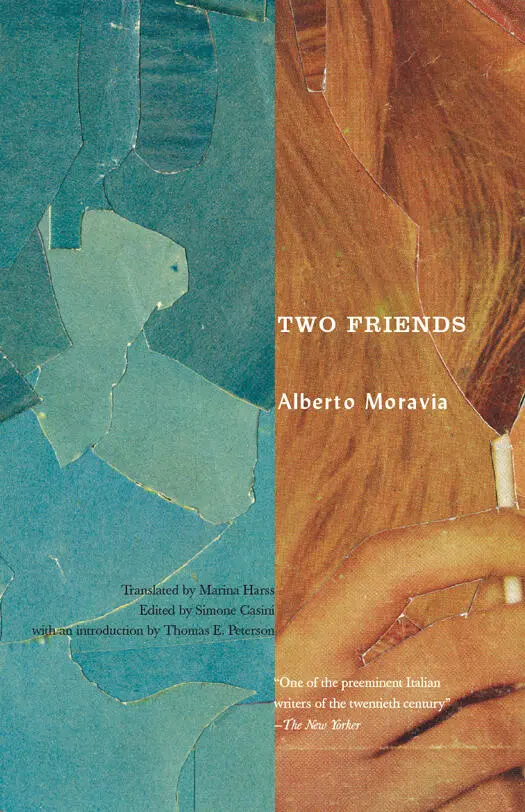
- Название:Two Friends
- Автор:
- Издательство:Other Press
- Жанр:
- Год:2011
- ISBN:нет данных
- Рейтинг книги:3 / 5. Голосов: 1
-
Избранное:Добавить в избранное
- Отзывы:
-
Ваша оценка:
Two Friends: краткое содержание, описание и аннотация
Предлагаем к чтению аннотацию, описание, краткое содержание или предисловие (зависит от того, что написал сам автор книги «Two Friends»). Если вы не нашли необходимую информацию о книге — напишите в комментариях, мы постараемся отыскать её.
Anyone interested in literature will relish the opportunity to watch Moravia at work, tinkering with his story and working at it from three unique perspectives.
Two Friends — читать онлайн бесплатно полную книгу (весь текст) целиком
Ниже представлен текст книги, разбитый по страницам. Система сохранения места последней прочитанной страницы, позволяет с удобством читать онлайн бесплатно книгу «Two Friends», без необходимости каждый раз заново искать на чём Вы остановились. Поставьте закладку, и сможете в любой момент перейти на страницу, на которой закончили чтение.
Интервал:
Закладка:
“Thank you,” Maurizio said with an odd look, adding: “Actually, I’m prepared to take the leap and sign on to the cause if you are willing to employ an irrational argument, as I mentioned the other day … Rational arguments won’t win me over. But we are made of flesh and blood and where rational arguments fail, irrational ones can drive us to action. Signing up is not simply a question of being convinced, it’s a call to action … therefore if you employ the right argument I’ll sign up.”
Sergio’s heart was beating fast. “What is the right argument, then?” he asked, softly.
“I thought you already knew.”
“I don’t know what you’re talking about.”
Maurizio removed a cigarette from the pack and played with it, leaning forward. “Well, there’s no use beating about the bush. It’s Lalla … If you let me take her to bed, I’ll sign up the next day. I’ll become a Communist for good.”
Sergio’s heart stopped racing. He felt completely calm and coolheaded. It was just as he had thought. The reality of knowing what argument would convince Maurizio, in other words discovering Maurizio’s weakness, changed everything; instead of feeling unsure of himself and inferior to Maurizio, he now felt confident and superior. Suddenly he was happy and completely lucid. Finally, he said to himself, Maurizio was in his power, after their many enervating
99
arguments in which he had always — rightly or wrongly — come up short. “I already knew,” he said, after a brief silence. “I saw you two, or rather I saw how you grabbed her hand the other day.”
“I knew you saw us.”
“And now,” Sergio continued, still calm, “I should get up, insult you, and leave.”
“But you won’t,” Maurizio answered, calmly.
“No, I won’t,” Sergio said, trying hard to emulate his calm demeanor. “Why would you want such a thing?”
“It’s simple,” Maurizio said, and for the first time since Sergio had known him, he became agitated. “I feel, shall we say”—and here his voice became a whisper, as if oppressed by the weight of his feeling—“I feel a very strong attraction to Lalla … I desire her violently, that’s all … It’s stupid, but there it is … I’m attracted to her, it’s in my blood. I’m completely contaminated by this feeling and I can’t stop desiring her … I even offered to marry her.”
“She told me.”
“Since she doesn’t want to marry me, I don’t see any other way to get what I want …”
“But why do you desire her so much?” Sergio said, knowing that it was a stupid question.
“I just do.”
Sergio pondered the question for a moment, or rather pretended to. This feeling of power — after being powerless for so long — made his head swim, and it was difficult to formulate precise thoughts. “Why do you think I can get something from her that she has already refused? She’ll refuse me as well.”
“She won’t refuse. If you tell her, ‘I want you to go to Maurizio and do what he asks,’ she’ll do it.”
“You’re a creep, you know that?”
Maurizio answered calmly: “Why do you feel the need to insult me? I’m not forcing you … There’s nothing reprehensible about my feelings for Lalla … You can simply turn down my offer and I’ll never mention it again.”
Turn down the offer? Nothing would be simpler,
100
Sergio reflected. But that was not what he wanted. In a certain sense that was his least attractive option. Turning down Maurizio’s offer would mean returning to his earlier, primitive state of insecurity and mistrust. He already had Lalla’s love, but it was no good to him. Holding on to that love, refusing Maurizio’s offer out of love for that love, would not help his situation. He needed to overcome Maurizio’s resistance, to convince him, to make him do what he wanted. “If I were to do what you ask … and I’m not saying I will … would you then do what I want?”
“Immediately … The next day, I’d request my Party membership.”
“But can’t you see,” Sergio said, realizing that the question was directed more to himself than to Maurizio, “that if I did this, your Party inscription would lose much of its value? Or even all of it?”
“Why?” Maurizio smiled. “What connection is there between Communism, which is a sociopolitical and economic theory, and my love for Lalla? None …”
“Your conversion would be neither spontaneous nor disinterested.”
Maurizio laughed. “Perhaps it would no longer be spontaneous, but is there really such a thing as a disinterested conversion? There is always a motivating interest of some sort.”
“And what if I refuse?”
“Then it would mean that Lalla matters more to you than the Party … in other words, you would be a bad Communist.”
“According to whom?”
“According to you Communists,” Maurizio added, harshly. “You’re just like the Christians. Christ said one should leave one’s family and follow him.”
“What would you think of me if I refused?”
“That you’re a bad Communist but a good lover.”
“And if I accepted?”
“That you are a bad lover but an excellent Communist.”
“And why would that make me a bad lover?”
“I think it’s obvious … What kind of question is that? What you want is reassurance.”
“What do you mean?”
“You want me to say that you can be both a good
101
lover and a good Communist.”
“Go to hell.”
Once again, Sergio was annoyed. He needed something to help him regain his feeling of superiority. “Sorry … You may not believe me, given the subject of our discussion at this little café table, but I love Lalla.”
“I don’t doubt it,” Maurizio answered, completely serious.
“I find it hard to control my feelings.”
“I can understand that.”
“What would you do if you were in my shoes?” Sergio asked, abruptly. Then, realizing how naïve his question sounded: “No, don’t answer me. It’s a silly question.”
“Why do you think it’s silly? I can say that since I’m not a Communist, the conflict does not present itself. I don’t have to choose.”
“There are other factors that might force you to choose.” Sergio wanted to discuss the matter further: “For example, I don’t know, your fortune, your inheritance.”
“Money means nothing to me … I wouldn’t give a square inch of a woman I love for all the wealth in the world.”
“Your freedom, then.”
Maurizio laughed. “Don’t you see that, not being a Communist, the question simply doesn’t apply, unless I was a coward or a miser or some other despicable being? Unless Communism is the prize, one simply is what one is by not giving up Lalla, even for a good cause … You Communists have invented the reason for giving her up, it is a reason created by you Communists over the course of the last fifty or one hundred years … or at least that is what you believe, and what you have convinced yourselves of. By which I mean a reason that does not put those who adopt it in an unfavorable light.”
“What you’re saying is that it would not be judged unfavorably,” Sergio said bitterly, “if I were to say to Lalla: spread your legs and let Maurizio have his way with you.”
Maurizio laughed. “Why do you have to put it
102
that way? But no, you would not be judged unfavorably … at least not by me.”
There was a long silence. Maurizio observed Sergio with his bright, alluring eyes. Finally, he said: “I want you to know that I understand … listen … Are you listening to me?”
“Yes.”
“All right, listen … You yourself said that bringing even a single person to the cause is an important achievement. Especially if that person is worthy of respect, staunch, and mature … So, on the one hand you have nothing less than Communism, the greatest dream of freedom and happiness man has ever conceived, a dream that the Communists are dedicated to realizing, in order to ensure the well-being of millions of human beings, the betterment of their lives, to give them the capacity to express themselves, to free their minds and fulfill their destinies. And on the other hand? Not much … a woman, like so many others, an ordinary woman, who has the misfortune of being desired by me … a human body that I desire … and yes, I want, as you said, for her to open her legs, as all women do, for love, stupidity, money, and for millions of other reasons … There is no comparison between these two things … Tell me if I’m wrong.”
Читать дальшеИнтервал:
Закладка:
Похожие книги на «Two Friends»
Представляем Вашему вниманию похожие книги на «Two Friends» списком для выбора. Мы отобрали схожую по названию и смыслу литературу в надежде предоставить читателям больше вариантов отыскать новые, интересные, ещё непрочитанные произведения.







Обсуждение, отзывы о книге «Two Friends» и просто собственные мнения читателей. Оставьте ваши комментарии, напишите, что Вы думаете о произведении, его смысле или главных героях. Укажите что конкретно понравилось, а что нет, и почему Вы так считаете.