Alberto Moravia - Two Friends
Здесь есть возможность читать онлайн «Alberto Moravia - Two Friends» весь текст электронной книги совершенно бесплатно (целиком полную версию без сокращений). В некоторых случаях можно слушать аудио, скачать через торрент в формате fb2 и присутствует краткое содержание. Год выпуска: 2011, Издательство: Other Press, Жанр: Современная проза, на английском языке. Описание произведения, (предисловие) а так же отзывы посетителей доступны на портале библиотеки ЛибКат.
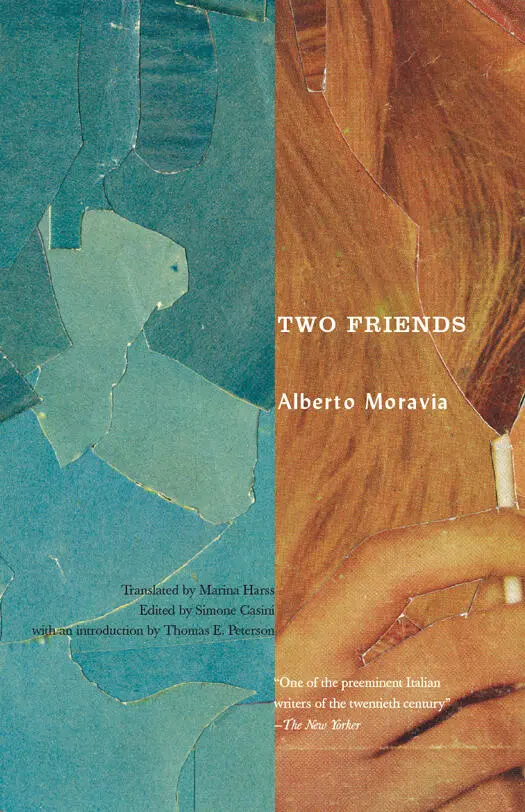
- Название:Two Friends
- Автор:
- Издательство:Other Press
- Жанр:
- Год:2011
- ISBN:нет данных
- Рейтинг книги:3 / 5. Голосов: 1
-
Избранное:Добавить в избранное
- Отзывы:
-
Ваша оценка:
Two Friends: краткое содержание, описание и аннотация
Предлагаем к чтению аннотацию, описание, краткое содержание или предисловие (зависит от того, что написал сам автор книги «Two Friends»). Если вы не нашли необходимую информацию о книге — напишите в комментариях, мы постараемся отыскать её.
Anyone interested in literature will relish the opportunity to watch Moravia at work, tinkering with his story and working at it from three unique perspectives.
Two Friends — читать онлайн бесплатно полную книгу (весь текст) целиком
Ниже представлен текст книги, разбитый по страницам. Система сохранения места последней прочитанной страницы, позволяет с удобством читать онлайн бесплатно книгу «Two Friends», без необходимости каждый раз заново искать на чём Вы остановились. Поставьте закладку, и сможете в любой момент перейти на страницу, на которой закончили чтение.
Интервал:
Закладка:
“What a shame, what a shame,” he mumbled as he rang the doorbell. “This too will end, but without glory.” These words, pronounced by the final secretary of the Fascist Party during a tearful proclamation, had stayed with him for days, like a refrain. Maurizio came to the door with a bright, open expression that surprised Sergio after all these funereal signs; it struck him as an indication of indifference bordering on ignorance. “Ah, it’s you,” Maurizio said, inviting him in. “There’s no one home … only the cook, all the others have left.” As he said this, he led Sergio
193
from the foyer, through a series of anterooms, and, finally, to the living room. It was dark; Maurizio went to one of the windows and pulled aside a heavy drape. The room was just as Sergio remembered it; not a single object or piece of furniture had been changed. But it looked smaller, faded, not at all luxurious or magnificent as it had appeared to him many years earlier when he had first entered this room. It was of medium size with walls covered in red imitation damask and ugly, gold-framed paintings on the walls; the furnishings — antiques, many of them probably reproductions — were distributed here and there. The sofas and armchairs looked worn and dirty; it was evident that nothing had been replaced and that even the cleanliness of the room was questionable. In a corner there was a settee on which lay something long and white. Sergio looked more closely and saw that it was a dog, lying on its side with its mouth slightly ajar, its fur matted, reddish eyes half closed. Maurizio followed his gaze and said, in a jocular tone: “I don’t know what’s going on around here … The dog and the cat are both sick; I think they are dying …” Sergio looked at Maurizio, who did not seem to attach any importance to the agony of these two animals; he opened his mouth as if to speak, but then decided not to. Everything seemed to be in agreement: the neglected old house, the animals’ suffering, the war, and the country’s impending disaster. Maurizio saw none of this, or at least did not react to it, a sure sign that he too was part of this world that was sinking, not standing outside looking in like Sergio, if only as an impotent spectator. Maurizio was part of it, an actor in the events and at the same time a victim. With some effort, Sergio said: “So, are you off to Capri?”
“Yes, tonight,” Maurizio said. “It’s too late to catch the last boat. I’ll spend the night in Naples and leave for Capri tomorrow.” He paused, adding, “So, have you changed your mind? Are you coming with me?”
Sergio answered slowly: “No, I can’t … I have work to do.”
“What work?”
194
“I’ve agreed to write for a paper … Look here.” He handed the newspaper to Maurizio, who took it reluctantly. On the way over, it had occurred to Sergio that he should show Maurizio his article in order to make clear what he thought of the events unfolding around them. But as he handed Maurizio the newspaper he realized that he had simply succumbed to vanity mixed with his old inferiority complex. He wanted to show his friend what he had written, to be admired by him. Maurizio glanced at the paper and set it aside. Sergio could not help remarking: “Why don’t you read it? That way at least you’ll know what I think, and why I’m staying.”
With a bored expression, Maurizio opened the newspaper, read a few lines, and then set it aside. “It’s useless, I don’t feel like reading it. I don’t care.”
“How do you know?” Sergio said, irritated. “You haven’t read it.”
“I can imagine what it says.”
“You can’t.”
“Of course I can. I know you.”
“All right then, let’s see,” Sergio said, his irritation growing. “What do you think I wrote?”
“You haven’t changed,” Maurizio said with a half smile. “Always the same.”
“Why should I change?”
“Anyway, you seem satisfied with yourself. You’ve written an article entitled ‘Who Is Responsible?’ So I’m sure you’ve done your best to indicate who is responsible for the war and for what is happening now.”
“That’s right.”
“Well, I can imagine that your point is that those responsible are not the military but the Fascists and the government in general. How original …” He dug around in his pocket for his gold cigarette case, pulled out a cigarette, and lit it. Sergio watched as he
195
smoked and repeatedly pushed back one of his blond curls, a familiar gesture. Just as he had when he saw the suffering of the two dying animals, Sergio felt the desire to speak up and explain his thoughts, or rather his feelings, but once again he lost his nerve. Maurizio was obviously a million miles away from what he considered to be the true path, and he felt an almost painful need to warn him and open his eyes. Maurizio did not seem to think that he too might be partly responsible. How could he, when even those directly and flagrantly responsible, the generals and the bosses, did not know it? Sergio felt a terrible sense of futility. He held out his hand, took back the newspaper, and said, somewhat falsely: “It doesn’t matter … If you don’t feel like reading it, I’m sure you have your reasons.”
There was a long pause. Maurizio smoked, seemingly lost in thought. Then he said, “How long do you think the war will last at this point?”
Sergio answered, “I don’t know, probably a long time.”
“I’m convinced,” Maurizio said, “that it will end very soon … I think the Allies will be in Rome in a week at the most, and then everything will return to normal. That’s why I’m going to Capri; it’s not worth giving up our vacation and even risking injury for something that is about to end.”
He continued to smoke with an air of conviction, adding, after a short pause: “Considering everything, Italy will come out all right … We haven’t been in the war for too long … As soon as it really got started, it’s all over, at least for us …”
Once again, Sergio was tempted to contradict his friend’s reasoning, which to him seemed so full of cynicism and skepticism. To Maurizio it was simply good sense. Once again, he held his tongue. Then he asked: “And then what?”
“Then, nothing,” Maurizio said offhandedly. “The Allies will arrive and set up whatever government they please. Of course, they’ll take away our colonies and our empire. After all, it’s what we deserve. If we hadn’t gone to war, we would have kept everything,
196
and Italy would have become the richest, most influential country in Europe. Mussolini was stupid.”
“Only stupid?”
“I can’t wait for it all to end,” Maurizio continued, without noting Sergio’s interruption. “I’ve wasted the past few years … I’d like to get a degree, even though it’s late now.”
“What kind of degree?”
“Maybe law,” Maurizio answered, in an uncertain tone which reflected the uncertainty of his decision. “I must tell you that from time to time I think that you may be right … It’s not good to hang around doing nothing … even people like me who have enough to live on. You were right when you told Emilia that I was wasting my life, do you remember? It made me angry at the time, of course, because no one likes to hear certain things; and the way she said it was so irritating … But I have to admit it: you were right.”
Sergio said nothing and instead peered at his friend. He saw that Maurizio had changed, like his house and everything it contained. His face was still youthful and attractive, but it had a grim and tired quality that was new. His blue eyes, which had once been clear, limpid, and pure, seemed to have a dark halo around them, with a turbid, bored quality around the irises, a sickly glow. A line, as fine as a razor’s edge, framed one corner of his mouth, making that side of his face look ten years older. And he was losing his hair, unevenly and in a manner that suggested dissoluteness and fatigue: a few blond hairs still stuck out of the middle of his balding pate, combed back, fine and trembling like bushes in the middle of a hillside full of mud, stones, and boulders. It was the face of a man who had enjoyed life to the fullest, and who still knew how. But when he spoke of wasted time and admitted to Sergio that he was right, his tone was unusually sincere and almost anguished. Sergio was moved by the idea that Maurizio
Читать дальшеИнтервал:
Закладка:
Похожие книги на «Two Friends»
Представляем Вашему вниманию похожие книги на «Two Friends» списком для выбора. Мы отобрали схожую по названию и смыслу литературу в надежде предоставить читателям больше вариантов отыскать новые, интересные, ещё непрочитанные произведения.


Обсуждение, отзывы о книге «Two Friends» и просто собственные мнения читателей. Оставьте ваши комментарии, напишите, что Вы думаете о произведении, его смысле или главных героях. Укажите что конкретно понравилось, а что нет, и почему Вы так считаете.