Karen Bender - Refund - Stories
Здесь есть возможность читать онлайн «Karen Bender - Refund - Stories» весь текст электронной книги совершенно бесплатно (целиком полную версию без сокращений). В некоторых случаях можно слушать аудио, скачать через торрент в формате fb2 и присутствует краткое содержание. Год выпуска: 2015, Издательство: Counterpoint, Жанр: Современная проза, на английском языке. Описание произведения, (предисловие) а так же отзывы посетителей доступны на портале библиотеки ЛибКат.
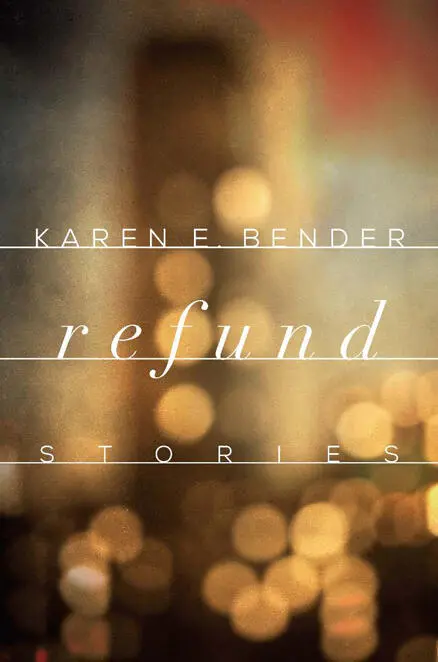
- Название:Refund: Stories
- Автор:
- Издательство:Counterpoint
- Жанр:
- Год:2015
- ISBN:нет данных
- Рейтинг книги:3 / 5. Голосов: 1
-
Избранное:Добавить в избранное
- Отзывы:
-
Ваша оценка:
Refund: Stories: краткое содержание, описание и аннотация
Предлагаем к чтению аннотацию, описание, краткое содержание или предисловие (зависит от того, что написал сам автор книги «Refund: Stories»). Если вы не нашли необходимую информацию о книге — напишите в комментариях, мы постараемся отыскать её.
In Refund, Bender creates an award-winning collection of stories that deeply explore the ways in which money and the estimation of value affect the lives of her characters. The stories in Refund reflect our contemporary world — swindlers, reality show creators, desperate artists, siblings, parents — who try to answer the question: What is the real definition of worth?
In “Theft,” an eighty-year-old swindler, accustomed to tricking people for their money, boards a cruise ship to see if she can find something of true value — a human connection. In “Anything for Money,” the creator of a reality show is thrown into the real world when his estranged granddaughter reenters his life in need of a new heart; and in the title story, young artist parents in downtown Manhattan escape the attack on 9/11 only to face a battle over their subletted apartment with a stranger who might have lost more than only her deposit.
Set in contemporary America, these stories herald a work of singular literary merit by an important writer at the height of her power.
Refund: Stories — читать онлайн бесплатно полную книгу (весь текст) целиком
Ниже представлен текст книги, разбитый по страницам. Система сохранения места последней прочитанной страницы, позволяет с удобством читать онлайн бесплатно книгу «Refund: Stories», без необходимости каждый раз заново искать на чём Вы остановились. Поставьте закладку, и сможете в любой момент перейти на страницу, на которой закончили чтение.
Интервал:
Закладка:
“Sorry,” he said. There was a plaintive quality to this word, his inability to come up with any sort of excuse; it seemed to designate everything about their future. The lights went off.
Jane got out of bed and went downstairs. She told herself she needed to take out the garbage, but she just needed to get outside. Opening the door, the night was thick and black and the air was fresh. She threw the bag of trash into the can and stood in front of her house. The cicadas sounded like an enormous machine. The sky was a riot of stars. She glanced around the empty street and began to run.
The neighborhood was beautiful at this hour, flowers and bushes randomly lit by small spotlights, as though each family wanted to illuminate some glorious part of itself. It was ten thirty, and the only discernible human sound was the canned television laughter floating out of windows. The houses looked anchored to these neat green plots of land. How much longer would her neighbors wake up, shower, eat their cereal, argue, dress their children, weep, prepare dinner, sit by the television, make love, sleep? She ran quietly, the sidewalk damp under her naked feet; she smelled the flowers, the jasmine, honeysuckle, magnolia, sweet and ferocious and dark.
She ran one block like this and stopped, breathing hard. Her forehead was sweating. She was a middle-aged woman in her pajamas, running from her house at ten thirty at night. Looking at her house, she saw the small night-light in her son’s room cast a lovely blue glow through the window. From here, the room looked enchanted, as if inhabited by fairies. Her breathing slowed, and the night air felt cool in her lungs. When she glanced up at the neighbors’ bedroom window, she noticed that their blinds were now shut.
MARY GRACE KNOCKED ON THE DOOR AT THREE THIRTY THE NEXT day. Jane thought she was dressed up early for Halloween, with a short blue accordion-skirt and a T-shirt decorated with a halo made of rhinestones, but it was actually a cheerleader outfit. She was going to a practice for Halo Hoops, the church basketball team. “I have to go to our basketball game at church,” she said. “I have ten minutes. That is all.” Jane held open the door, and Mary Grace jumped inside and did a twirl.
“Can I marry you, Mary Grace?” her son asked.
“No,” said Mary Grace. “I’m older than you.” She looked at Jane. “I’m going to be a superstar singer. I’m going to be in the top five. Wanna hear—” She belted out a few words of a pop song. She was stocky, tuneless, and loud. Jane’s son was enchanted and requested more. He grabbed Mary Grace’s hand, and Jane’s heart flinched.
“Can we make cookies?” Mary Grace asked. “Quick?”
They bustled into the kitchen and proceeded to bake. No one came to take the girl to Halo Hoops. The kitchen suddenly smelled like a bakery. Mary Grace stood too close to her. “Do you like my singing?” she pleaded.
“Sure,” said Jane.
“Me, too,” said the girl. Jane felt Mary Grace’s breath on her arm. The girl’s breath had the warmth of a dragon or another unnatural beast. The girl’s belief in Jane’s worth was awful. “You have pretty hair,” said Mary Grace, reaching up to Jane and touching a strand. The girl had a startlingly gentle touch. Her hand smelled of sweet dough and chocolate.
“Thanks,” said Jane. The boy and the baby stared at Mary Grace. The baby, hanging on Jane’s hip, reached out and swatted Mary Grace away. Mary Grace’s face tightened, aggrieved.
“Do I have pretty hair?” asked Mary Grace.
The baby yanked Jane’s hair. “Ow!” said Jane, grabbing the tiny hand.
“Do I?” asked Mary Grace; it was almost a shout.
Before Jane could answer, her son stepped forward and grabbed Mary Grace’s arm. “Do you want to stay for dinner?” he asked.
Mary Grace recoiled from his touch. Jane saw all of the girl’s self-hatred light up her eyes: that she had no other friends besides this five-year-old, that her parents did not want her at their table. “No,” she snapped, “Ick. Why do you keep asking me!”
Her son dropped his head, wounded. Jane slapped her hand on the table. It made a clear, sharp sound. “Then just go home!” she yelled at Mary Grace.
The children were suddenly alert. Jane was frozen, ashamed. The girl slowly picked up her jacket and, shoulders slumped, eyes cast downward, trudged to the door, a position already so well-worn it had carved itself into her posture. Her son screamed, “Stay!” and skidded toward her, arms open, but Mary Grace moved to the door and was gone.
THAT NIGHT JANE SAT BESIDE HER HUSBAND AND REALIZED THAT they had known each other for fifteen years. She wanted to tell her husband something new about herself, something she had never told anyone before. She wanted to tell him a secret that would bring them to a new level of closeness. What else could she tell him? Would he be more grateful for a humiliating moment in her life or a transforming one? Did people love others based on the ways they had similarly debased themselves or the proud ways they had lifted themselves up?
“What?” he asked, sensing a disturbance.
“I yelled at the girl,” she said. “She was mean to our boy, and I couldn’t stand it. I shouldn’t have. She turned around and left.”
“They already hate us,” he said, calmly. Then he returned to his book.
She was now revved up for an argument.
“I’m wasting my life picking up towels,” she said. “For every ten towels I pick up, you pick up one. I’m sick of it, and they smell like goats.”
Now he looked up. “I pick up towels,” he said. “Plenty of them.”
“Not as many as me,” she said.
He jumped out of bed, standing on the balls of his feet, like a boxer who had been secretly preparing for this barrage, and then grabbed a robe and tossed it over himself. “What do I give up for this family! Look at this leg.” He held it out. “If I had any time at all to exercise, then I would be able to get in great shape. I could run a marathon! I could make love ten times a day.” The edge in his voice, the raw and bottomless yearning, was so sharply reminiscent of her own father’s during her childhood that she felt time as a funnel: she’d been emptied into her old home, the same person but just a different size. He sank down into his chair and began to tap his foot nervously, looking anywhere but at her.
“We would have had a third child,” she said. “I stopped it.”
He looked at her.
“This week,” she said.
She remembered the night that she and her husband had brought their son home from the hospital. They had cupped him in their hands, a person just two days old. When he began to cry, his first human wails rising into their apartment, she and her husband realized that they were supposed to comfort him. It was them. They gazed with longing into his hopeful eyes.
He stared at her. Carefully, he clasped his hands. His eyes were bright; she realized there were tears in them.
“Did you forget about me?” he asked.
His voice was soft, and it sounded as though it came directly out of the black night outside. “We couldn’t have done it,” she said.
“You didn’t want to,” he replied, sharply.
“You didn’t either,” she said. “I know you.”
“Do you?” he asked. “Look at me. What am I thinking right now?”
She looked into his dark eyes. When they got married, she wanted to know, to own everything about him.
She leaned toward him and looked closer. She and her husband were sitting beside each other, half-dressed, their windows open. Outside, the leaves on the trees gleamed in the orange street-lights. Jane touched his hand. She thought she heard weak laughter in the neighbors’ house, carried through the streets on a warm and fragrant wind.
Читать дальшеИнтервал:
Закладка:
Похожие книги на «Refund: Stories»
Представляем Вашему вниманию похожие книги на «Refund: Stories» списком для выбора. Мы отобрали схожую по названию и смыслу литературу в надежде предоставить читателям больше вариантов отыскать новые, интересные, ещё непрочитанные произведения.






Обсуждение, отзывы о книге «Refund: Stories» и просто собственные мнения читателей. Оставьте ваши комментарии, напишите, что Вы думаете о произведении, его смысле или главных героях. Укажите что конкретно понравилось, а что нет, и почему Вы так считаете.