Karen Bender - Refund - Stories
Здесь есть возможность читать онлайн «Karen Bender - Refund - Stories» весь текст электронной книги совершенно бесплатно (целиком полную версию без сокращений). В некоторых случаях можно слушать аудио, скачать через торрент в формате fb2 и присутствует краткое содержание. Год выпуска: 2015, Издательство: Counterpoint, Жанр: Современная проза, на английском языке. Описание произведения, (предисловие) а так же отзывы посетителей доступны на портале библиотеки ЛибКат.
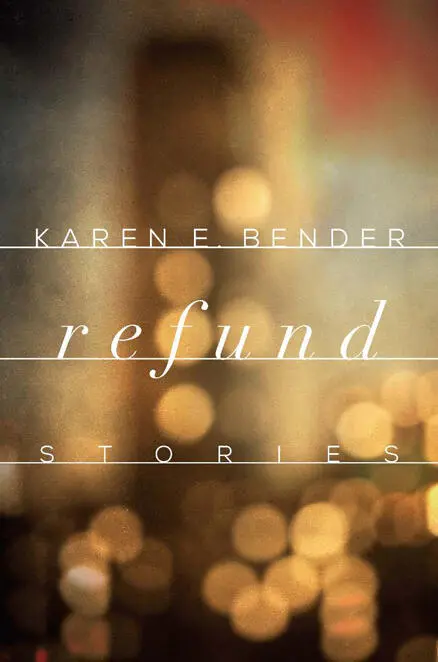
- Название:Refund: Stories
- Автор:
- Издательство:Counterpoint
- Жанр:
- Год:2015
- ISBN:нет данных
- Рейтинг книги:3 / 5. Голосов: 1
-
Избранное:Добавить в избранное
- Отзывы:
-
Ваша оценка:
Refund: Stories: краткое содержание, описание и аннотация
Предлагаем к чтению аннотацию, описание, краткое содержание или предисловие (зависит от того, что написал сам автор книги «Refund: Stories»). Если вы не нашли необходимую информацию о книге — напишите в комментариях, мы постараемся отыскать её.
In Refund, Bender creates an award-winning collection of stories that deeply explore the ways in which money and the estimation of value affect the lives of her characters. The stories in Refund reflect our contemporary world — swindlers, reality show creators, desperate artists, siblings, parents — who try to answer the question: What is the real definition of worth?
In “Theft,” an eighty-year-old swindler, accustomed to tricking people for their money, boards a cruise ship to see if she can find something of true value — a human connection. In “Anything for Money,” the creator of a reality show is thrown into the real world when his estranged granddaughter reenters his life in need of a new heart; and in the title story, young artist parents in downtown Manhattan escape the attack on 9/11 only to face a battle over their subletted apartment with a stranger who might have lost more than only her deposit.
Set in contemporary America, these stories herald a work of singular literary merit by an important writer at the height of her power.
Refund: Stories — читать онлайн бесплатно полную книгу (весь текст) целиком
Ниже представлен текст книги, разбитый по страницам. Система сохранения места последней прочитанной страницы, позволяет с удобством читать онлайн бесплатно книгу «Refund: Stories», без необходимости каждый раз заново искать на чём Вы остановились. Поставьте закладку, и сможете в любой момент перейти на страницу, на которой закончили чтение.
Интервал:
Закладка:
MARY GRACE WAS BACK THE NEXT AFTERNOON, WASHING UP AT their door as inevitably as the tide. There was something ancient about her, the way she smiled warily at Jane, scratching her leg and pretending that yesterday had not happened. She loved them simply because they opened the door.
“Could we make a lemonade stand?” Mary Grace asked. “We could sell lemonade for twenty-five cents.”
Jane moved outside. It was a cool day, with drizzly rain. “I don’t know,” said Jane, looking at the sky. But her son ran out the door, bubbling with joy that the girl was back. “Yes!” he yelled. He and Mary Grace arranged themselves around a card table in the front yard, a pitcher of lemonade and some cups between them. Mary Grace clutched an umbrella. Jane watched their small, dignified backs as they regarded the neighborhood, set in their belief that others would want what they offered.
She did not have many plastic cups. She thought she could ask Mary Grace’s mother if she had any cups; she looked up the woman’s number in the phone book.
“Hello,” said Mary Grace’s mother. Her voice sounded high-pitched and young.
“It’s Jane Goldman, next door,” she said. “Mary Grace’s over right now. I just wanted to say hi.” There was a silence. “Well, the kids are having a lemonade stand, and well, I wondered if you have any plastic cups—”
She heard a deep intake of breath. “Stop,” said Mary Grace’s mother.
“Excuse me?” said Jane.
“She knows that she can get sweets from you. She needs to lose ten pounds. I don’t want her to look ugly. Do you?”
“No!” said Jane. “Maybe she’d stay at your house if you actually talked to her—”
“I’m a good mother,” said Mary Grace’s mother. “I keep her clean. She minds her manners.” There was the sound of growling. At first Jane thought it was the mother but then realized it was the family dog. “Stay away from her,” said Mary Grace’s mother, her voice rising, “Stop feeding her—”
Jane banged down the phone. “Dammit!” she yelled. She heard Mary Grace and her son laughing outside, and she knew that it would be the last time the girl would visit their house. It would be his first grief, the loss of a friend; it would tip like a domino against the losses to come. Mary Grace would have her own disappointments with her sour and careless parents, and the families would live side by side until this particular race was over.
Everyone — the children, the parents — were visitors on earth; they were here briefly, and then they would vanish. The children sat, stalwart, behind a plastic pitcher. The clouds broke apart, and sunlight fell upon them. She went and bought a cup for a dollar because she had no change. Others bought lemonade, too, with dollars, and the children still had no change, and within an hour they had ten dollars. The children were gleeful at their unexpected riches. “I will buy billions and billions of toys!” her son screamed. The baby, sitting on a blanket, crowed as she regarded them. The children stood around the table, counting their riches, over and over, counting their riches, over and over.
The Loan Officer’s Visit
For the first sixteen years of my life, my father was a vigorous man. Once upon a time, he was almost a blur. But when he became ill, he spent half of the morning lying in bed with the curtains drawn. Then he put on a gray suit, walked gingerly to his Chevy, and sat at his desk at Great Mutual in Beverly Hills listening to people — some wealthy, some not — ask for loans to acquire boats, houses in Hawaii, expensive cars. He listened to the customers’ excited and rambling descriptions of the trips they were going to take, the second homes they were going to decorate; he set up meetings with imaginary people at 3:00 PM so he could instead shut the door to his office, lay his cheek on his maroon couch, and close his eyes, trying to conserve the energy he needed to get to the end of the day.
He was never quite sure if he could make it to 6:00 PM; his superiors tried to be flexible, as he was a good closer, but he knew they had their limits, and he did not want to lose his job. He was a stubborn man, and he did manage to sit at his desk until the doors of the bank were locked, even if he was sometimes damp with sweat by the end, as though he had run a marathon.
Once, when I was seventeen, I stopped by his office and waited for a ride home. I sat on the couch in his office, the fabric the peculiar spongy consistency of an alien landscape. I always enjoyed watching the oddities who wanted money from the bank, or more personally, my father. That day, a couple thanked my father for helping them arrange a loan to furnish their necessary chalet in Switzerland. The woman wore spike heels that looked like they could puncture a rubber tire. The man, in a peculiar shiny blazer, nodded too often and gripped his gold pen as though it warmed his hand. My father smiled, asked innocuous questions about their vacation plans, indicated the x ’s where they were supposed to sign.
— It’s right at the edge of the Alps, the woman bragged. She glanced around, as though listening to applause from an invisible crowd. — You just walk out your door and hop on your skis. So simple! Fabulous!
I disliked this couple, not for their money, but for the casual acceptance of their freedom. My father laughed and shook hands with them; he was an excellent loan officer because he knew how to make them believe they deserved whatever they sought.
— Have a good time, he said to her. — Bon voyage.
That night, he drove me home. I was about to graduate high school and move off, oddly, to college in Arizona, a place I had applied to only because it was the one school that had sent me a brochure; this seemed a sign of something fortuitous. It was also the only college that had accepted me.
— Why do you want to go there? he asked. — What’s there?
— I don’t know, I said. I tried to think of something interesting. — Cactuses. Cacti.
— But what’s wrong with here?
I looked through the windshield at Wilshire Boulevard. It was the mid-1980s, a rainy night, and the tall, gray marble buildings of the Wilshire Corridor gleamed in the damp clouds. The cars and their headlights trembling in long, pale streaks on the pavement, the streetlights green and red lozenges in the night.
I didn’t answer.
— Look at everything we have here! Beaches! Museums! So why go?
The tenor of his voice made me not want to meet his eyes; it seemed in some way reasonable but not what I wanted to hear. I shifted around in my seat, silent because there was no good reason but that I was seventeen and somehow, here, it had become difficult to breathe.
— They offer good ceramics courses, I tried, lamely. — I would like to learn ceramics.
— Well, what do you want to be? he asked. — Doctor, lawyer, what?
— I don’t know, I said. This question felt like a vise around my heart. — What did you think of that couple? The Swiss chalet ones.
— I have no opinion, he said.
— Come on, I said. — I know you do.
— Okay, he said, gripping the wheel. — They were silly. What do they need that chalet for? What do any of them need a second house for? I don’t know.
MY FATHER LAY IN A SHADOWED ROOM, SLEEPING LIKE AN INFANT, while I grew and grew. I strapped myself into a creaky plane and let it take me to college. Ceramics was full of extremely focused ceramicists, who were intimidating, so instead I tried biology, communications, European history, Korean literature, Portuguese, archaeology, becoming the sort of student who was the bane of guidance counselors. I graduated, settled on the spectacularly jobless field of conserving Renaissance art, sent my résumés out to museums across the country, acquired jobs, hunched over rare paintings in museum basements, trying to return them to their former glory, lost the jobs when funding ran out, which it always seemed to do. I did not know where I wanted to go and let the paintings, the museums that needed me, pull me where I was needed, and eventually I found a man who wanted to marry me.
Читать дальшеИнтервал:
Закладка:
Похожие книги на «Refund: Stories»
Представляем Вашему вниманию похожие книги на «Refund: Stories» списком для выбора. Мы отобрали схожую по названию и смыслу литературу в надежде предоставить читателям больше вариантов отыскать новые, интересные, ещё непрочитанные произведения.








Обсуждение, отзывы о книге «Refund: Stories» и просто собственные мнения читателей. Оставьте ваши комментарии, напишите, что Вы думаете о произведении, его смысле или главных героях. Укажите что конкретно понравилось, а что нет, и почему Вы так считаете.