Karen Bender - Refund - Stories
Здесь есть возможность читать онлайн «Karen Bender - Refund - Stories» весь текст электронной книги совершенно бесплатно (целиком полную версию без сокращений). В некоторых случаях можно слушать аудио, скачать через торрент в формате fb2 и присутствует краткое содержание. Год выпуска: 2015, Издательство: Counterpoint, Жанр: Современная проза, на английском языке. Описание произведения, (предисловие) а так же отзывы посетителей доступны на портале библиотеки ЛибКат.
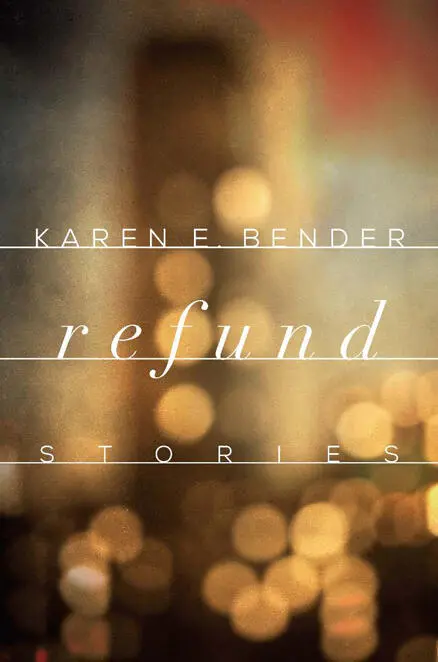
- Название:Refund: Stories
- Автор:
- Издательство:Counterpoint
- Жанр:
- Год:2015
- ISBN:нет данных
- Рейтинг книги:3 / 5. Голосов: 1
-
Избранное:Добавить в избранное
- Отзывы:
-
Ваша оценка:
Refund: Stories: краткое содержание, описание и аннотация
Предлагаем к чтению аннотацию, описание, краткое содержание или предисловие (зависит от того, что написал сам автор книги «Refund: Stories»). Если вы не нашли необходимую информацию о книге — напишите в комментариях, мы постараемся отыскать её.
In Refund, Bender creates an award-winning collection of stories that deeply explore the ways in which money and the estimation of value affect the lives of her characters. The stories in Refund reflect our contemporary world — swindlers, reality show creators, desperate artists, siblings, parents — who try to answer the question: What is the real definition of worth?
In “Theft,” an eighty-year-old swindler, accustomed to tricking people for their money, boards a cruise ship to see if she can find something of true value — a human connection. In “Anything for Money,” the creator of a reality show is thrown into the real world when his estranged granddaughter reenters his life in need of a new heart; and in the title story, young artist parents in downtown Manhattan escape the attack on 9/11 only to face a battle over their subletted apartment with a stranger who might have lost more than only her deposit.
Set in contemporary America, these stories herald a work of singular literary merit by an important writer at the height of her power.
Refund: Stories — читать онлайн бесплатно полную книгу (весь текст) целиком
Ниже представлен текст книги, разбитый по страницам. Система сохранения места последней прочитанной страницы, позволяет с удобством читать онлайн бесплатно книгу «Refund: Stories», без необходимости каждый раз заново искать на чём Вы остановились. Поставьте закладку, и сможете в любой момент перейти на страницу, на которой закончили чтение.
Интервал:
Закладка:
“Then she had my brother like that, boom , and then my sister, and she says if she gets back to her high school weight, she’ll look seventeen again.” Mary Grace took the baking soda, poured it in, and the mixture began to fizz and rise. The children shrieked at the possibilities implied in this, and when the potion puttered out they looked toward Jane. “More!” called her son.
“I want a snack now,” Mary Grace said.
Jane opened the refrigerator. She felt more blood slip out of her, sharply took a breath. “Do you want some carrots?” she asked.
“I want ice cream with hot fudge syrup,” said the girl. “Please.”
IN BOSTON, WHERE JANE USED TO LIVE, HER HUSBAND HAD A SUCCESSFUL business constructing corporate websites, but he most enjoyed helping people create elaborate personal shrines that floated in no place on earth. People wanted all sorts of things on them: personal philosophy, photos both personal and professional, diary fragments, links to other people whom they admired but to whom they had no other connection. Her husband understood their desire to communicate their best selves with an unknown, invisible public; a shy person, he had forced himself to become sociable and liked convincing people of all the intimate facts they needed to tell strangers about themselves. When they met, he was exuberant, and she was disdainful of websites; she was the only person he had ever met who did not want one for herself. “Don’t you want people to click and find out all about you?” he asked. “Your achievements and innermost thoughts?” He was leaning, one arm against a wall, clutching cheap wine in a plastic glass.
“No,” she said.
He sensed she was holding back, and that made her appear to conceal something deeply valuable. She admired his shamelessness, the way he could go up to people at a party and convince them to create monuments to themselves. They had both stumbled out from families in which they felt they did not belong: she, second of four, he, oldest of three. He had a beautiful, careless mother who had left the family for two years when he was seven; this created in him a sharp and fierce practicality, a need to ingratiate himself and to hoard money. She had been belittled by her father and for years had cultivated the aloofness of the shy.
The economy quickly broke apart their life. People and companies were running out of money to create themselves in an invisible space. She had been working as an editor for a small publisher, and that was the first job she lost simply because the company was folding. Their rent was shooting up, they were in their late thirties with a three-year-old, another on the way, and they had nothing saved for retirement. It was time to move on.
HER HUSBAND CAME HOME THAT EVENING IN A CHEERFUL, DETERMINED mood, armed with a new digital camera. He wanted to take pictures of them in the garden and arrange them on a website that would record the children’s growth as well as that of the various vegetables and flowers they had recently planted. The routine quality of his new job sometimes filled him with a manic, expansive energy. So many parts of him were unused. The camera had cost $345. “We can do this every few days,” he said. “We can tell people about it. They can click from everywhere and see our garden. We can start a trend!” He tried, with difficulty, to arrange the children beside the plot of dirt.
She did not want him to take a picture of her. She did not want to see a picture of her face on this day.
“We need more good pictures of you,” he said, irritation flickering across his face.
“I look tired,” she said.
“No, you don’t,” he said. “You need a picture with pearls. Holding a rose. Jackie Kennedy. A socialite surrounded by her darling cherubs.” He laughed.
“Oh, right,” she said. It was a sweet but clichéd worldview that he reverted to when he felt uprooted, and it comforted him. He had nurtured it when he was alone and neglected as a child and had formed his ideas of happiness, what his family and love should be.
She had been the daughter of nervous parents who cut up apples in her lunch so she would not choke and drove only on the right side of the road, and she had been drawn to his point of view when they were dating. She remembered the first time she saw his childhood house, in a suburban tract in Los Angeles — it was a small house that attempted to resemble a Southern mansion, with columns on the porch and a trim rose-bed in the front. There was something in the stalwart embrace of other people’s tastes that made Jane envious — not of the house so much as the purity of longing.
She heard the children shriek, and there was no such simplicity. Your own family was the death of it.
“Come on,” he said. “Throw something on. Wash your face.”
She looked at him.
“What’s wrong?” he asked.
She did not want to injure his perception of himself as a good person. But she knew that now, at night, he clutched his pillow as though he were drowning.
Her family stumbled around the barren garden, hair lit up by the late-afternoon sun. He was clutching his camera, eager to record the physical growth of his children. “Look,” she said to him, wanting him to see everything.
THE CHILDREN WERE IN BED, SLEEPING. SHE BROUGHT BLANKETS TO their chins, watched their breath move in and out. Their eyelids twitched with fervent dreams. The sight of her children sleeping always brought up in her a love that was vast and irreproachable. No one could question this love. She remembered the first time she and her husband hired a babysitter and went to dinner, two months after their boy was born. They had walked the streets, ten minutes from their home. They had hoped that when they sat down in a restaurant, they would enjoy the same easy joy of self-absorption. But they realized, slowly, that they would never in their lives forget about him. The rest of the date they spent in a stunned silence understanding, for the first time, how this love would both nourish and entrap them for the rest of their lives.
She sat beside her husband in bed. She was still cramping; she went to the bathroom to urinate, and there was still blood. She was relieved as she felt the blood leave her, pretending that it was just another period, but she did not want to look too closely at the material that came with it. The names they might have used came to her: Charles, Wendy, Diane. But they were names for nothing now, air. There was no kindness she could offer it now, and that made her feel dry, stunted. She went to the children’s rooms and kissed them again.
She could not sleep. She was sitting in the darkness when she noticed a light go on in her neighbors’ house. Their houses were side by side, about ten feet apart, and the neighbors’ blinds were usually closed. Tonight she saw that they were open as though they were trying to enjoy the new warmth. The mother had put up curtains, but they were sheer, and Jane could see right into their room.
She saw Mary Grace’s mother sitting on her bed. Their bedroom had been decorated with the lukewarm blandness of a hotel room and was so clean as to deny any human interaction inside it. The mother wore a frilly aqua nightie that made her resemble a large, clumsy girl. She was sitting on the edge of the bed and suddenly pulled the nightie over her head. She was watching the husband, who wore bright boxer shorts and no shirt. The curtain lifted in the warm wind. The husband walked over to the wife, and she lifted her face for a kiss; the husband pulled her breast as though he were milking a cow. The wife’s face was blank.
“I know what you forgot! The detergent!” she exclaimed, in a clear voice. The husband drew back. His shoulders slumped as though he were begging. There was quiet, and Jane waited for his answer.
Читать дальшеИнтервал:
Закладка:
Похожие книги на «Refund: Stories»
Представляем Вашему вниманию похожие книги на «Refund: Stories» списком для выбора. Мы отобрали схожую по названию и смыслу литературу в надежде предоставить читателям больше вариантов отыскать новые, интересные, ещё непрочитанные произведения.











Обсуждение, отзывы о книге «Refund: Stories» и просто собственные мнения читателей. Оставьте ваши комментарии, напишите, что Вы думаете о произведении, его смысле или главных героях. Укажите что конкретно понравилось, а что нет, и почему Вы так считаете.