Karen Bender - Refund - Stories
Здесь есть возможность читать онлайн «Karen Bender - Refund - Stories» весь текст электронной книги совершенно бесплатно (целиком полную версию без сокращений). В некоторых случаях можно слушать аудио, скачать через торрент в формате fb2 и присутствует краткое содержание. Год выпуска: 2015, Издательство: Counterpoint, Жанр: Современная проза, на английском языке. Описание произведения, (предисловие) а так же отзывы посетителей доступны на портале библиотеки ЛибКат.
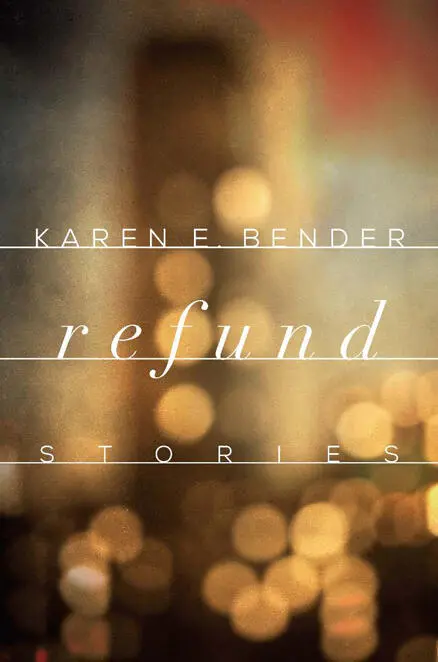
- Название:Refund: Stories
- Автор:
- Издательство:Counterpoint
- Жанр:
- Год:2015
- ISBN:нет данных
- Рейтинг книги:3 / 5. Голосов: 1
-
Избранное:Добавить в избранное
- Отзывы:
-
Ваша оценка:
Refund: Stories: краткое содержание, описание и аннотация
Предлагаем к чтению аннотацию, описание, краткое содержание или предисловие (зависит от того, что написал сам автор книги «Refund: Stories»). Если вы не нашли необходимую информацию о книге — напишите в комментариях, мы постараемся отыскать её.
In Refund, Bender creates an award-winning collection of stories that deeply explore the ways in which money and the estimation of value affect the lives of her characters. The stories in Refund reflect our contemporary world — swindlers, reality show creators, desperate artists, siblings, parents — who try to answer the question: What is the real definition of worth?
In “Theft,” an eighty-year-old swindler, accustomed to tricking people for their money, boards a cruise ship to see if she can find something of true value — a human connection. In “Anything for Money,” the creator of a reality show is thrown into the real world when his estranged granddaughter reenters his life in need of a new heart; and in the title story, young artist parents in downtown Manhattan escape the attack on 9/11 only to face a battle over their subletted apartment with a stranger who might have lost more than only her deposit.
Set in contemporary America, these stories herald a work of singular literary merit by an important writer at the height of her power.
Refund: Stories — читать онлайн бесплатно полную книгу (весь текст) целиком
Ниже представлен текст книги, разбитый по страницам. Система сохранения места последней прочитанной страницы, позволяет с удобством читать онлайн бесплатно книгу «Refund: Stories», без необходимости каждый раз заново искать на чём Вы остановились. Поставьте закладку, и сможете в любой момент перейти на страницу, на которой закончили чтение.
Интервал:
Закладка:
The husband staggered awake after a depressing dream in which a childhood friend had retired early and moved to Tuscany. The kitchen smelled fetid, as though an animal had crawled into a corner and died. The boy, still grief-stricken over his sister’s birth, utilizing their guilt over this to demand endless presents, described his longing for a Slinky that another child had brought to school. “I did want it,” he wailed in a monotone. “I did. I did. I did. I did.” He wanted to wear his Superman shirt with the red cape attached to the shoulders and spent his breakfast leaping out of his seat and trying to shoot his sister with a plastic gun. She, too, already had preferences and screamed until Jane put her into a purple outfit with floppy bunny ears. They wanted to be anything but human. Her husband could not find anything to put on his lunch sandwich and, with a sort of martyred defiance, slapped margarine on bread. “What a man does to save money,” he murmured.
“Why don’t you just buy your lunch?” she asked.
“Do you know how much that costs?” he said. “Do you know how much I’m saving this family by eating crap on bread every day?”
“Get me a Slinky!” the boy yelled, to everyone. The baby screamed.
“Will everyone please shut up?” she said, and then she flinched, embarrassed.
“Don’t say that around the children,” he said.
“I can say what I want.”
“Don’t say shut up ,” the boy said, in a ponderous tone.
“Eat your breakfast,” she hissed at him.
“I hate it,” he wailed, writhing out of his seat and onto the floor, where he curled up under the table as though preparing for a nuclear bomb. She glanced at her husband; their love had been, like all love at the beginning, a mutual and essential misunderstanding, a belief that each could absorb qualities held by the other, that each could save the other from loneliness, that their future held endless promise, that they would not be separated by death. This version of joy was what they had chosen of their own free will.
The baby, not wanting to be outdone, suddenly struck a pose like a fashion model. “How cute,” said the husband; they all hungered for a moment of beauty. The baby laughed, a glittery sound. The boy wept. The future lay before them, limp and endless. The husband got on his hands and knees by the son. “Come now,” he said, his voice exquisite with tenderness. “You’re a big boy now.” He pleaded for maturity for five minutes, and when his voice was about to snap, the boy crawled out and donned a backpack, which made him resemble a miniature college student. He turned around, delighted, so they all applauded.
Their son ran out to their lawn. There was a sweet green freshness in the morning air. It was a Tuesday; she believed she was six weeks along; there was a bad taste in her mouth, of ash. Behind them was their house, a flimsy tribute to the middle class, but one bad car crash, one growing lump, a few missed paychecks would send them packing. They could not afford to have a heart attack, to lose their minds. It was just spring; daffodils burst out of the cold earth. She and her husband stood, bewildered, watching the children in the golden Southern sunlight. She loved them so deeply her skin felt as if it were burning, and she also knew that her love, which she had thought contained boundless wealth, could be handed out to dozens, hundreds, had its finite limits as well.
She called the babysitter, kissed her children goodbye, and went to the clinic. She was afraid that he would have tried to convince her to have the third child. She wept on the way there, for her certainty that she could not have another, for her desire to be good enough for the boy and girl. When she arrived at the clinic, she had stopped weeping. She drove home, sore and cramping, three hours later, down the broad gray lanes bordered by fast-food emporiums, wanting to swerve in and run inside to the high school girls in bright hats behind the counters so that she could hear them say brightly, May I help you?
SOMETIMES DURING THE DAY THERE WOULD BE A KNOCK ON THE door, and it would be their eight-year-old neighbor Mary Grace. She was the only person who was ever at the door. She was beloved by their son, and for this reason, Jane let her wander into their house at all times. Mary Grace was fiercely competitive in all areas including height, hour of bedtime, and the quality of bribe her mother had given her in order for her to get a flu shot. She had thin brown hair, and her eyes were hooded with the suspicion that her parents would do anything possible to keep from listening to her.
Mary Grace’s parents were silent, mysterious types who were very involved in their Baptist church. Jane and her husband tried to guess why the parents never spoke to them and why they never invited the son to their house. Perhaps Mary Grace’s father was having an affair. Or the mother was having an affair. Perhaps they never had sex or had bad sex. Perhaps they did not make each other laugh. Perhaps the mother was sad because she wished she had become a ballet dancer, a doctor, a rock star. Perhaps one drank too much. Perhaps he wanted to live in Australia. Perhaps she hated his taste in clothes. Perhaps one of them had cancer. Perhaps they did not want their floors to get dirty. Would they break up or marinate in their sourness for years? Mary Grace’s parents did not set up any sort of social life for her. Jane noticed the wife spending most of her free time snipping their front hedges with gardening implements that were large and vicious. Jane saw the husband on his dutiful evening walks around the block, his eyes cast down, his feet lifting in a peculiar way so he seemed to be tiptoeing across ice. Mary Grace scuttled over to Jane’s at least once a day, neatly dressed and clean, but always with the demeanor of someone who was starving.
That day, she was grateful for the girl’s knock. Jane had returned from the clinic, opened the door to her home slowly, as though she were an intruder. The children noticed nothing; their absorption in their own crises was complete. They saw only that she was their mother and fell toward her. She was aching and exhausted, but the babysitter couldn’t stay. Jane needed a stranger in the kitchen, someone to speak because she could not.
“Let’s make a magic potion,” Mary Grace announced. She believed touchingly that she could realize her great dreams in their home. The girl rushed into the kitchen. Her hands rummaged through drawers, plucked juice boxes from cupboards. “We need to make a magic potion,” she said. “We need olive oil. Lemonade. Baking soda. Seltzer.”
“Yes,” her son said, gazing at Mary Grace.
Jane brought the items over, and Mary Grace poured them carefully into a glass. Her son was now whispering to her, his face intent, and the girl said, rolling her eyes, “No. It will not make you into a cheetah.” Jane looked at Mary Grace.
“He can become a cheetah if he wants,” Jane broke in.
“Then I want to become a princess,” said Mary Grace.
She brought them some vinegar and mayonnaise and seltzer and watched them stir their concoction. Mary Grace looked up and said, “My mother’s doing her fitness video. She wants to get to her high school weight.”
“Oh,” said Jane.
“She was going to become a fitness instructor, but then she was dating my dad and they knew each other three weeks, and then she dropped everything to have me.” She giggled frantically, as though she was not sure what sound to make. Then Mary Grace grasped Jane’s forearm. The girl’s nails were long and sharp. “Can we add perfume to make princesses?” she asked.
Jane allowed the girl to hold her arm for a moment. “No,” she said. She patted Mary Grace’s hand carefully. “I’m sure she’s very glad she has you,” she said, and she reached up to a cabinet for some baking soda. Mary Grace released her hand.
Читать дальшеИнтервал:
Закладка:
Похожие книги на «Refund: Stories»
Представляем Вашему вниманию похожие книги на «Refund: Stories» списком для выбора. Мы отобрали схожую по названию и смыслу литературу в надежде предоставить читателям больше вариантов отыскать новые, интересные, ещё непрочитанные произведения.








Обсуждение, отзывы о книге «Refund: Stories» и просто собственные мнения читателей. Оставьте ваши комментарии, напишите, что Вы думаете о произведении, его смысле или главных героях. Укажите что конкретно понравилось, а что нет, и почему Вы так считаете.