Karen Bender - Refund - Stories
Здесь есть возможность читать онлайн «Karen Bender - Refund - Stories» весь текст электронной книги совершенно бесплатно (целиком полную версию без сокращений). В некоторых случаях можно слушать аудио, скачать через торрент в формате fb2 и присутствует краткое содержание. Год выпуска: 2015, Издательство: Counterpoint, Жанр: Современная проза, на английском языке. Описание произведения, (предисловие) а так же отзывы посетителей доступны на портале библиотеки ЛибКат.
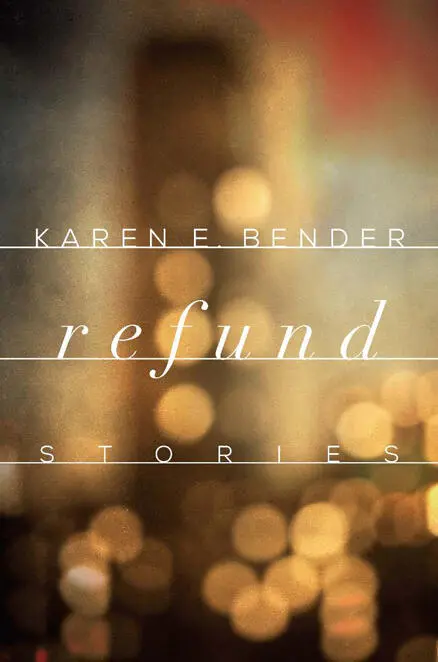
- Название:Refund: Stories
- Автор:
- Издательство:Counterpoint
- Жанр:
- Год:2015
- ISBN:нет данных
- Рейтинг книги:3 / 5. Голосов: 1
-
Избранное:Добавить в избранное
- Отзывы:
-
Ваша оценка:
Refund: Stories: краткое содержание, описание и аннотация
Предлагаем к чтению аннотацию, описание, краткое содержание или предисловие (зависит от того, что написал сам автор книги «Refund: Stories»). Если вы не нашли необходимую информацию о книге — напишите в комментариях, мы постараемся отыскать её.
In Refund, Bender creates an award-winning collection of stories that deeply explore the ways in which money and the estimation of value affect the lives of her characters. The stories in Refund reflect our contemporary world — swindlers, reality show creators, desperate artists, siblings, parents — who try to answer the question: What is the real definition of worth?
In “Theft,” an eighty-year-old swindler, accustomed to tricking people for their money, boards a cruise ship to see if she can find something of true value — a human connection. In “Anything for Money,” the creator of a reality show is thrown into the real world when his estranged granddaughter reenters his life in need of a new heart; and in the title story, young artist parents in downtown Manhattan escape the attack on 9/11 only to face a battle over their subletted apartment with a stranger who might have lost more than only her deposit.
Set in contemporary America, these stories herald a work of singular literary merit by an important writer at the height of her power.
Refund: Stories — читать онлайн бесплатно полную книгу (весь текст) целиком
Ниже представлен текст книги, разбитый по страницам. Система сохранения места последней прочитанной страницы, позволяет с удобством читать онлайн бесплатно книгу «Refund: Stories», без необходимости каждый раз заново искать на чём Вы остановились. Поставьте закладку, и сможете в любой момент перейти на страницу, на которой закончили чтение.
Интервал:
Закладка:
“Go on,” he said.
“They make a neighborhood,” she said. “They add other sad aliens, Kogo and Zarooom. They build big walls around their neighborhood made of glass roses. The only aliens who can move in are other losers. They all have had bad luck. In their neighborhood, they can talk to each other. They make up songs and have contests. Nobody wins. When the good-luck aliens try to see through the wall of roses, they are jealous and lonely.”
He looked at her face. Her forehead was gray and creased, like an old person’s.
“I’ll produce,” he said.
HE DID NOT STOP LOOKING. HE HAD KEPT THE AUDITION SLIPS OF the people who had been willing to give up their hearts for $5 million and was meeting one, Wayne Olden, secretly, for lunch at a Fatburger in Hollywood to check him out. He was planning to take him in for a full medical exam; after that he would hand over the organ donation forms. Lenny had not figured out how he would kill the man, particularly to maintain the integrity of his organs. They were finishing up a hot dog when he received a call.
“I’m not feeling good,” said Aurora.
“What’s wrong?”
“I don’t know.”
Lenny jumped up.
“I have to go,” he said to the man.
“You’re kidding,” said the man.
“Here,” said Lenny, throwing him a thousand-dollar bill. “That’s for lunch.”
The man looked disappointed. “I thought I was going to get five million bucks!”
LENNY’S MERCEDES RACED HOME. IT WAS LATE AFTERNOON, THE shadows long and dark across the grass. Aurora was sitting on the lawn by the pool. She had brought out the sack of stolen items and had set out everything that she had taken. There were pens, staplers, shoes, caps, some loose change, postcards, a spoon, a sock, paper clips, some crumpled Kleenex. The brown paper bags that held them were crumpled up, a pile of small paper balls. All of this surrounded her; the late sun made her face look gold.
“What’s wrong?” he asked.
“I don’t have enough,” she said.
He sat down beside her. His throat was stiff, tense. He said, “Tell me about them.”
She looked at the many items spread out in front of her. She picked up an aluminum cupcake tin. “Sharon Eastman. Cook in the Ambassador Hotel in Chicago, asked me about my favorite foods and showed me how to make cupcakes with buttercream frosting. She made one for me with a rose on it, as I said I wanted one.”
She picked up a coat hanger and said, “This was Greg Mixon’s, who was the coat-check man at the Century 100 Restaurant in Miami, where we went every night for dinner for a month, and who let me sit and read in a corner in the coat closet and gave me a new button for my coat and said this coat hanger would hold it. .”
He listened to her talk and talk, her words coming fast, as though she were in a rush to get everything out. She remembered so much that the others had said, as though she had stored each sentence up when she had been told it. She leaned softly against his shoulder, and he put his arm around her. He was aware of the way his hands fell open by his sides, the way they could hold absolutely nothing.
“Aurora,” he said. “Wait.”
She stopped. Her face was flushed.
“Give me something.”
“What?”
“Give me something of yours. I need it.”
“What thing?”
“Anything.”
“You want something of mine?” she whispered, surprised.
“Yes. Now.”
She shrugged and dug into her pocket. There she had a small piece of red velvet that she had used on her poster for Danger . She handed it to him.
“Here,” she said.
He took the scrap of velvet, closed his fingers around it.
She sat up very straight and looked right at him. Her gaze was sharp. He froze. His skin was as thin as silk. He wondered what she could see, what the light of her gaze detected. He was aware of the palm trees moving gently in the warm wind; he believed he had stopped breathing.
He waited.
Around them, the night sky pressed down like a lid, the stars faint nicks of light in the darkness.
She sat back down; she didn’t say anything. It was a flat, immense silence, and it frightened him. He didn’t know what she saw, and he never would. He sat, not knowing what to say.
She picked up a paper clip off the lawn. She cupped it protectively in her hand.
“This was from Jennifer Macon in Washington, D.C.,” she said. He listened as she told about the paper clip and the rose barrette and the jar of lip balm. She talked, her voice softly piercing the air. The city lit up, a bright, glimmering plain, below them as the sky drained from orange to blue to black. Together, they sat, looking into the dim green exuberance of the garden.
The Third Child
As the streetlights blinked on, Jane Goldman stepped onto her front porch to listen to the faint sound of screaming float from the other houses on her street. The screaming was the sound of children protesting everything: eating, bathing, sharing toys, going to sleep. As the weather warmed, she stood outside on her porch, smoking a rare cigarette and listening. This was her life now, at forty: she had married a man whom she admired and loved, and after the initial confusion of early marriage — the fact that they betrayed the other simply by being themselves — they fell into the exhausting momentum that was their lives. They had produced a son, now five years old, and a daughter, now eight months, two beings who hurtled into the world, ruby-lipped, peach-skinned, and who now held them hostage as surely as masked gunmen controlled a bank.
Jane was a freelance editor for technical manuals, and her husband, after seeing his business as a high-priced website designer dry up, settled into a job as a consultant. They had moved to a midsized city in South Carolina. It was not their first choice, and they did not know if they would ever feel at home there, but they could afford, finally, a small house as well as a car. They had found their own happiness, weighted by resignation: that they were who they were, that they could never truly know the thoughts of another person, that their love was bruised by the carelessness of their own parents (his mother, her father); that they would wander the world in their dreams with ghostly, intangible lovers, that their children would move from adoration of them to fury, that they and their parents would die in different cities, that they would never accomplish anything that would leave any lasting mark on the world. They had longed for this, from the first lonely moment of their childhoods when they realized they could not marry their fathers or mothers, through the burning romanticism of their teens, to the bustling search of their twenties, and there was the faint regret that this tumult and exhaustion was what they had longed for too, and soon it would be gone.
Jane stood on the porch each night, watching the dusk settle on to their street. And when the screaming had ended, she sat watching the other families move behind the windows, gliding silently in their aquariums of golden light.
ONE MORNING SOON AFTER, JANE SAT CROSS-LEGGED ON THE FLOOR of the bathroom, the baby grappling at her breasts, and watched the line form on the test. She and her husband had not been trying for another child. She pressed her lips to her baby girl’s soft head, this one she wanted to love, and she understood, clearly, that she did not feel capable of loving a third child. She had given everything to the others. She kissed the baby’s head, grateful for the aura of kindness the baby bestowed upon her, for now there was no illusion, as there had been when she was a young woman, that this being inside of her would not become a child; she held the thick, muscular result in her hands. The baby’s tiny fingers made her feel faint. They lived in a part of the country where a third (or fourth or fifth) unexpected child arrived and, with jovial weariness, families “made room” for them. She looked at the red line, and it measured all the moments remaining in her life.
Читать дальшеИнтервал:
Закладка:
Похожие книги на «Refund: Stories»
Представляем Вашему вниманию похожие книги на «Refund: Stories» списком для выбора. Мы отобрали схожую по названию и смыслу литературу в надежде предоставить читателям больше вариантов отыскать новые, интересные, ещё непрочитанные произведения.









Обсуждение, отзывы о книге «Refund: Stories» и просто собственные мнения читателей. Оставьте ваши комментарии, напишите, что Вы думаете о произведении, его смысле или главных героях. Укажите что конкретно понравилось, а что нет, и почему Вы так считаете.