Karen Bender - Refund - Stories
Здесь есть возможность читать онлайн «Karen Bender - Refund - Stories» весь текст электронной книги совершенно бесплатно (целиком полную версию без сокращений). В некоторых случаях можно слушать аудио, скачать через торрент в формате fb2 и присутствует краткое содержание. Год выпуска: 2015, Издательство: Counterpoint, Жанр: Современная проза, на английском языке. Описание произведения, (предисловие) а так же отзывы посетителей доступны на портале библиотеки ЛибКат.
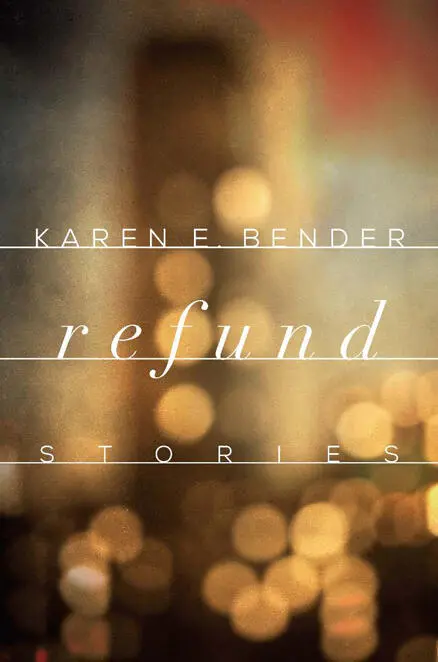
- Название:Refund: Stories
- Автор:
- Издательство:Counterpoint
- Жанр:
- Год:2015
- ISBN:нет данных
- Рейтинг книги:3 / 5. Голосов: 1
-
Избранное:Добавить в избранное
- Отзывы:
-
Ваша оценка:
Refund: Stories: краткое содержание, описание и аннотация
Предлагаем к чтению аннотацию, описание, краткое содержание или предисловие (зависит от того, что написал сам автор книги «Refund: Stories»). Если вы не нашли необходимую информацию о книге — напишите в комментариях, мы постараемся отыскать её.
In Refund, Bender creates an award-winning collection of stories that deeply explore the ways in which money and the estimation of value affect the lives of her characters. The stories in Refund reflect our contemporary world — swindlers, reality show creators, desperate artists, siblings, parents — who try to answer the question: What is the real definition of worth?
In “Theft,” an eighty-year-old swindler, accustomed to tricking people for their money, boards a cruise ship to see if she can find something of true value — a human connection. In “Anything for Money,” the creator of a reality show is thrown into the real world when his estranged granddaughter reenters his life in need of a new heart; and in the title story, young artist parents in downtown Manhattan escape the attack on 9/11 only to face a battle over their subletted apartment with a stranger who might have lost more than only her deposit.
Set in contemporary America, these stories herald a work of singular literary merit by an important writer at the height of her power.
Refund: Stories — читать онлайн бесплатно полную книгу (весь текст) целиком
Ниже представлен текст книги, разбитый по страницам. Система сохранения места последней прочитанной страницы, позволяет с удобством читать онлайн бесплатно книгу «Refund: Stories», без необходимости каждый раз заново искать на чём Вы остановились. Поставьте закладку, и сможете в любой момент перейти на страницу, на которой закончили чтение.
Интервал:
Закладка:
— What’s wrong? he asked, innocent.
— You look different, I said, stepping back.
My mother turned to me; I gasped. In the hard, aching sunlight, she, too, appeared to have plummeted through the years; her hair was lush, dark, around her shoulders, and her face seemed slim as a deer’s.
— I wish you’d cleaned the car, said my mother, smoothing her hair.
— It was clean, I said, a little insulted.
— Not enough, she said. — There was a cup.
— What cup? I asked.
— On the floor. Harold, what are you doing? Let’s check out our room.
My father was standing by the window, practicing his golf swing. His arms gripped an imaginary club, they reached back, and whisk !
I walked with them to the elevator. I touched my arms, my face. Perhaps I had lost my grip on reality, but maybe it felt good to lose my grip. Maybe there was some comfort in having no grip; maybe that was even the answer. Gazing into the mirrored, gold-veined glass of the elevator, I could see that I was still myself, in my forties and worn and sinking south. I was afraid of scrutinizing them too closely; I liked the idea of them as these other beings. My mother tilted my father’s face toward hers and kissed him at length. Thankfully, the elevator door opened.
— Time to get out! I called.
We entered their room. Silence.
— Bad room, said my father.
— Ugh, awful, said my mother.
— What’s the problem? I asked, puzzled.
— Look!
I looked. It was a perfectly decent hotel room. There were mints perched on the swirly gold comforters. There was even a Jacuzzi tub in the middle of the room.
— Lucky you, I said. — You have a Jacuzzi.
— No, but we could trip over it! I can’t see well at night.
— Call downstairs, Laura. Get it changed now—
My mother was already on the phone. Now, in the sour orange light of the bedroom, they were aged, familiar again. Their shoulders stooped slightly, my father shuffling across the room, his beard faded.
I WENT TO THE CAR, CHECKED MYSELF IN THE MIRROR, SAW NOTHING good, tossed the offending cup out of the backseat. After awhile, my parents descended. Now they were in room 126, with no problematic Jacuzzi. They walked, arm in arm, to my car.
— Now I want to show you our home, I said.
I drove for fifteen minutes. What a grand, peculiar sensation, driving my parents. In the various cities where I’d lived, as I cracked thirty and thirty-five and then forty years of age, I had harbored secret hopes of them being my children, of toting them around like this, offering snacks. Now I asked them if anyone would like a peanut butter cracker. This was not the sort of snack to which they were accustomed. However, they accepted them. I pulled up to our house to the sound of crackers being munched.
— Home! I said.
The children ran out of the house, as they had been instructed to do. Burst out of the front door, I said, run like your life depends on it. I had studied our neighbors on national holidays, the way in which they welcomed visiting relatives. They always ran out. Now my children ran out, and they were not acting, I could tell.
My parents clutched their grandchildren. Hello. Hello. You’ve grown so much. Hello.
They walked through the door of our house. Here was my husband, wearing a clean shirt, his hair neatly parted; he stood up, holding out his hand.
I brought them drinks in our finest crystal glasses. My parents sat in our living room. My mother rubbed her hand along the arm of the blue couch.
— That’s the first couch I ever bought, I told them. — I got it in Seattle ten years ago. It was where Jeff and I first sat and talked and thought that perhaps we were interested in each other. We lugged it all the way across the country because it seemed lucky.
How strange the furniture looked, sitting here; it looked like it had been plopped here, without any concern for design or utility. In its randomness, there was, somehow, a sense of shame.
Perched on the couch, my mother brushed her hair. And now the hazy pinkish light of dusk was playing tricks on me. My mother was sluffing off years again! She wasn’t the dark-haired, glossy being from the hotel, but now she looked to be around fifty, a little heavy around the hips, her hair graying with more force. I peered through the room’s dim light.
— How are you doing this? Getting younger? I asked, alarmed.
— Well, thank you, my mother said. — I am using a new moisture cream.
She was scaring me. There was my father, walking around the room, also clocking in at about fifty, his eyes aglow, his stride buoyant, almost a swagger. He had never walked like this at fifty.
I sat down and rubbed my forehead.
— What do you want to do now? my father asked.
I had not thought this far ahead. Here were my parents, sitting on our old lucky couch, and, I thought, veering crazily from decade to decade, while the children ran around the living room and my husband lounged on a chair. It was too much, really.
— I’m making everyone dinner! I said.
The refrigerator was stuffed with foods I had made in preparation. I wanted to make up for thirty years of not having cooked for them. They wandered in.
— What are we having? my father asked.
— Beef Wellington, leek and pumpkin soup, raspberry granita for dessert.
— Is it low-sodium? my father asked.
— Uh, no, I said.
— Oh, he said. — Well, so what! Let’s just celebrate.
They sat patiently and watched as I heated, stirred, poured, etc. The children set the table. The window flushed with the artificial heat. I wanted them to like what I had prepared for them. They waited patiently for their first course. I set the table with the sterling silverware we had received for our wedding. I understood, just then, that I had never set a table with it because no event had seemed important enough.
AFTER ABOUT AN HOUR, THEY WERE READY TO GO BACK TO THE hotel. I drove, hands trembling, afraid to leave them there for the night. They seemed reluctant for me to depart, too. My mother had a sudden, anxious craving for potato chips. My father wanted dental floss. They flipped through the hotel directory, wondering where to get these items. I went to the gift shop downstairs and purchased the chips and dental floss, and then they wanted to shoo me out. They were ready to enjoy their hotel room. I hugged them, feeling their slim shoulders under my hands, and left.
I wondered what age they would wake up in the morning. Sixty? Thirty? One hundred? Did they remember what it was to be forty, fifty? Their faces at that age were a blur to me. What did they look like before I was born?
My car passed the restaurants, businesses, movie theaters of our city. The developments carved out of pine forests, the office buildings, shadowed in the darkness, seemed like they could, at any moment, be stomped by a giant. Our home, bathed in little spotlights, clung to its patch of lawn.
Was this all a joke? What was it?
Hurtling into the house, I found my husband calmly reading a copy of Consumer Reports .
— What are you reading about? I asked.
— There are good deals on lawn mowers, he said.
He sat on the couch, innocent and precious, eating some Cheez-Its, but I was now curdling with dissatisfaction and wanted to pick a fight. In his zeal to find a decent lawn mower, he had forgotten to check the dryer, which had wet clothes in it. Now the clothes smelled like wet dogs.
— I asked you to do this small thing! I burst out.
— No, you didn’t, he said. — Why do I have to be the one to check the dryer?
— Why not you?
— You’re being self-centered.
— No, you.
We sunk into one of those silent, glum familial nights in which every glass we rinsed seemed about to break, every lampshade unfortunate, our breath too loud and alien. We climbed into bed and I felt my husband’s leg, a fine, muscular leg, a leg I knew very well, wrapped around mine, then rubbing against mine, and despite ourselves, our obstinate rightness, of course, all that followed.
Читать дальшеИнтервал:
Закладка:
Похожие книги на «Refund: Stories»
Представляем Вашему вниманию похожие книги на «Refund: Stories» списком для выбора. Мы отобрали схожую по названию и смыслу литературу в надежде предоставить читателям больше вариантов отыскать новые, интересные, ещё непрочитанные произведения.










Обсуждение, отзывы о книге «Refund: Stories» и просто собственные мнения читателей. Оставьте ваши комментарии, напишите, что Вы думаете о произведении, его смысле или главных героях. Укажите что конкретно понравилось, а что нет, и почему Вы так считаете.