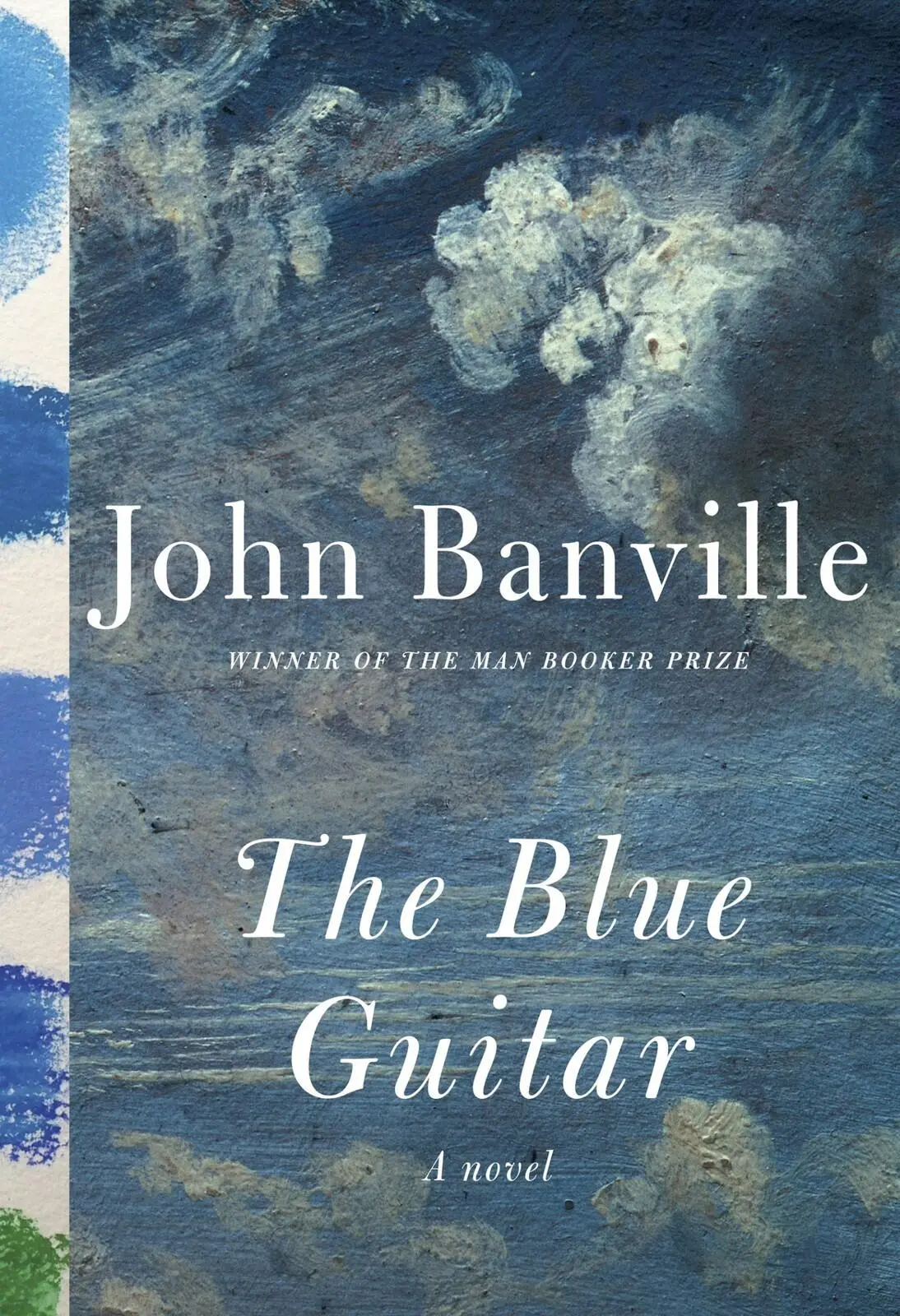
John Banville - The Blue Guitar
Здесь есть возможность читать онлайн «John Banville - The Blue Guitar» весь текст электронной книги совершенно бесплатно (целиком полную версию без сокращений). В некоторых случаях можно слушать аудио, скачать через торрент в формате fb2 и присутствует краткое содержание. Год выпуска: 2015, Издательство: Knopf, Жанр: Современная проза, на английском языке. Описание произведения, (предисловие) а так же отзывы посетителей доступны на портале библиотеки ЛибКат.
- Название:The Blue Guitar
- Автор:
- Издательство:Knopf
- Жанр:
- Год:2015
- ISBN:нет данных
- Рейтинг книги:4 / 5. Голосов: 1
-
Избранное:Добавить в избранное
- Отзывы:
-
Ваша оценка:
The Blue Guitar: краткое содержание, описание и аннотация
Предлагаем к чтению аннотацию, описание, краткое содержание или предисловие (зависит от того, что написал сам автор книги «The Blue Guitar»). Если вы не нашли необходимую информацию о книге — напишите в комментариях, мы постараемся отыскать её.
and
a new novel-at once trenchant, witty, and shattering-about the intricacies of artistic creation and theft, and about the ways in which we learn to possess one another, and to hold on to ourselves. Equally self-aggrandizing and self-deprecating, our narrator, Oliver Otway Orme, is a painter of some renown, and a petty thief who does not steal for profit and has never before been caught. But he's pushing fifty, feels like a hundred, and things have not been going so well lately. Having recognized the "man-killing crevasse" that exists between what he sees and any representation he might make of it-any attempt to make what he sees his own-he's stopped painting. And his last purloined possession-aquired the last time he felt the "secret shiver of bliss" in thievery-has been discovered. The fact that it was the wife of the man who was, perhaps, his best friend, has compelled him to run away: from his mistress, his home, his wife, from whatever remains of his impulse to paint and from the tragedy that haunts him, and to sequester himself in the house where he was born, trying to uncover in himself the answer to how and why things have turned out as they did. Excavating memories of family, of places he's called home, and of the way he has apprehended the world around him ("no matter what else is going on, one of my eyes is always swivelling towards the world beyond"), Ollie reveals the very essence of a man who, in some way, has always been waiting to be rescued from himself.
The Blue Guitar — читать онлайн бесплатно полную книгу (весь текст) целиком
Ниже представлен текст книги, разбитый по страницам. Система сохранения места последней прочитанной страницы, позволяет с удобством читать онлайн бесплатно книгу «The Blue Guitar», без необходимости каждый раз заново искать на чём Вы остановились. Поставьте закладку, и сможете в любой момент перейти на страницу, на которой закончили чтение.
Интервал:
Закладка:
It has just struck me, who knows why, that old Freddie is probably younger than I am. This is a bit of a shock, I can tell you. The fact is, I keep forgetting how old I am; I’m not old-old, but neither am I the blithe youth I so often mistake myself for. What was I thinking of, at my age, to fall in love with Polly and make such a ruinous hash of everything? As well ask why I steal — stole, I mean — or why I stopped painting, or why, for that matter, I started in the first place. One does what one does, and blunders bleeding out of the china shop.
When I got into the hall Polly was nowhere to be seen. I tracked her, guided by the sound of the child’s wails, to a curious little cubby-hole connecting two much larger rooms. The tiny space was dominated by a pair of opposing white doors and, between them, a tall sash window looking out on to the lawn and the drive winding away in the direction of the front gates and the road. Under the window there was a padded bench seat, and here Polly sat, holding the babe on her knee. Mother and child were by now equally distressed, both of them crying, more or less forcefully, their faces flushed and swollen. Polly glared at me and gave a muffled cry of anguish and anger, her eyes shiny and awash and her mouth an open rectangle sagging at the side. One sees why Pablo, the brute, so often went out of his way to make them cry.
Polly, before I could get in a word, began to rail at me with a violence that even in the circumstances seemed to me uncalled-for. She started off by demanding why I had come here. I thought she meant here to Grange Hall, but when I protested that it was she who had insisted I take her home — her very words, remember? — she cut me off impatiently. “Not here!” she cried. “To the town, I mean! You could have lived anywhere, you could have stayed in that place, Aigues-whatever-it’s-called, with the flamingos and the white horses and all the rest of it, but no, you had to come back to us and ruin everything.”
In her agitation she was bouncing the child violently up and down on her knee, like a giant salt-cellar, so that the poor mite’s eyes were rolling in her head and her sobs were compressed into a series of gargles and burps. The sudden shadow of a cloud swooped across the window, but a moment later the pallid sunlight crept out again. No matter what else is going on, one of my eyes is forever turning towards the world beyond.
“Polly,” I began, holding out suppliant hands to her, “dearest Polly—”
“Oh, shut up!” she almost shouted. “Don’t call me that, don’t call me dearest! It makes me sick.”
Little Pip, who had stopped crying, was fixed on me with moony intentness. All children have the artist’s dispassionate gaze; either that, or vice versa.
Now abruptly Polly’s tone changed. “What do you think of him?” she asked, in almost a chatty tone. I frowned; I was baffled. Who? “Mr. Hyland!” she snapped, with a toss of her head. “The Prince, as you call him!” I took a step backwards. I didn’t know what to say. Was there a catch in the question, was it a test of some kind? I progress through the world like a tightrope walker, though I seem always to be in the middle of the rope, where it’s at its slackest, its most elastic. “He’s very shy,” she said, “isn’t he?” Is he? “Yes,” she said, “he is,” glaring at me, as if I had contradicted her.
Outside, once more, the sunlight was doused with a soundless click, and yet again cautiously reasserted itself; far off, a line of bare, gesticulating trees leaned their branches slantwise in the wind.
Polly sighed. “What are we going to do?” she said, sounding not angry now but only vexed and impatient.
The child pressed her head against her mother’s breast and snuggled there possessively, casting back at me a spiteful, drowsy-eyed glance. I say it again, children know more than they know.
I asked Polly if she intended to go back to Marcus. The question was no sooner out than I knew I shouldn’t have asked it. Indeed, more than that: I knew before I asked it that I shouldn’t ask it. There is something or someone in me, a reckless sort of hobbledehoy, lurking in the interstices of what passes for my personality — what am I but a gatherum of will-less affects? — that must always poke a finger into the wasps’ nest. “Will I go back to him?” Polly said archly, as if it were a novel notion, one that had never occurred to her until now. She looked aside then, seeming more uncertain than anything else, and said she didn’t know; that she might; that anyway she doubted he would have her, and that even if he would, she wasn’t sure she wanted to be taken back, like damaged goods being returned to the shop where they had been bought. Evidently I figured nowhere in these considerations of hers. And why should I?
I felt tired, immeasurably tired, and Polly made room for me beside her on the seat and I sat down, leaning dully forwards with my hands on my knees and my eyes fixed vacantly on the floor. The child was asleep by now, and Polly rocked her back and forth, back and forth. The wind keened to itself in a chink in the window frame, a distant, immemorial voice. When the time arrives for me to die I want it to happen at a stilled moment like that, a fermata in the world’s melody, when everything comes to a pause, forgetting itself. How gently I should go then, dropping without a murmur into the void.
Why did I come back and ruin everything? she asked. What a question.
I heard footsteps approaching and sprang guiltily to my feet. Why guiltily? It’s a general condition. Little Pip, still huddled against Polly’s breast, stirred too and awoke. Yet another thing about children: you can fire off a revolver next to their ears and they’ll sleep on without a stir, but pocket the weapon and try tiptoeing out of the nursery and you’ll have them up yelling and waving like shipwrecked sailors. Pip had particularly sharp hearing, as I learned on the one disastrous occasion when Polly brought her to the studio and tried to get her to sleep while we made furtive love on the sofa. She did sleep, curled in a splash of sunlight on a nest of paint-encrusted dust-sheets, until Polly, eyelids aflutter and her throat pulsing, let escape the tiniest, helpless squeak, and I peered over my shoulder to see the child sit up abruptly, as if jerked by a string, to stare in solemn-eyed amazement at the single, naked, monstrously entangled creature into which her mummy and her mummy’s naughty friend had somehow been transformed.
The footsteps, soft and slurred, were Mr. Plomer’s. He hesitated when he saw us there, me standing guard, like poor old Joseph at a bivouac on the flight to Egypt, and Polly seated, cradling the child, with the window and the wind-blown day at her back. Little Pip held out eager arms to her granddad, wanting to be lifted up. He touched her cheek distractedly. “My dear,” he said to his daughter, “I wonder if you’ve seen the little book I was showing to you last evening — the volume of poems? I want to return it to Mr. Hyland, whose property it is, but I can’t seem to find it anywhere.”
—
By late afternoon the rain was back with a vengeance, and I went for a walk. Yes yes, I know what I said about walks and going for them, but on this occasion outdoors was more tolerable than in. A great search had been instituted for Freddie’s missing book. To join in it, under Janey’s command, two extra housemaids were summoned. Up to this they must have been confined in some chamber deep in the lower regions of the house, for I hadn’t known of their existence until they popped up, blushing and tittering. Meg and Molly they were called, a mousy pair, with red knuckles and their hair in buns. There was much clattering of heels on stairs and a raucous calling of voices from room to room, and many a red-bound volume was carried hopefully to Mr. Plomer, but over all of them he sadly shook his head. “I can’t think what has become of it,” he kept repeating, in an increasingly agitated tone, “I really can’t.” Impatient with all this fuss, and seeing in it a reason if not an excuse to be off, I waylaid Janey in the hall and asked if there was some rain-gear I could borrow. Polly, cross with me again because I had declined to take part in the search, caught me slipping out at the front door and gave me a wounded glare. “Daddy’s in an awful sweat,” she said accusingly, “and now Mr. Hyland has taken offence and is threatening to leave because we can’t find his blasted book — and you’re going for a walk. Take Pip with you, at least.” I said I would love to take the child, of course, of course I would, except that it was raining, look, and stepping smartly out on to the glistening step I shut the door behind me and made off.
Читать дальшеИнтервал:
Закладка:
Похожие книги на «The Blue Guitar»
Представляем Вашему вниманию похожие книги на «The Blue Guitar» списком для выбора. Мы отобрали схожую по названию и смыслу литературу в надежде предоставить читателям больше вариантов отыскать новые, интересные, ещё непрочитанные произведения.




Обсуждение, отзывы о книге «The Blue Guitar» и просто собственные мнения читателей. Оставьте ваши комментарии, напишите, что Вы думаете о произведении, его смысле или главных героях. Укажите что конкретно понравилось, а что нет, и почему Вы так считаете.