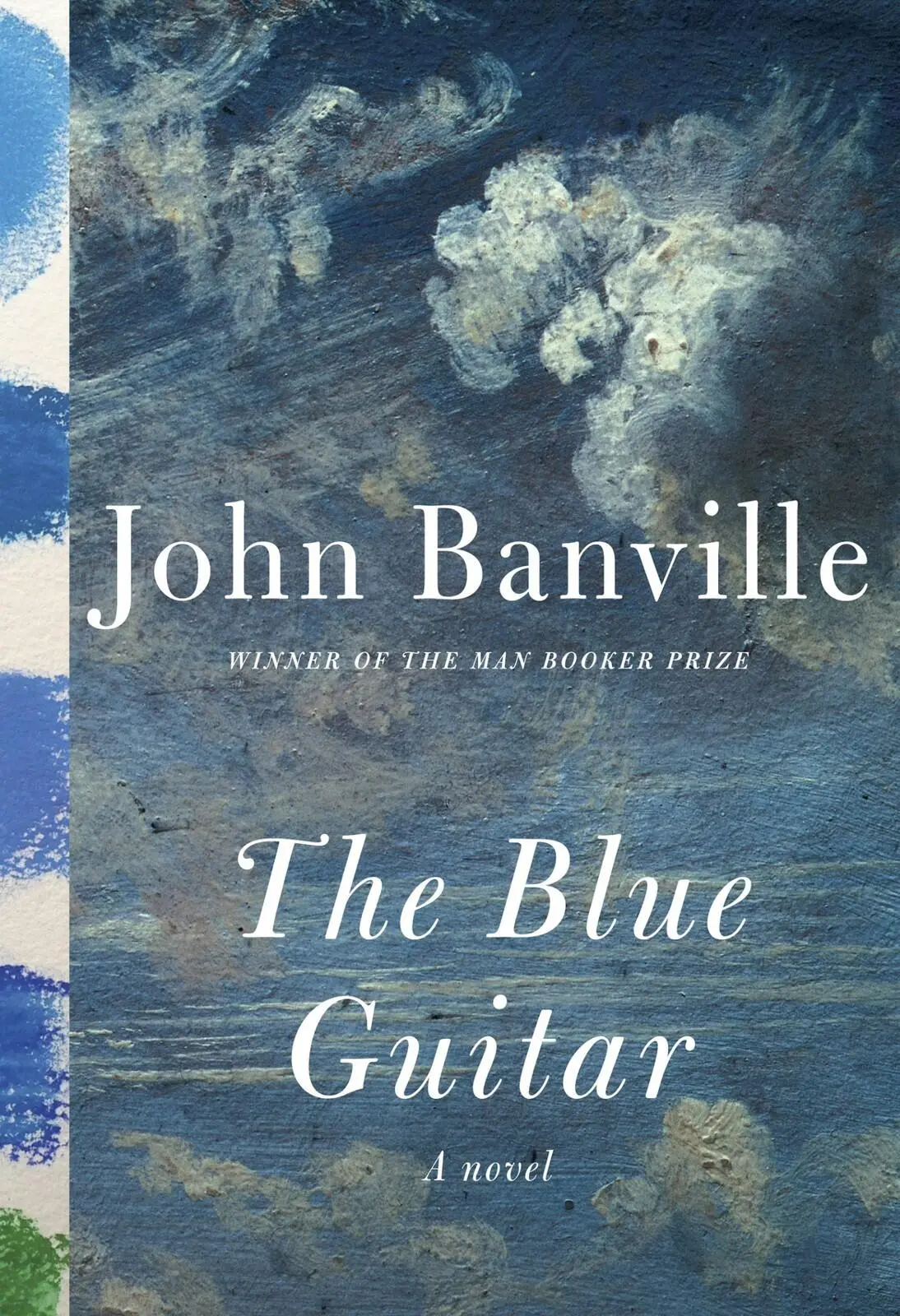
John Banville - The Blue Guitar
Здесь есть возможность читать онлайн «John Banville - The Blue Guitar» весь текст электронной книги совершенно бесплатно (целиком полную версию без сокращений). В некоторых случаях можно слушать аудио, скачать через торрент в формате fb2 и присутствует краткое содержание. Год выпуска: 2015, Издательство: Knopf, Жанр: Современная проза, на английском языке. Описание произведения, (предисловие) а так же отзывы посетителей доступны на портале библиотеки ЛибКат.
- Название:The Blue Guitar
- Автор:
- Издательство:Knopf
- Жанр:
- Год:2015
- ISBN:нет данных
- Рейтинг книги:4 / 5. Голосов: 1
-
Избранное:Добавить в избранное
- Отзывы:
-
Ваша оценка:
The Blue Guitar: краткое содержание, описание и аннотация
Предлагаем к чтению аннотацию, описание, краткое содержание или предисловие (зависит от того, что написал сам автор книги «The Blue Guitar»). Если вы не нашли необходимую информацию о книге — напишите в комментариях, мы постараемся отыскать её.
and
a new novel-at once trenchant, witty, and shattering-about the intricacies of artistic creation and theft, and about the ways in which we learn to possess one another, and to hold on to ourselves. Equally self-aggrandizing and self-deprecating, our narrator, Oliver Otway Orme, is a painter of some renown, and a petty thief who does not steal for profit and has never before been caught. But he's pushing fifty, feels like a hundred, and things have not been going so well lately. Having recognized the "man-killing crevasse" that exists between what he sees and any representation he might make of it-any attempt to make what he sees his own-he's stopped painting. And his last purloined possession-aquired the last time he felt the "secret shiver of bliss" in thievery-has been discovered. The fact that it was the wife of the man who was, perhaps, his best friend, has compelled him to run away: from his mistress, his home, his wife, from whatever remains of his impulse to paint and from the tragedy that haunts him, and to sequester himself in the house where he was born, trying to uncover in himself the answer to how and why things have turned out as they did. Excavating memories of family, of places he's called home, and of the way he has apprehended the world around him ("no matter what else is going on, one of my eyes is always swivelling towards the world beyond"), Ollie reveals the very essence of a man who, in some way, has always been waiting to be rescued from himself.
The Blue Guitar — читать онлайн бесплатно полную книгу (весь текст) целиком
Ниже представлен текст книги, разбитый по страницам. Система сохранения места последней прочитанной страницы, позволяет с удобством читать онлайн бесплатно книгу «The Blue Guitar», без необходимости каждый раз заново искать на чём Вы остановились. Поставьте закладку, и сможете в любой момент перейти на страницу, на которой закончили чтение.
Интервал:
Закладка:
Now I walked on, heedless of the encroaching dark, unnerved by that hallucinatory encounter and yet strangely elated, too. Presently all the foliage round about began to be lit up by the headlights of a vehicle approaching behind me. I stopped and stepped back on to the grass verge again, but instead of passing me by the thing slowed and drew to a shuddering halt. It was Freddie Hyland’s absurd, high-backed jalopy, and here was Freddie himself, peering down at me from the cab.
“I thought it was you,” he said. “May I offer you a lift?”
How does he do it, how does he manage it, that grave, patrician sonority, so that the simplest things he says convey the weight of generations? After all, he was only Freddie Hyland whom my brothers used to bully in the school-yard, snatching his schoolbag from him and kicking it around for a football. I wonder if he remembers those days.
My first impulse was to thank him for his kind offer and politely decline it — a lift to where, anyway? — but instead I found myself walking round by the front of the throbbing machine, through the glare of the head-lamps, and climbing up into the passenger seat. Freddie bestowed on me his slow, melancholy smile. He was wearing his cape and his peaked cap. Chug-chug, and off we went. The big steering-wheel was set horizontally, as in an old-fashioned bus, so that Freddie had to lean out over it, like a croupier spinning a roulette wheel, at the same time devoting much intricate footwork to the pedals on the floor. He drove at an unhurried rate, sedately. The road before us seemed an endless tunnel into which we and our lights were being drawn inexorably. Freddie asked if town was where I wanted to go and, without thinking, I said it was. Why not? As well there as anywhere else. I was on the run again.
I asked Freddie if he had encountered the caravan from the east, as he was coming along the road. He didn’t speak, only shook his head and smiled again, enigmatically, I thought, keeping his eyes on the road.
“The town is where you were born, yes?” he said, after a little time. In the glow from the dashboard his face was a long, greenish mask, the eye-sockets empty and the mouth a thin black gash. I told him about the gate-lodge, rented to us by his cousin, the well-named bearish Urs. To this, too, he returned no comment. Perhaps there is for him a clear band of reference, demarcated long ago, and all that falls outside it he declines to acknowledge. “I have nowhere that I think of as home,” he said pensively. “Of course, I am here, but I’m not of here. The people laugh at us, I know. And yet it’s a hundred years since my great-uncle first came and purchased land and built his house. I’ve always thought we should not have changed our name.” He braked as a fox sprinted across the road in front of us, its brush low and its sharp black snout lifted. “Do you know Alpinia?” he enquired, glancing sideways at me. “Those countries, those regions — Bavaria, the Engadin, Gorizia — perhaps there is my home.” The engine groaned and rattled as we picked up speed again. I seemed to feel a cold sharp breath, as of a gust of wind blowing down from snowy heights. My hat was on the floor at my feet, my blackthorn stick was between my knees. “Our family were Regensburgers,” the Prince said in his weary way, “from the town of Regensburg, in the old time. I often dream of it, of the river and the stone bridge, of those strange Moorish towers with the cranes’ nests built on the top of them. Perhaps I shall go back there, one day, to my people’s place.”
I looked out at the trees as they rose up abruptly in the headlights and as abruptly toppled away again into the darkness behind us. Remember how, in the days when we were little, and what was to become Alpinia was still a mess of warring peoples, there used to be free offers on the backs of corn-flakes packets? You cut out so many coupons and sent them off to an address abroad, and days or weeks later your free gift would come in the post. What a thrill it was, the thought of a stranger somewhere, maybe a girl, with scarlet nail polish and her hair in a perm, wielding her paper-knife and taking out your letter and holding it, actually holding it in her fingers, and reading it, the letter you wrote, and folded, and slid, crackling, as white and crisp as starched linen, into its envelope that smelt so evocatively of wood-pulp and gum. And then there was the thing itself, the gift, a cheap plastic toy that would break after a day or two but that yet was a sacred object, a talisman made magical simply — simply! — by being from elsewhere. No cargo-cultist could have experienced the mystical fervour that I did when my precious parcel came tumbling from the sky. I’ve said it before but I’m going to say it again: that’s the function of stealing, that stolen, the most trivial object is transfigured into something new and numinously precious, something which—
I knew I’d get on to stealing, the subject is never far from my thoughts.
But whoa, you’ll cry, dismount for a minute from that fancy hobby-horse of yours and tell us this: How was it that Polly Pettit née Plomer, whom you pinched from her husband and sought to set among the stars, how was it that she so suddenly lost her goddess’s glow? For that’s what you were out to do, we all know that, to make her divine and nothing less. All right, I admit it, I did attempt the task usually allotted to Eros — yes, Eros — the task of conferring divine light upon the commonplace. But no, no, it was more than that I was about: it was nothing less than total transformation, the clay made spirit. Pleasure, delight, the raptures of the flesh, such things mean nothing, next to nothing, to a man like me. Trans-this and trans-that, all the transes, that’s what I was after, the making over of things, of everything, by the force of concentration, which is, and don’t mistake it, the force of forces. The world would be so thoroughly the object of my passionate regard that it would break out and blush madly in a blaze of self-awareness. There were times, I remember, when Polly would shy away from me, covering herself with her hands, like Venus on her half-shell. “Don’t look at me like that!” she would say, smiling but frowning too, nervous of me and my devouring eye. And she was right to be nervous, for I was out to consume her entirely. And what was this urge’s secret spring? Love’s limitless mad demands, the lover’s furious hunger? Surely not, I say, surely not! It was aesthetics: it was all, always, an aesthetic endeavour. That’s right, Olly, go ahead, hold up your hands and pretend you are misunderstood. You don’t like it, do you, when the knife gets near the bone? Poor Polly, was it not the worst thing of all you could have done to her, to try to have her be something she was not, even if only in your eyes? And look at you now, in flight from her yet again, in some sort of queer cahoots with the Prince of the Snowy Shoulders. What a sham, what a self-deluding, shameless sham you are.
Ah, yes, nothing like the silken whip of self-reproach to soothe a smarting conscience.
Where was I, where were we? Rolling along, yes, Freddie and I, through the darkling eve. We got to the town as the shops were shutting. Always a saddish time of day, in autumn especially. Freddie asked where he might set me down. I didn’t know what to say, and said the railway station, which was the first place that came into my head. He looked surprised, and asked if I were going on a journey, if I were going away. I said yes. I don’t know why I lied. Maybe I did mean to go, to be gone, thus removing the fly, the buzzing bluebottle, from everyone’s ointment. He eyed my oilskins and my blackthorn stick, but made no comment. I could see him thinking, though, and even seemed to detect a stir of unwonted animation in his manner. What could it be that was exciting him?
Читать дальшеИнтервал:
Закладка:
Похожие книги на «The Blue Guitar»
Представляем Вашему вниманию похожие книги на «The Blue Guitar» списком для выбора. Мы отобрали схожую по названию и смыслу литературу в надежде предоставить читателям больше вариантов отыскать новые, интересные, ещё непрочитанные произведения.




Обсуждение, отзывы о книге «The Blue Guitar» и просто собственные мнения читателей. Оставьте ваши комментарии, напишите, что Вы думаете о произведении, его смысле или главных героях. Укажите что конкретно понравилось, а что нет, и почему Вы так считаете.