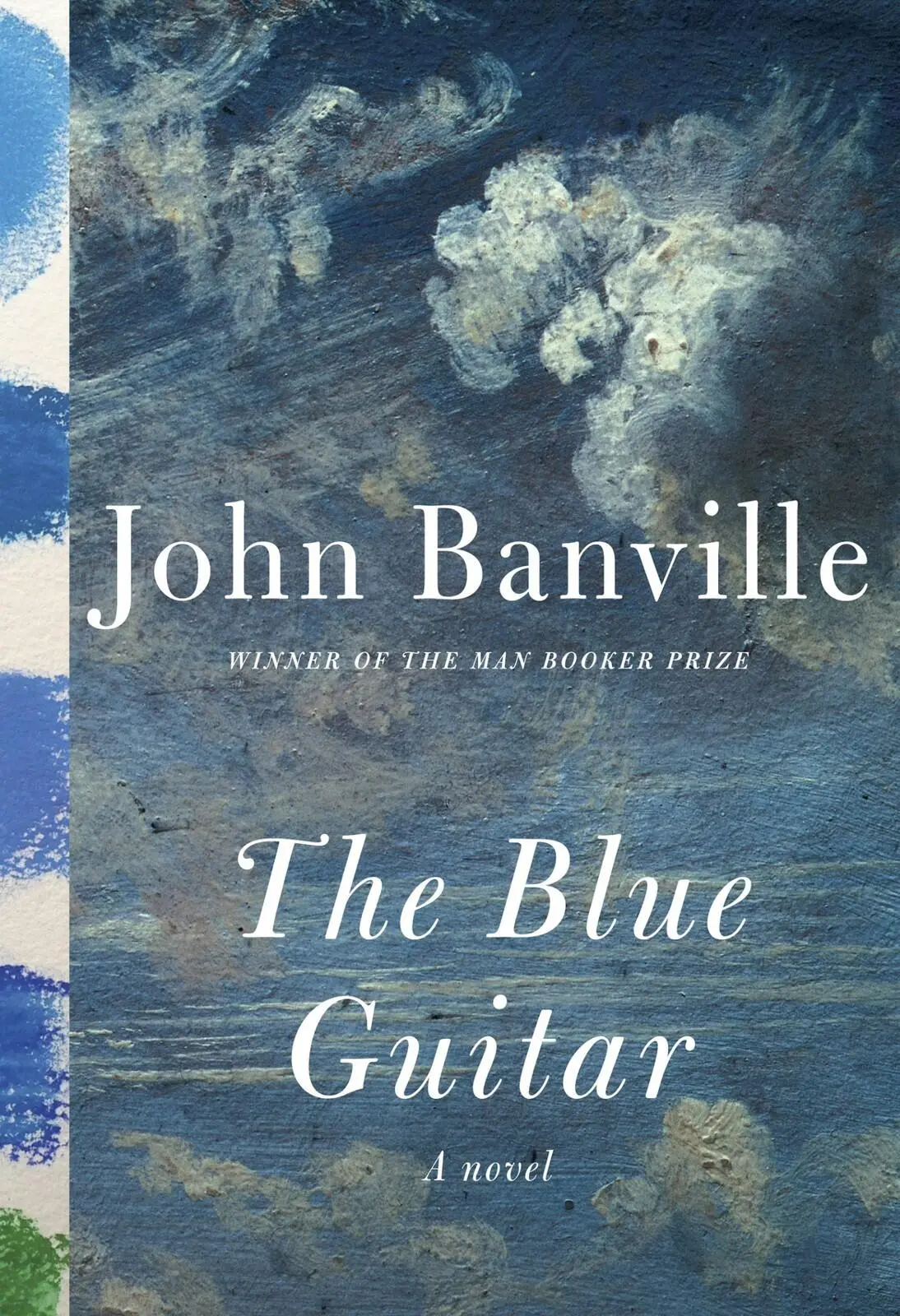
John Banville - The Blue Guitar
Здесь есть возможность читать онлайн «John Banville - The Blue Guitar» весь текст электронной книги совершенно бесплатно (целиком полную версию без сокращений). В некоторых случаях можно слушать аудио, скачать через торрент в формате fb2 и присутствует краткое содержание. Год выпуска: 2015, Издательство: Knopf, Жанр: Современная проза, на английском языке. Описание произведения, (предисловие) а так же отзывы посетителей доступны на портале библиотеки ЛибКат.
- Название:The Blue Guitar
- Автор:
- Издательство:Knopf
- Жанр:
- Год:2015
- ISBN:нет данных
- Рейтинг книги:4 / 5. Голосов: 1
-
Избранное:Добавить в избранное
- Отзывы:
-
Ваша оценка:
The Blue Guitar: краткое содержание, описание и аннотация
Предлагаем к чтению аннотацию, описание, краткое содержание или предисловие (зависит от того, что написал сам автор книги «The Blue Guitar»). Если вы не нашли необходимую информацию о книге — напишите в комментариях, мы постараемся отыскать её.
and
a new novel-at once trenchant, witty, and shattering-about the intricacies of artistic creation and theft, and about the ways in which we learn to possess one another, and to hold on to ourselves. Equally self-aggrandizing and self-deprecating, our narrator, Oliver Otway Orme, is a painter of some renown, and a petty thief who does not steal for profit and has never before been caught. But he's pushing fifty, feels like a hundred, and things have not been going so well lately. Having recognized the "man-killing crevasse" that exists between what he sees and any representation he might make of it-any attempt to make what he sees his own-he's stopped painting. And his last purloined possession-aquired the last time he felt the "secret shiver of bliss" in thievery-has been discovered. The fact that it was the wife of the man who was, perhaps, his best friend, has compelled him to run away: from his mistress, his home, his wife, from whatever remains of his impulse to paint and from the tragedy that haunts him, and to sequester himself in the house where he was born, trying to uncover in himself the answer to how and why things have turned out as they did. Excavating memories of family, of places he's called home, and of the way he has apprehended the world around him ("no matter what else is going on, one of my eyes is always swivelling towards the world beyond"), Ollie reveals the very essence of a man who, in some way, has always been waiting to be rescued from himself.
The Blue Guitar — читать онлайн бесплатно полную книгу (весь текст) целиком
Ниже представлен текст книги, разбитый по страницам. Система сохранения места последней прочитанной страницы, позволяет с удобством читать онлайн бесплатно книгу «The Blue Guitar», без необходимости каждый раз заново искать на чём Вы остановились. Поставьте закладку, и сможете в любой момент перейти на страницу, на которой закончили чтение.
Интервал:
Закладка:
Yet it ended in a not altogether unhappy truce when Polly, exhausted by her own rhetoric and the steadily ravelling tangle of accusations she had been bringing against me, gave in and turned off the lamp and lay down again, and even permitted me to lie beside her, not under the covers, no, but on top of them, wrapped up tight like a caterpillar in the scratchy cocoon of my blanket. And so we rested there, somewhat together on her impossibly narrow bed, listening to the rain falling on the world. I could feel Polly drifting into sleep, and so did I, soon after. It wasn’t long, though, before the cold and the damp wakened me again. The rain had stopped and all was silent save for the rhythmic soughing of Polly’s breathing. She must have been having a bad dream — she would hardly be having a good one, considering all that had gone on that night — for now and then she gave a soft moan at the back of her throat, like a child crying in its sleep. The curtains were open and through the window I could see that the sky had cleared, and the stars were out, sharp and atremble, as if each one were hanging by a fine, invisible thread. I know the dark before dawn is supposed to be the bleakest hour of the day, but I love it, and love to be awake in it. Always it is so still then, with everything holding back, waiting on the sun’s great roar. Polly was lying against me now and even through the thickness of the eiderdown I could feel her heart beating, and her breath was on my cheek, too, slightly stale, familiar, human. I saw a shooting star and, almost immediately, in rapid succession, two more. Zip, zip zip. Then in stately stealth an airship appeared, rising on a slant out of the east, light greyish-blue against the sky’s rich purplish-black, its cabin slung underneath like a lifeboat with lighted windows, sailing steadily at no great height, sausage-shaped, preposterous, yet a thing for me to marvel at, a frail and silent vessel travelling westwards, carrying its cargo of lives.
Oh, Polly. Oh, Gloria.
Oh, Poloria!
—
In the morning there was another round of comic scenes, with no one laughing. For all our sakes I shall pass over breakfast in silence, except to say that the centrepiece of the repast was a big soot-black pot of porridge, and that Barney the dog, who had taken a shine to me, came and flopped down under the table at my feet, or mostly on my feet, in fact, and produced at intervals a series of soundless farts the stench of which made me almost gag on my stirabout. Afterwards I locked myself away for half an hour in the bathroom I had not been able to find the night before, possibly because it was next door to the room I had slept in. It was cramped and wedge-shaped, with a single narrow window at the pointed end. There was a hip bath, the porcelain chipped and yellowed, and an enormous stately lavatory with a wooden seat like a carthorse’s yoke, on which I sat at stool for a long time, with my elbows on my knees, gazing into a vast and torpid emptiness. Then, standing at the sink, I saw that the window looked out on the same view, of stables, hill and trees, that I had seen from Polly’s room on the next floor down. The sky was cloudless and the yard below was awash with watery sunlight. I had brought nothing with me from the gate-lodge, and had to shave as best I could with a pearl-handled cut-throat razor I found at the back of a cabinet beside the bath. There was a diagonal crack in the shaving mirror hanging on a nail over the sink, and as I scraped away the stubble — frustratingly, though probably fortunately, the blade was blunt — I looked to myself disconcertingly like one of the demoiselles of Avignon, the jut-faced odalisque in the middle, with the jaunty top-knot, I should think. How sad is my ridiculousness, how ridiculous my sadness.
Somewhere nearby, down in the stables, it must have been, a donkey began to bray. I hadn’t heard a donkey braying since — since I don’t know when. What did it think it was saying? Most creatures of this earth, when we raise a solitary voice like that, have only one thing on our minds, but could those glottal bellowings, a truly astonishing noise, be a cry of love and longing? If so, what does the damsel donkey think, hearing it? For all I know, it may sound to her bristling ears like the tenderest lay of the troubadour. What a world, dear Lord, what a world, and I in it, old braying donkey that I am.
I spent the rest of the morning dodging about the house, anxious to avoid another confrontation, even in daylight, with Polly’s crack-brained mother. Nor did I care to encounter her father, who I feared would manoeuvre me gently but inescapably into a corner and require of me, in his diffident way, an account of what exactly my intentions were towards his daughter, who was a married woman, and on whom, not by the way, I had nearly a good twenty years in age. Intentions, did I have intentions? If so, I certainly had no clear idea any longer of what they were, if I ever had. I thought I had broken free from Polly, thought I had jumped ship and paddled away in the dark at a furious rate, only to find myself, at first light, still wallowing helplessly in her wake, the painter — the painter! — tangled round the tiller of my frail bark, the knots swollen with salt water and tough as a knuckle of bog-oak. Why when she fell asleep didn’t I get up from her bed and go, as I had gone before, a thief, verily a thief, in the night? Why was I still there? What held me? What was that woody knot I couldn’t unpick? For her part, Polly in the course of the morning paid me scant heed, engaged as she was in the tricky task of being at once a mother and a daughter. When on occasion we came unavoidably face to face, she gave me only a harried stare and barged past me, muttering impatiently under her breath. The result of all this was that I began to feel oddly detached, not only from Grange Hall and the people in it, but from myself, too. It was as if I had been pushed somehow off-balance, and had to keep grasping at air to stop myself falling over. Odd sensation. And suddenly, now, I recall another donkey, from long ago, in my lost boyhood. A sweep of concrete-coloured beach, the day overcast with a whitish glare; there is the sharp ricochet of children’s voices along the sand and the happy shrieks of bathers breasting the surf. The donkey’s name is Neddy; it is written on a cardboard sign. He wears a straw hat with holes cut in it for his outlandish ears to stick through. He stands stolidly on his prim little feet, chewing something. His eyes are large and glossy, they fascinate me — I imagine he must be able to see practically all the way around the horizon. His attitude to everything about him is one of vast indifference. I refuse to ride on him, because I’m frightened. They don’t fool me, animals, with their pretence of dullness: I see the look in their eye that they try to hide but can’t; they all know something about me that I don’t. My father, breathing heavily, grasps me roughly by the shoulders and orders me to stand next to Neddy, to do that much, at least, so that he can take my photograph. My mother gives my hand a secret squeeze, we are conspirators together. Then, as my fussy father at last presses the button and the shutter clicks, Neddy shifts heavily on his haunches, and in doing so leans against me, no, leans into me; I feel the solid, tight-packed weight of him and smell the dry, brownish odour of his pelt, and for a moment I am displaced, as if the world, as if Nature, as if the great god Pan himself, has given me a nudge and knocked me out of true. And that’s how it was with me again, that morning at Grange Hall, as I drifted through the house in search of my own displaced self.
There was another reason, more immediate and prosaic, to feel pushed to the sidelines. Although Polly’s father had been acquainted with the Prince, so-called, for many years, this was the first time His Nibs had paid a personal visit, and the household was agog with nervous anticipation. Already Janey had taken offence over some suggestion as to what she should serve for lunch, and had shut herself away in the kitchen to sulk. Pa Plomer, though outwardly vague and absent as usual, seemed to emit a continuous high-pitched hum, and his hands must have been raw from the constant rubbings he was giving them. His wife, alone of all the household, floated above the general excitement, serene behind a smile of secret knowing.
Читать дальшеИнтервал:
Закладка:
Похожие книги на «The Blue Guitar»
Представляем Вашему вниманию похожие книги на «The Blue Guitar» списком для выбора. Мы отобрали схожую по названию и смыслу литературу в надежде предоставить читателям больше вариантов отыскать новые, интересные, ещё непрочитанные произведения.



Обсуждение, отзывы о книге «The Blue Guitar» и просто собственные мнения читателей. Оставьте ваши комментарии, напишите, что Вы думаете о произведении, его смысле или главных героях. Укажите что конкретно понравилось, а что нет, и почему Вы так считаете.