Alan Moorehead - Gallipoli
Здесь есть возможность читать онлайн «Alan Moorehead - Gallipoli» весь текст электронной книги совершенно бесплатно (целиком полную версию без сокращений). В некоторых случаях можно слушать аудио, скачать через торрент в формате fb2 и присутствует краткое содержание. Год выпуска: 0101, ISBN: 0101, Издательство: Rockport Publishers, Жанр: prose_military, military_history, на английском языке. Описание произведения, (предисловие) а так же отзывы посетителей доступны на портале библиотеки ЛибКат.
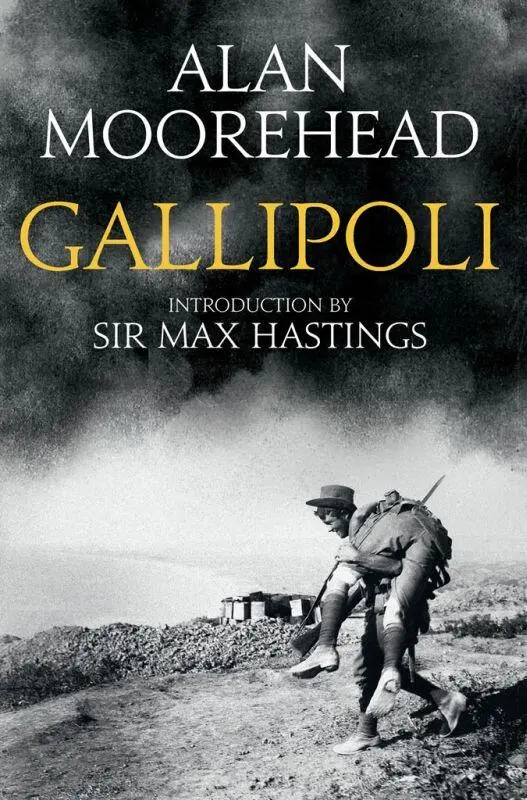
- Название:Gallipoli
- Автор:
- Издательство:Rockport Publishers
- Жанр:
- Год:0101
- ISBN:9781781314852
- Рейтинг книги:5 / 5. Голосов: 1
-
Избранное:Добавить в избранное
- Отзывы:
-
Ваша оценка:
Gallipoli: краткое содержание, описание и аннотация
Предлагаем к чтению аннотацию, описание, краткое содержание или предисловие (зависит от того, что написал сам автор книги «Gallipoli»). Если вы не нашли необходимую информацию о книге — напишите в комментариях, мы постараемся отыскать её.
Gallipoli — читать онлайн бесплатно полную книгу (весь текст) целиком
Ниже представлен текст книги, разбитый по страницам. Система сохранения места последней прочитанной страницы, позволяет с удобством читать онлайн бесплатно книгу «Gallipoli», без необходимости каждый раз заново искать на чём Вы остановились. Поставьте закладку, и сможете в любой момент перейти на страницу, на которой закончили чтение.
Интервал:
Закладка:
Together the two parties left the beach, and passing through cornfields flecked with poppies walked up to the hills where the battle had taken place. ‘Then,’ Herbert says, ‘the fearful smell of death began as we came upon scattered bodies. We mounted over a plateau and down through gullies filled with thyme, where there lay about 4,000 Turkish dead. It was indescribable. One was grateful for the rain and the grey sky. A Turkish Red Crescent man came and gave me some antiseptic wool with scent on it, and this they renewed frequently. There were two wounded crying in that multitude of silence.’
Many of the dead had sunk to the ground in the precise attitude they had adopted at the moment when the bullets stopped their rush, their hands clasping their bayonets, their heads thrust forward or doubled up beneath them. Nothing was missing except the spark of life. They lay in mounds on the wet earth, whole companies of soldiers, like some ghastly tableau made of wax.
Among the living men there was at first some little friction. Everyone was nervous, everyone expected that even in these awful nightmarish surroundings some kind of treachery had been planned by the other side. There were complaints: the Australians were stealing arms: the Turks were coming too close to the Anzac trenches. At Quinn’s Post, where the lines were only ten or fifteen yards apart, the tension was almost a palpable thing in the air, an inflammable essence that might explode at any moment. Hands on their triggers the men watched one another across the narrow space, expecting at every minute that someone would make some foolish gesture that would start the fighting again. On the wider stretches of the battlefield, however, Turks and Anzac troops worked together in digging great communal graves, and as the hours went by they began to fraternize, offering cigarettes to one another, talking in broken scraps of English and Arabic, exchanging badges and gadgets from their pockets as souvenirs.
Herbert was kept busy settling points of difference. He allowed the Turks to extract for burial some bodies which had been built into their emplacements, and once he was even permitted to go into the enemy trenches to satisfy himself that the Turks were not using this lull to fortify and advance their positions. He found there a group of soldiers whom he had known previously in Albania. They gathered round him cheering and clapping, and he had to stop them because they were interrupting the burial services which were being conducted round about by the Moslem Imams and die Christian priests. From this time onwards the Turks were constantly corning up to him for orders, and even getting him to sign receipts for money taken from the dead. Intervals of bright sunshine had now followed the rain.
Compton Mackenzie and Major Jack Churchill (the brother of Winston Churchill) had come over from the Arcadian for the day, and they stood on a parapet constructed chiefly of dead bodies to watch the scene. ‘In the foreground,’ Mackenzie writes, ‘was a narrow stretch of level scrub along which white flags were stuck at intervals, and a line of sentries, Australians and Turks, faced one another. Staff officers of both sides were standing around in little groups, and there was an atmosphere about the scene of local magnates at the annual sports making suggestions about the start of the obstacle race. Aubrey Herbert looked so like the indispensable bachelor that every country neighbourhood retains to take complete control of the proceedings on such occasions. Here he was, shuffling about, loose-gaited, his neck out-thrust and swinging from side to side as he went peering up into people’s faces to see whether they were the enemy or not, so that, if they were, he could offer them cigarettes and exchange a few courtesies with them in their own language…
‘The impression which that scene from the ridge by Quinn’s Post made on my mind has obliterated all the rest of the time at Anzac. I cannot recall a single incident on the way back down the valley. I know only that nothing could cleanse the smell of death from the nostrils for a fortnight afterwards. There was no herb so aromatic but it reeked of carrion, not thyme nor lavender, nor even rosemary.’
By three in the afternoon the work was practically done. There were two crises: it was discovered at the last minute that the Turks’ watches were eight minutes ahead of the British, and a hurried adjustment had to be made. Then, as the hour for the ending of the truce was approaching, a shot rang out. Standing there in the open with tens of thousands of rifles pointed towards them the burial parties stood in a sudden hush, but nothing followed and they returned to their work again.
At four o’clock the Turks near Quinn’s Post came to Herbert for their final orders, since none of their own officers were about. He first sent back the grave-diggers to their own trenches, and at seven minutes past four retired the men who were carrying the white flags. He then walked over to the Turkish trenches to say good-bye. When he remarked to the enemy soldiers there that they would probably shoot him on the following day, they answered in a horrified chorus, ‘God forbid.’ Seeing Herbert standing there, groups of Australians came up to the Turks to shake hands and say good-bye. ‘Good-bye, old chap; good luck.’ The Turks answered with one of their proverbs: ‘Smiling may you go and smiling may you come again.’
All the remaining men in the open were now sent back to their lines, and Herbert made a last minute inspection along the front, reminding the Turks that firing was not to begin again for a further twenty-five minutes. He was answered with salaams, and he too finally dropped out of sight. At 4.45 p.m. a Turkish sniper fired from somewhere in the hills. Immediately the Australians answered and the roar of high explosive closed over the battlefield again.
There had been some irregularities. On both sides a good deal of surreptitious digging had been done, and both Turkish and British staff officers had strolled about no-man’s-land, covertly studying the lie of each other’s trenches. It was even said — and the story has never been denied in Turkey — that Kemal had disguised himself as a sergeant and had spent the whole nine hours with various burial parties close to the Anzac trenches.
Much the most important result of the battle and the truce, however, was that from this time onwards all real rancour against the Turks died out in the Anzac ranks. They now knew the enemy from their own experience, and he had ceased to be a propaganda figure. He was no longer a coward, a fanatic or a monster. He was a normal man and they thought him very brave.
This camaraderie with the enemy — the mutual respect of men who are committed to killing one another — was not peculiar to Gallipoli for it existed also in France; but on this isolated battlefield it had a special intensity. The Australian and New Zealand troops refused to use the gas-masks that were now issued to them. When they were questioned about this they made some such reply as, ‘The Turks won’t use gas. They’re clean fighters.’ [18] Gas was never used at Gallipoli.
Had the soldiers known Enver a little better they might not have been so certain of this; yet perhaps they did know Enver, for politicians generally were held in contempt at Gallipoli and by both sides, and in a way that seldom occurred in the second world war. Soon many of the British began to feel as Herbert felt: that the campaign need never have been fought at all had only the politicians acted more responsibly in the beginning.
The extreme ferocity with which the battles were fought at Gallipoli gives no inkling of the compassion that the opposing soldiers in the front line felt for one another. In the periods of comparative calm which followed May 19 at Anzac, the most bizarre incidents occurred. Once a staff officer visiting the front saw with astonishment that a number of Turks were walking about behind their lines in full view of the Australians. He asked, ‘Why don’t you shoot?’ and was answered, ‘Well, they’re not doing any harm are they? Might as well leave the poor beggars alone.’ Later in the campaign there was an old Turk who apparently had been given the job of doing the washing for his platoon. Regularly each day he emerged from his trench and hung out the wet shirts and socks in a line along the parapet, and no Allied soldier would have dreamed of shooting him. The Turks on their side usually withheld their fire from the survivors of wrecked ships, and in the front line at least their prisoners were treated with kindness.
Читать дальшеИнтервал:
Закладка:
Похожие книги на «Gallipoli»
Представляем Вашему вниманию похожие книги на «Gallipoli» списком для выбора. Мы отобрали схожую по названию и смыслу литературу в надежде предоставить читателям больше вариантов отыскать новые, интересные, ещё непрочитанные произведения.







Обсуждение, отзывы о книге «Gallipoli» и просто собственные мнения читателей. Оставьте ваши комментарии, напишите, что Вы думаете о произведении, его смысле или главных героях. Укажите что конкретно понравилось, а что нет, и почему Вы так считаете.