Alan Moorehead - Gallipoli
Здесь есть возможность читать онлайн «Alan Moorehead - Gallipoli» весь текст электронной книги совершенно бесплатно (целиком полную версию без сокращений). В некоторых случаях можно слушать аудио, скачать через торрент в формате fb2 и присутствует краткое содержание. Год выпуска: 0101, ISBN: 0101, Издательство: Rockport Publishers, Жанр: prose_military, military_history, на английском языке. Описание произведения, (предисловие) а так же отзывы посетителей доступны на портале библиотеки ЛибКат.
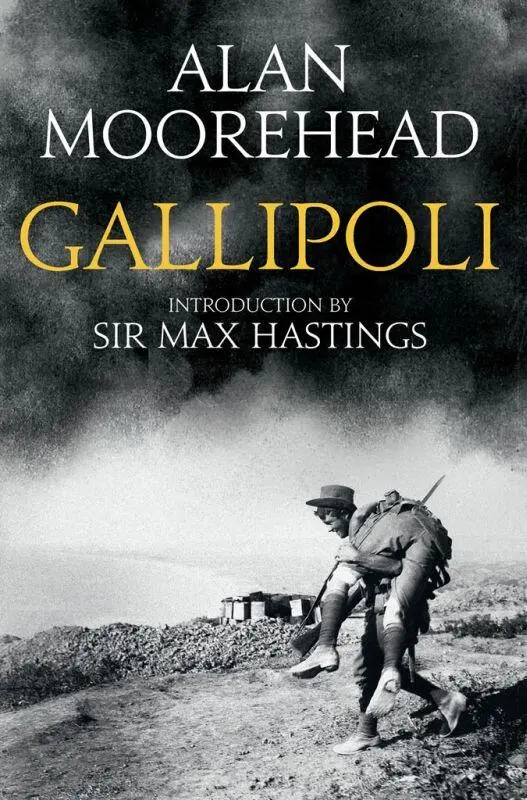
- Название:Gallipoli
- Автор:
- Издательство:Rockport Publishers
- Жанр:
- Год:0101
- ISBN:9781781314852
- Рейтинг книги:5 / 5. Голосов: 1
-
Избранное:Добавить в избранное
- Отзывы:
-
Ваша оценка:
Gallipoli: краткое содержание, описание и аннотация
Предлагаем к чтению аннотацию, описание, краткое содержание или предисловие (зависит от того, что написал сам автор книги «Gallipoli»). Если вы не нашли необходимую информацию о книге — напишите в комментариях, мы постараемся отыскать её.
Gallipoli — читать онлайн бесплатно полную книгу (весь текст) целиком
Ниже представлен текст книги, разбитый по страницам. Система сохранения места последней прочитанной страницы, позволяет с удобством читать онлайн бесплатно книгу «Gallipoli», без необходимости каждый раз заново искать на чём Вы остановились. Поставьте закладку, и сможете в любой момент перейти на страницу, на которой закончили чтение.
Интервал:
Закладка:
These high spirits, this fineness and integrity created by the powerful drug of risk, might not perhaps have continued indefinitely under such a strain, but there had certainly been no weakening in morale when, on May 18, the soldiers became aware that something unusual was happening in the enemy lines.
An unaccountable silence spread through the hills before them. For the first time since they had landed the fearful racket of the Turkish howitzers died away, and for several minutes at a stretch no rifle or machine-gun was fired. In this strange quiet most of the day went by. Then at five o’clock in the evening a tremendous artillery barrage broke out, and it continued for about half an hour. It chanced that on this day a naval aircraft had been sent out to fix the position of an enemy warship in the straits, and on his return the pilot reported that he had seen large numbers of men massing behind the Turkish lines. Later in the day this information was confirmed by a second pilot who had also seen enemy soldiers coming across the straits in boats from the Asiatic side; and from the battleship Triumph there was a further report that Turkish reinforcements were marching north from Cape Helles to the Anzac front. On hearing this, Birdwood sent a message to his two divisional commanders warning them to expect an attack that night; the men were to stand to arms at 3 a.m., which was half an hour before the usual time.
The night turned cold and misty, and when the moon went down at 11.35 p.m. there was hardly a sound along the front except for the breaking of the waves on the shore. Suddenly at fifteen minutes to midnight, a fusillade of rifle fire which was heavier than anything that had been heard before burst out from the Turkish trenches, and as it spread along the line the Anzac commanders kept telephoning to their outposts to ask if they were being attacked. But nothing followed, and presently the uproar dwindled into silence again. At 3 a.m. the men were roused, and they took their places on the firing steps with their bayonets fixed to their rifles. It was still cold and most of them were wearing their overcoats.
Hardly five minutes had gone by when a shout of warning went up from one of the outposts, and a company of Turks was seen advancing down a ravine known as Wire Gully in the centre of the line. There had been no preliminary bugle call, none of the usual shouts of Allah, Allah: merely these shadowy forms in the half-darkness and the long line of bayonets. The Australians opened fire from either side of the gully, and immediately the enemy bugles sounded and the charge began. Everywhere along the line the Turks jumped up from their hiding places and in a dark cloud swept forward over the broken ground.
At most places the oncoming enemy had to cross two or three hundred yards before they reached the Anzac entrenchments, and so there was half a minute or more when they were exposed in the open and quite defenceless. Very few of them survived even that amount of time. There was a kind of cascading movement in the battle; directly one line of soldiers had come over the parapet and been destroyed another line formed up, emerged into view and was cut down. For the first hour it was simply a matter of indiscriminate killing, but presently the Australians and New Zealanders began to adopt more systematic methods: when a Turkish officer appeared they deliberately withheld their fire until he had assembled the full company of his men in the open. Then all were destroyed together. At some points it became a kind of game to pick off the survivors as they ran back and forth across the battlefield like terrified rabbits in search of cover. Here and there some few of the Turks did manage to get into the Anzac trenches, but they survived only for a few minutes; there was a quick and awful bayoneting and then the tide receded again.
As daylight broke the battle assumed the character of a hunt, with the Turkish officers serving in the role of beaters driving the game on to the guns. A wild, almost berserk excitement filled the Australian and New Zealand ranks. In order to get a better view many of the soldiers jumped up and sat astride the parapets and from there they blazed away at the screaming mass of Turks before them. The Anzac soldiers who had been held in reserve could not bear to be left out of the fight; they came pressing forward offering to pay for a place on the firing line. In one trench two soldiers actually fought one another with their fists for a vacant position on the parapet, and there was a kind of mad surrealism in the shouts and cries along the line as each new Turkish rush came on. ‘Backsheesh’ ‘Imshi Yallah’, ‘Eggs is cooked’. [17] Or ‘Eggs-a-cook’, an expression used by the Egyptian vendors when they sold eggs to the Anzac troops during their stay in Egypt.
Once an Australian was heard shouting to the Turks as they fell back from his trench, ‘ Saida (good-bye). Play you again next Saturday.’
By 5 a.m., when a hot sun was beginning to stream down on to the battlefield, the attack was broken. But the orders to the Turks were that they should continue the fight until they got through to the sea, and so they went on with the struggle for another six hours, each new charge getting a little feebler than the last. Mustafa Kemal had been reduced to the command of a single division, the 19th, for the period of the offensive, and he alone, of the four divisional commanders engaged, had succeeded in making any headway. When at midday Essad Pasha decided to break off the action 10,000 of his men had fallen, and of these some 5,000, dead, dying and wounded, were lying out in the open between the trenches.
Other heavier battles than this were fought at Gallipoli, but none with such a terrible concentration of killing, none so one-sided, and none with so strange an aftermath. Through the long afternoon the wounded lay with the dead on the battlefield, and although the trenches on either side were only a yard or two away no one could go out and bring them in without taking the risk of being instantly shot.
‘No sound came from that dreadful space,’ the Australian history of the campaign relates, ‘but here and there some wounded or dying man, silently lying without help or any hope of it under the sun which glared from a cloudless sky, turned painfully from one side to the other, or slowly raised an arm towards heaven.’
Birdwood was warned by his medical staff that, quite apart from any feelings of humanity, the dead should be buried as quickly as possible to prevent infection spreading through the Army. When the afternoon had passed without any sign of the Turks renewing the attack, he sent off Aubrey Herbert to ask Hamilton aboard the Arcadian if he might arrange an armistice.
Herbert was an odd figure on the Anzac bridgehead — indeed, he would have been odd in any army on any battlefield: a Member of Parliament turned soldier, an eccentric, a poet and a scholar who, far from hating the Turks, was captivated by them. This did not mean he was disloyal — he was determined that they should be defeated — but he knew Turkey and Turkish very well, and he believed that with better handling by the politicians they might have been converted into allies. Of all the band who had been with Rupert Brooke at Alexandria he was the one most possessed of ideas, and despite his short-sightedness, his impulsive and agitated manner, he was very brave and saw very clearly under the façade of things. Hamilton was glad enough to have him on his staff as an intelligence officer with the rank of lieutenant-colonel, but he noted in his diary that he was ‘excessively unorthodox’.
Herbert chose to do his intelligence work in the front line at Anzac, and he proceeded to war in the manner of a nineteenth-century gentleman-adventurer. Servants were engaged at Lemnos, suitable horses and mules acquired, an adequate kit assembled, and off he went with an extraordinary assemblage of Greek and Levantine interpreters to the peninsula. There were staff troubles almost at once. A spy mania was raging through the Anzac bridgehead — the fear of spies seems to be endemic in every crisis in every military campaign — and his interpreters were arrested as many as four and five times a day. A terrible hail of shrapnel once fell on Herbert’s dugout, and the cook, a Greek named Christopher of the Black Lamp, with the tears pouring down his face gave two hours’ notice, though why it should be two hours and not two minutes he was unable to explain. Among these and other domestic anxieties Herbert continued with his work of questioning the Turkish prisoners and of acting as a kind of general confidant of the commanders in all questions relating to the habits and character of the enemy.
Читать дальшеИнтервал:
Закладка:
Похожие книги на «Gallipoli»
Представляем Вашему вниманию похожие книги на «Gallipoli» списком для выбора. Мы отобрали схожую по названию и смыслу литературу в надежде предоставить читателям больше вариантов отыскать новые, интересные, ещё непрочитанные произведения.








Обсуждение, отзывы о книге «Gallipoli» и просто собственные мнения читателей. Оставьте ваши комментарии, напишите, что Вы думаете о произведении, его смысле или главных героях. Укажите что конкретно понравилось, а что нет, и почему Вы так считаете.