Alan Moorehead - Gallipoli
Здесь есть возможность читать онлайн «Alan Moorehead - Gallipoli» весь текст электронной книги совершенно бесплатно (целиком полную версию без сокращений). В некоторых случаях можно слушать аудио, скачать через торрент в формате fb2 и присутствует краткое содержание. Год выпуска: 0101, ISBN: 0101, Издательство: Rockport Publishers, Жанр: prose_military, military_history, на английском языке. Описание произведения, (предисловие) а так же отзывы посетителей доступны на портале библиотеки ЛибКат.
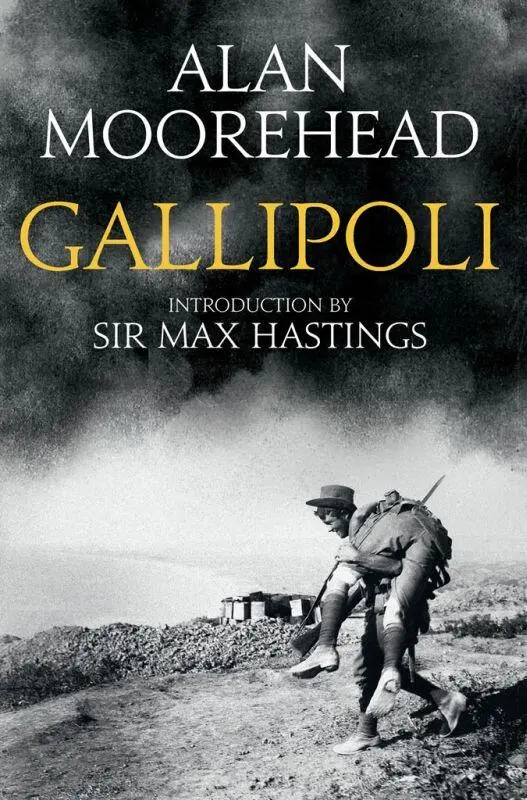
- Название:Gallipoli
- Автор:
- Издательство:Rockport Publishers
- Жанр:
- Год:0101
- ISBN:9781781314852
- Рейтинг книги:5 / 5. Голосов: 1
-
Избранное:Добавить в избранное
- Отзывы:
-
Ваша оценка:
Gallipoli: краткое содержание, описание и аннотация
Предлагаем к чтению аннотацию, описание, краткое содержание или предисловие (зависит от того, что написал сам автор книги «Gallipoli»). Если вы не нашли необходимую информацию о книге — напишите в комментариях, мы постараемся отыскать её.
Gallipoli — читать онлайн бесплатно полную книгу (весь текст) целиком
Ниже представлен текст книги, разбитый по страницам. Система сохранения места последней прочитанной страницы, позволяет с удобством читать онлайн бесплатно книгу «Gallipoli», без необходимости каждый раз заново искать на чём Вы остановились. Поставьте закладку, и сможете в любой момент перейти на страницу, на которой закончили чтение.
Интервал:
Закладка:
His methods of propaganda were very direct. He crawled into the foremost trenches and from there he addressed the enemy soldiers in their own language, urging them to desert, promising them good treatment and pointing out that the real quarrel of the Allies was not with Turkey but with the Germans. At times he actually got into trenches which communicated directly into the enemy emplacements, and lying on the dead bodies there, he called to the Turks through a single barrier of sandbags. Occasionally they would listen and enter into argument with him. More often they replied with hand-grenades — a thing which did not make Herbert very welcome with the Anzac troops — and in Constantinople one of the newspapers announced that there was someone in the Anzac bridgehead who was making a low attempt to lure the Turks from their duty by imitating the prayers of the muezzin.
It now fell to Herbert to put the case to Hamilton for an armistice. He argued that unless something was done quickly the situation would become intolerable: our own wounded as well as Turkish were still lying in the open, and in the hot sun the dead bodies were decomposing rapidly. Hamilton answered that he would not initiate any proposal himself, because the enemy would make propaganda of it, but if the Turks liked to come forward he was willing to grant them a cessation of hostilities for a limited period. It was agreed finally that notes could be thrown into the Turkish trenches telling them of this.
Meanwhile all May 20 had gone by and unknown to Hamilton and Herbert the soldiers at the front had already taken matters into their own hands. Towards evening an Australian colonel caused a Red Cross flag to be hoisted on a plateau at the lower end of the line. He intended to send out his stretcher-bearers to bring in a number of wounded Turks who were crying out pitiably in front of his trenches. Before they could move, however, the Turks put two bullets through the staff of the flag and brought it down. A moment later a man jumped up from the Turkish trenches and came running across no-man’s-land. He stopped on the parapet above the Australians’ heads, spoke a few words of apology, and then ran back to his own lines again. Immediately afterwards Red Crescent flags appeared above the enemy trenches, and Turkish stretcher-bearers came out. All firing ceased along the line, and in this eerie stillness General Walker, the commander of the 1st Australian Division, got up and walked towards the enemy. A group of Turkish officers came out to meet him, and for a while they stood there in the open, smoking, and talking in French. It was agreed that they should exchange letters on the subject of an armistice at 8 p.m. that night.
While this was going on another impromptu parley with the enemy had opened on another section of the line. It was now growing late and Birdwood, as soon as he heard what was happening, issued an order that no further burials were to be made that night. A note signed by the General’s A.D.C. was handed to a Turkish officer: ‘If you want a truce to bury your dead,’ it said, ‘send a staff officer, under a flag of truce, to our headquarters via the Gaba Tepe road, between 10 a.m. and 12 noon tomorrow.’
At this stage neither side seems to have been absolutely sure of themselves; there was a tense feeling that some act of treachery might occur at any moment, that an attack might be launched under the cover of the white flags — and indeed, an Australian soldier who had been out in no-man’s-land came back with the report that the enemy trenches were filled with men who were apparently ready to attack. Upon this the Australians opened fire on a party of stretcher-bearers who were still wandering about in the failing light. At once the Turkish artillery started up again and the bombardment continued intermittently all night.
Hamilton says he was very much annoyed when he heard of these irregular dealings with the enemy, and he dispatched Braithwaite to Anzac to handle the negotiations. The following letter, addressed to ‘ Commandant en chef des Forces Britanniques , Sir John Hamilton,’ arrived from Liman von Sanders.
‘Grand Quartier Général de la 5 me. Armée Ottomane.
le 22 mai 1915.
Excellence,
J’ai l’honneur d’informer Votre Excellence que les propositions concernant la conclusion d’un armistice pour enterrer les morts et secourir les blessés des deux parties adverses, ont trouvé mon plein consentement — et que seuls nos sentiments d’humanité nous y ont déterminés.
J’ai investi le lieutenant-colonel Fahreddin du pouvoir de signer en mon nom.
J’ai l’honneur d’être avec assurance de ma plus haute considération.
Liman von Sanders, Commandant en chef de la 5 me. Armée Ottomane.’There is an air of fantasy about the conference that took place at Birdwood’s headquarters on May 22. Herbert walked through heavy showers of rain along the Gaba Tepe beach, and a ‘fierce Arab officer and a wandery-looking Turkish lieutenant’ came out to meet him. They sat down and smoked in a field of scarlet poppies. Presently Kemal himself arrived on horseback with other Turkish officers, and they were blindfolded and led on foot into the Anzac bridgehead. The British intelligence officers were anxious to give the impression that a great deal of barbed-wire entanglement had been erected on the beach, and they forced Kemal to keep goose-stepping over imaginary obstacles as he went along. Presently the Turks were remounted and taken to Birdwood’s dugout by the beach.
The conference in the narrow cave was a stiff and strained affair, the Turkish Beys in their gold lace, the British generals in their red tabs, each side trying to make it clear that it was not they who were eager for the armistice. But the atmosphere was relieved by one moment of pure farce: an Australian soldier, not knowing or caring about what was going on inside the dugout, put his head round the canvas flap and demanded, ‘Have any of you bastards got my kettle?’
Herbert meanwhile had been taken into the Turkish lines as a hostage. He was mounted on a horse and blindfolded, and then led round and round in circles to confuse his sense of direction. At one stage the fierce Arab officer cried out to the man who was supposed to be leading the horse, ‘You old fool. Can’t you see he’s riding straight over the cliff?’ Herbert protested strongly and they went on again. When finally the bandage was taken from his eyes he found himself in a tent in a grove of olives, and the Arab officer said, ‘This is the beginning of a lifelong friendship’. He ordered cheese, tea and coffee to be brought, and offered to eat first to prove that the food was not poisoned. They had an amiable conversation, and in the evening when Kemal and the other Turks came back from Birdwood’s headquarters Herbert was blindfolded again and returned to the British lines.
The terms of the truce had been settled as precisely as possible; it was to take place on May 24 and was to continue for nine hours. Three zones were to be marked out with white flags for the burial of the dead — one Turkish, one British and the third common to both sides. Priests, doctors and soldiers taking part in the burials were to wear white armbands and were not to use field-glasses or enter enemy trenches. All firing was of course to cease along the line, and the soldiers in the opposing trenches were not to put their heads above their parapets during the period of the truce. It was also agreed that all rifles minus their bolts were to be handed back to whichever side they belonged to — but this move was circumvented to some extent by the Australians, who on the previous evening crept out into no man’s-land and gathered up as many weapons as they could find.
The morning of May 24 broke wet and cold, and the soldiers were in their greatcoats. Soon after dawn the firing died away, and at six-thirty Herbert set out again with a group of officers for Gaba Tepe beach. Heavy rain was falling. After an hour the Turks arrived — Herbert’s acquaintance of two days before and several others, including a certain Arif, the son of Achmet Pasha, who handed Herbert a visiting card inscribed with the words, Sculpteur et Peintre. Etudiant de Poésie.
Читать дальшеИнтервал:
Закладка:
Похожие книги на «Gallipoli»
Представляем Вашему вниманию похожие книги на «Gallipoli» списком для выбора. Мы отобрали схожую по названию и смыслу литературу в надежде предоставить читателям больше вариантов отыскать новые, интересные, ещё непрочитанные произведения.









Обсуждение, отзывы о книге «Gallipoli» и просто собственные мнения читателей. Оставьте ваши комментарии, напишите, что Вы думаете о произведении, его смысле или главных героях. Укажите что конкретно понравилось, а что нет, и почему Вы так считаете.