Alan Moorehead - Gallipoli
Здесь есть возможность читать онлайн «Alan Moorehead - Gallipoli» весь текст электронной книги совершенно бесплатно (целиком полную версию без сокращений). В некоторых случаях можно слушать аудио, скачать через торрент в формате fb2 и присутствует краткое содержание. Год выпуска: 0101, ISBN: 0101, Издательство: Rockport Publishers, Жанр: prose_military, military_history, на английском языке. Описание произведения, (предисловие) а так же отзывы посетителей доступны на портале библиотеки ЛибКат.
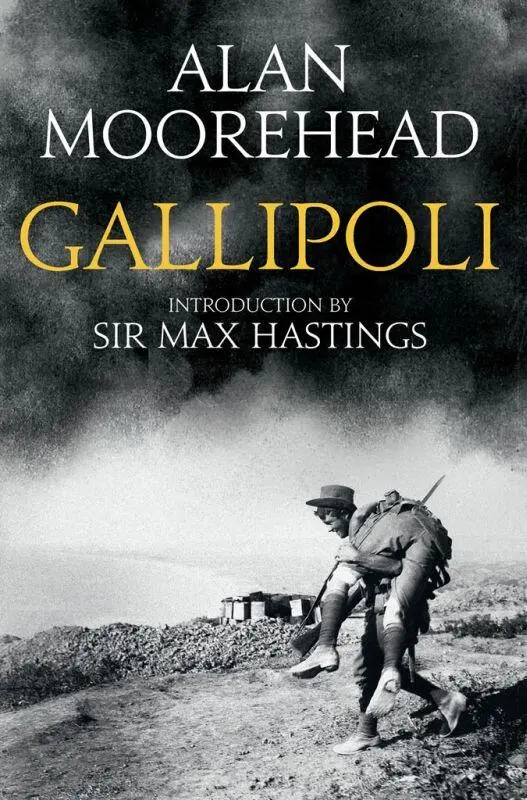
- Название:Gallipoli
- Автор:
- Издательство:Rockport Publishers
- Жанр:
- Год:0101
- ISBN:9781781314852
- Рейтинг книги:5 / 5. Голосов: 1
-
Избранное:Добавить в избранное
- Отзывы:
-
Ваша оценка:
Gallipoli: краткое содержание, описание и аннотация
Предлагаем к чтению аннотацию, описание, краткое содержание или предисловие (зависит от того, что написал сам автор книги «Gallipoli»). Если вы не нашли необходимую информацию о книге — напишите в комментариях, мы постараемся отыскать её.
Gallipoli — читать онлайн бесплатно полную книгу (весь текст) целиком
Ниже представлен текст книги, разбитый по страницам. Система сохранения места последней прочитанной страницы, позволяет с удобством читать онлайн бесплатно книгу «Gallipoli», без необходимости каждый раз заново искать на чём Вы остановились. Поставьте закладку, и сможете в любой момент перейти на страницу, на которой закончили чтение.
Интервал:
Закладка:
There is a revealing quality about this grotesque little incident, for it was symptomatic of the general tug-of-war in which they were all engaged: Maxwell withholding troops from Hamilton, Fisher withholding ships from Churchill, the Conservatives withholding political support from Asquith. The setback at Gallipoli, in short, had brought out into the open, and more bitterly than ever, the great issue which in the end was to dominate all others before the end of the year: were they to fight in the East or the West?
Meanwhile on the peninsula the Army’s store of ammunition had fallen so low that the guns were rationed to two shells a day. On the two fronts at Anzac and Cape Helles there was desultory fighting from time to time, but hardly more than a few yards of ground changed hands, and it seemed now that nothing could break the deadlock. Yet the situation could not remain as it was, some sort of decision would have to be taken. And, in fact, at this ultimate moment of hesitation, a glimpse of reality was on its way. A few moments before dawn, on this same day, May 19, General Birdwood was woken in his dugout at Anzac with the news that, in a packed mass of many thousands, the Turks were streaming across to his trenches in the darkness.
CHAPTER NINE
THERE is some dispute as to who ordered the attack on the Anzac bridgehead on the night of May 18. Liman von Sanders says that he himself made the plan and he takes the responsibility for it; others believe that it was conceived by Enver when he first visited the peninsula on May 10, and the circumstances of the enterprise do, in fact, bear the impress of Enver’s headlong cast of mind. There was no subtlety or caution about the matter: some 42,000 men under the command of Essad Pasha were assembled, and their orders were nothing less than to demolish the whole Anzac bridgehead at a single blow. By nightfall it was hoped that the last Dominion soldier would have been killed, captured or driven into the sea, and that the entire Turkish army would have then been free to turn south to deal with the remainder of Hamilton’s forces at Cape Helles.
At this time the Australian and New Zealand Corps had dwindled to some 10,000 effective men, and it was only by luck that a brigade which had been sent round to Cape Helles earlier in the month was returned to Birdwood on the eve of the battle. This brought his numbers to a total of about 17,000, of which 12,500 were available for fighting in the front line. They were thus outnumbered by more than three to one.
The Anzac position had by now become very clearly defined: it was a shallow triangle, covering about 400 acres, its base, a mile and a half long, resting on the sea, its apex reaching to the slopes of Sari Bair about a thousand yards from the shore. In order to avoid the fire of the British Fleet the Turks had dug their trenches almost on top of the Anzac lines, and at some places the two sides were divided by not more than ten yards. The situation at Quinn’s and Courtnay’s Posts in the centre of the line was fantastic; directly behind the Australian trench (which was kept packed with men by day and night), a steep cliff fell away to the gully below, and the Turks had only to make an advance of five yards in order to drive a wedge through the bridgehead to the sea. But this they never could succeed in doing, though they attacked repeatedly during the first half of May. No-man’s-land at these and other points was no larger than a small room, and it was the easiest thing in the world for the Turks to toss a hand grenade into the Anzac trenches. The only real defence against this was to throw the grenade smartly back again before it exploded; except for a few jam tins which were filled with explosive at a makeshift workshop on the beach, the Australians had no such weapons of their own. No man could expose the smallest fraction of his body for an instant without being shot, and even a periscope hoisted for a moment above the parapet was immediately shattered. An extreme tension prevailed in the bridgehead; there was no hour when some new raid was not expected or delivered, no minute when shells were not crashing among them or bullets screaming overhead. The soldiers managed to sleep through this racket at odd hours of the day and night, but it was never a sufficient rest. No one was ever safe. On May 14 General Bridges, the commander of the Australian Division, was mortally wounded, and the following day Birdwood had his hair parted by a bullet while he was looking through a periscope. The wound turned septic and was very painful but he continued in command.
There was an intense hatred of the Turks among the Dominion soldiers. Most of them had grown up in a world of clear and obvious values; a fight was a fight, you knew who your enemy was and you stood up to him and had it out, fairly and squarely, in the open. It was in this spirit that they had volunteered for service in the Army. The charge was the thing, the quick and palpable blow in the face that knocked the man down. War, in fact, was an extension of the pub brawl, and it had in it the elements of rioting, of street fighting, of instant physical revenge.
But nothing of the kind had happened at Gallipoli. From the day they had landed the soldiers had scarcely ever seen the enemy; he lurked unseen in the heights above, he sniped down on them and caught them unawares, he stood back at a safe distance with his guns and burst his shrapnel above their heads, and there seemed to be no effective way of retaliating. After more than three weeks of this the soldiers were beginning to feel an increasing sense of frustration and of impotent anger in their narrow bridgehead. A claustrophobia had developed; they felt that they had been caught in a trap, and there seemed to be something unfair in this kind of fighting in which they were never given a chance of showing their real courage and their strength.
Beyond this there was at this early stage another and perhaps deeper feeling that there was a monstrosity and inhumanity about the Turks: they were cruel and sinister fanatics, capable of any sort of vice and bestiality — in brief, it was the popular picture that had been drawn of them by Byron and the emotions of Gladstonian liberal England. The Turks were ‘natives’—but natives of a peculiarly dangerous and subtle kind. And so the Australian and New Zealand soldiers fought, not an ordinary man, but a monster prefigured by imagination and by propaganda; and they hated him.
Despite these things, perhaps even because of them, an extraordinary cheerfulness and exaltation possessed the men in the front line. Living with the instant prospect of death, all pettiness, all the normal anxieties and jealousies of life, deserted them, and they developed an almost mystical feeling towards the extreme danger that surrounded them. The fighting became an elaborate and exciting game in which they were all immensely engrossed, and it was only when they were retired to rest for a while in some half-haven under the cliffs that they became aware again of the miseries of their situation, the monotonous food, the endless physical discomfort, the impossible limits of a life in which even a canteen of fresh water or a bathe in the sea were the utmost luxuries.
By now death had become a familiar, and they often talked about it in a half-derisive deprecating slang. In the same way as the Chinese will laugh at other people’s pain it became a huge joke when the men bathing off the beach were caught in a burst of shrapnel, or when some poor devil had his head blown off while he was in the latrine. There had to be some sort of expression which would help to rationalize the unbearable circumstances of their lives, some way of obtaining relief from the shock of it all, and since tears were impossible this callous hard-boiled laughter became the thing. They were not fatalists. They believed that a mistake had been made in the landing at Gaba Tepe and that they might easily have to pay for it with their lives; but they very much wanted to go on living, they were all for the battle and they hoped and believed obscurely that in the end they would win.
Читать дальшеИнтервал:
Закладка:
Похожие книги на «Gallipoli»
Представляем Вашему вниманию похожие книги на «Gallipoli» списком для выбора. Мы отобрали схожую по названию и смыслу литературу в надежде предоставить читателям больше вариантов отыскать новые, интересные, ещё непрочитанные произведения.









Обсуждение, отзывы о книге «Gallipoli» и просто собственные мнения читателей. Оставьте ваши комментарии, напишите, что Вы думаете о произведении, его смысле или главных героях. Укажите что конкретно понравилось, а что нет, и почему Вы так считаете.