Alan Moorehead - Gallipoli
Здесь есть возможность читать онлайн «Alan Moorehead - Gallipoli» весь текст электронной книги совершенно бесплатно (целиком полную версию без сокращений). В некоторых случаях можно слушать аудио, скачать через торрент в формате fb2 и присутствует краткое содержание. Год выпуска: 0101, ISBN: 0101, Издательство: Rockport Publishers, Жанр: prose_military, military_history, на английском языке. Описание произведения, (предисловие) а так же отзывы посетителей доступны на портале библиотеки ЛибКат.
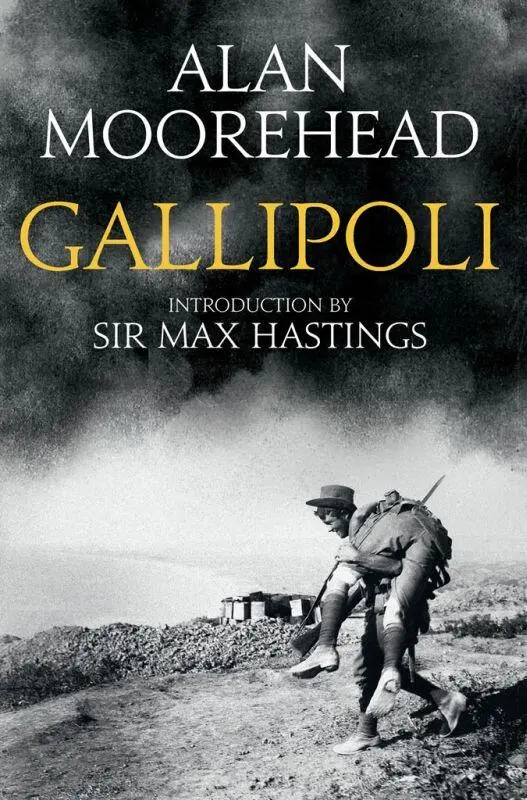
- Название:Gallipoli
- Автор:
- Издательство:Rockport Publishers
- Жанр:
- Год:0101
- ISBN:9781781314852
- Рейтинг книги:5 / 5. Голосов: 1
-
Избранное:Добавить в избранное
- Отзывы:
-
Ваша оценка:
Gallipoli: краткое содержание, описание и аннотация
Предлагаем к чтению аннотацию, описание, краткое содержание или предисловие (зависит от того, что написал сам автор книги «Gallipoli»). Если вы не нашли необходимую информацию о книге — напишите в комментариях, мы постараемся отыскать её.
Gallipoli — читать онлайн бесплатно полную книгу (весь текст) целиком
Ниже представлен текст книги, разбитый по страницам. Система сохранения места последней прочитанной страницы, позволяет с удобством читать онлайн бесплатно книгу «Gallipoli», без необходимости каждый раз заново искать на чём Вы остановились. Поставьте закладку, и сможете в любой момент перейти на страницу, на которой закончили чтение.
Интервал:
Закладка:
But it was the physical appearance of the Dominion soldiers — Colonials as they were then called — that captivated everybody who came to Anzac, and there is hardly an account of the campaign which does not refer to it with admiration and even a kind of awe. ‘As a child,’ Mackenzie wrote, ‘I used to pore for hours over those illustrations of Flaxman for Homer and Virgil which simulated the effect of ancient pottery. There was not one of those glorious young men I saw that day who might not himself have been Ajax or Diomed, Hector or Achilles. Their almost complete nudity, their tallness and majestic simplicity of line, their rose-brown flesh burnt by the sun and purged of all grossness by the ordeal through which they were passing, all these united to create something as near to absolute beauty as I shall hope ever to see in this world.’
The soldiers themselves might not have thought of it in this way, but here perhaps, in this unlikely place, was the expression of Rupert Brooke’s dream of war, the Grecian frieze, the man entirely heroic and entirely beautiful, the best in the presence of death. Just for this moment at the end of May and in the months that followed they were the living embodiment of the legend they were creating. This was the highest moment of their countries’ short history; they had fought and won their first great battle, they were still in the glow of it, they knew suffering and they were not afraid. They had made a fortress of this wretched strip of foreign soil on which they had so haphazardly drifted, and they were quite determined to hold on. Never again in the whole course of the campaign did the Turks attempt an assault in force upon the Anzac bridgehead.
CHAPTER TEN
DURING the first few weeks of the campaign the wildest rumours went about Constantinople; ten thousand British were said to have been killed at the landing, and another thirty thousand taken prisoner. At one moment the Allies were reported to be advancing on the city and at the next they had been driven into the sea. Once again there was talk of special trains that were to evacuate the Government into the interior, of bombardments and of riots. Yet it was not quite the same ferment, the near panic, that had followed the naval attack on the Narrows in March. The Allied Fleet then had been feared in much the same way as the Air Force bombers were feared at the start of the second world war, but a military campaign on land was something that everyone could understand, a slower and a more familiar thing; there was no question of the capital being demolished overnight.
Enver took a firm line from the outset; he announced flatly that the Allies were already defeated, and to celebrate the event there was a ceremony at St. Sophia at which the Sultan was invested with the tide of El Ghazi, the Conqueror, the driver of the Allies into the sea. Flags were hung out in all the principal streets and public squares.
It is doubtful if anyone was much impressed by this, but by the end of the first week in May it was clear at least that the invading army was not making much headway. An apathetic quiet settled on the streets, and the city began to accustom itself to the suspense, the misery and the occasional shocks of a long campaign. Presently the old familiar signs of war began to appear: the conscripts marching through the streets in their shabby field grey uniforms and pyramidal hats, the Army communiqués that announced yesterday’s victory all over again, the ferocious newspaper articles, the flags and the parades, the spy hunt and the renewed outburst of official xenophobia.
Once again the foreign minorities, the Armenians and the Greeks, went underground with their thoughts and, where they could, their belongings. Bedri, the Chief of Police, pursued them as persistently as he could, issuing worthless receipts for the goods he seized from their shops and houses, and extracting money by the simple process of keeping people in gaol until they bought themselves out. One day his men swooped on the Bon Marché and carried off all the boxes of toy soldiers in the shop on the ground that they had been manufactured in France.
After the first rush on the banks and the stores there was the usual shortage of coal and petrol. ‘The bazaar is dead,’ one of the foreign diplomats wrote in his diary. ‘Nothing is bought or sold.’ The Germans, meanwhile, managed to exercise a censorship on news since they controlled the newsprint that was imported into the country and issued it only to those newspapers which took a line that was strongly favourable to Germany.
For the rest, however, the rhythm of the city was not much changed, and travellers arriving there on the Orient Express were astonished at how normal it all was. The lights went on at night, the Pera Palace Hotel was open, the restaurants appeared to have plenty of food, and for the rich at least the war continued to rumble somewhere in the distance, unseen and only faintly heard like a far-off summer thunderstorm which yet might blow itself away. Even the bombardments of the Bosphorus by the Russian Black Sea Fleet caused very little alarm, for they were hit-and-run affairs and soon ceased altogether. At the international club where the foreign diplomats gathered Talaat was often to be seen serenely playing poker far into the night, and Enver continued to be very confident. He liked to show his visitors his latest trophy from the Dardanelles: an unexploded shell from the Queen Elizabeth mounted on a Byzantine column in his palace garden.
Wangenheim was a masterful figure in Constantinople during these weeks. He would come into the Club in the evening, huge, garrulous and assured, and when the other diplomats gathered round him he would retail the latest news from Potsdam: another 100,000 Russian prisoners taken, a break in the French line on the Marne, another British cruiser sunk in the North Sea. It was known that he had a wireless station attached to his Embassy, and was in direct touch with Berlin, if not with the Kaiser himself.
The other members of the Club were in no position to deny or check any of Wangenheim’s stories; they had no wireless stations of their own and the Turkish newspapers told, them nothing that they could believe. Without Wangenheim’s daily bulletins they were forced to fall back on the small change of local gossip. The surprising thing about this gossip is not that it should have been so cynical, so entertaining and so futile in itself, but that it was so very nearly accurate. Thus someone would report that his doorman — or his cook or his butler — had positive information that the Italian Ambassadress had booked sleepers on the Orient Express; and this surely was a firm sign that Italy was about to declare war at last. Or again it would be some devious story of how Enver had quarrelled again with Liman von Sanders and was about to replace him at the front. There was much talk of peace: the Germans, it was said, had made a secret approach to Russia offering her Constantinople if she would abandon the Allies. Bulgaria, with her army of 600,000 men and her traditional hatred of Turkey was, naturally, very much on their minds, and there was a flurry in the foreign colony when it was learned that the Bulgarian students at the Robert College outside Constantinople had been recalled home by their Government. This, they argued, could hardly have happened unless Bulgaria, too, was about to come into the war. But on whose side? And when? Or was it just another move in the game of bargaining with her neutrality?
On such matters Wangenheim was always ready to comment, to correct and to inform. He was like the boy who has the crib with all the answers in it, and he spoke with a large air of frankness that seemed to put an end to all doubts and speculations.
As the spring advanced he developed the habit of sitting at the bottom of his garden at Therapia, on the Bosphorus, within nodding distance of all who passed by. He liked to stop his acquaintances when they were out walking in the morning and read them tit-bits from his latest telegrams. Soon Morgenthau noticed that when things were going well for the Germans the Ambassador was always there in his accustomed seat by the garden wall, but when the news was bad he was nowhere to be found. He told Wangenheim one day that he reminded him of one of those patent weather gauges equipped with a little figure that emerged in the sunshine and disappeared in the rain. Wangenheim laughed very heartily.
Читать дальшеИнтервал:
Закладка:
Похожие книги на «Gallipoli»
Представляем Вашему вниманию похожие книги на «Gallipoli» списком для выбора. Мы отобрали схожую по названию и смыслу литературу в надежде предоставить читателям больше вариантов отыскать новые, интересные, ещё непрочитанные произведения.








Обсуждение, отзывы о книге «Gallipoli» и просто собственные мнения читателей. Оставьте ваши комментарии, напишите, что Вы думаете о произведении, его смысле или главных героях. Укажите что конкретно понравилось, а что нет, и почему Вы так считаете.