Alan Moorehead - Gallipoli
Здесь есть возможность читать онлайн «Alan Moorehead - Gallipoli» весь текст электронной книги совершенно бесплатно (целиком полную версию без сокращений). В некоторых случаях можно слушать аудио, скачать через торрент в формате fb2 и присутствует краткое содержание. Год выпуска: 0101, ISBN: 0101, Издательство: Rockport Publishers, Жанр: prose_military, military_history, на английском языке. Описание произведения, (предисловие) а так же отзывы посетителей доступны на портале библиотеки ЛибКат.
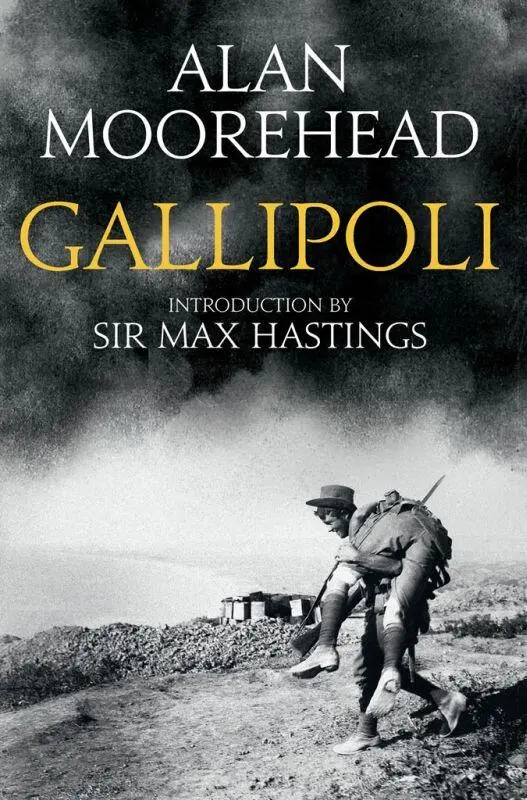
- Название:Gallipoli
- Автор:
- Издательство:Rockport Publishers
- Жанр:
- Год:0101
- ISBN:9781781314852
- Рейтинг книги:5 / 5. Голосов: 1
-
Избранное:Добавить в избранное
- Отзывы:
-
Ваша оценка:
Gallipoli: краткое содержание, описание и аннотация
Предлагаем к чтению аннотацию, описание, краткое содержание или предисловие (зависит от того, что написал сам автор книги «Gallipoli»). Если вы не нашли необходимую информацию о книге — напишите в комментариях, мы постараемся отыскать её.
Gallipoli — читать онлайн бесплатно полную книгу (весь текст) целиком
Ниже представлен текст книги, разбитый по страницам. Система сохранения места последней прочитанной страницы, позволяет с удобством читать онлайн бесплатно книгу «Gallipoli», без необходимости каждый раз заново искать на чём Вы остановились. Поставьте закладку, и сможете в любой момент перейти на страницу, на которой закончили чтение.
Интервал:
Закладка:
But now, at the end of April, there began a series of events which were to alter the whole character of the campaign. On April 25, the very day of the landing, Lieut.-Commander Otto Hersing, in the German U-boat 21, set out from Ems on the long journey around the north of Scotland for the Mediterranean. Two days later at Gallipoli, Lieut.-Commander Boyle, in the British E 14, slipped quietly into the Dardanelles and headed for the Narrows. From this moment both the Allied Fleet and the Turks on Gallipoli were in extreme danger.
Boyle had the idea of going through the Dardanelles on the surface under the cover of darkness, and he set off at two in the morning. He had not gone very far, however, before the Turkish searchlights and guns drove him down to a depth of ninety feet, and he continued there until he judged that he had passed under the Kephez minefield. Then he came up to twenty-two feet, intending to make the actual passage of the Narrows with his periscope raised. The disadvantage of this manœuvre was that the periscope made a distinct wash on the sea, and there was a desperate half-hour when the enemy guns around Chanak got his range. At one stage the crew of a Turkish patrol boat were grabbing at the periscope whenever Boyle brought it to the surface for a few seconds to see where he was going. Yet he got away, and soon after dawn came up unscathed in the Sea of Marmara. The passage had taken six hours.
For the next three weeks the E 14 cruised about at will. Her greatest success was the sinking of an old White Star liner that was bringing down from Constantinople 6,000 troops who were to join in the battle on the Cape Helles front. There were no survivors. It was a bigger victory than anything that had yet occurred on land, and there was immense elation in the Allied Fleet when Boyle came safely out again into the Ægean on May 18. Now at last they had found a way through. Admiral Guépratte had in the meantime lost a French submarine in the mysterious barrier in the straits, but that did not prevent him from congratulating the British; he sailed his flagship round the E 14 with his band playing Tipperary and the British national anthem.
Another submarine, the E 11, was waiting to take the E 14’s place in the Marmara, and her young captain, Lieut-Commander Nasmith, dined aboard the flagship on the night of May 18 with de Robeck, Keyes and Boyle. It was an animated party. Boyle had been recommended for an immediate award of the Victoria Cross. Keyes, who was still chafing at the withdrawal of the Queen Elizabeth and at the latest refusal of the Admiralty to allow the Fleet to resume its attack on the Narrows, thought he had begun to see a ray of light at last. Having heard Boyle’s story, Nasmith set off that same night, and sixteen hours after leaving the Admiral’s dining-table he was resting on the bottom of the Sea of Marmara. Unknown to anyone he had formed a plan which was more daring than anything which had been attempted before: a direct attack on Constantinople itself.
His first act on coming to the surface near the town of Gallipoli was to seize a Turkish sailing vessel and lash her to the E 11’s side, so that she would act both as a disguise and a decoy. When after several days no target appeared he cast off this Trojan sea-horse and steamed directly up the Marmara.
On May 23 he sank a Turkish gunboat and several other smaller craft, and then on the following day he fell in with the Nagara , a transport that was making its way down to the Dardanelles. There was an American journalist on board the Nagara , Raymond Gram Swing of the Chicago Daily News , and he says he was on deck that morning chatting to a Bavarian doctor. Boyle’s exploits of the previous weeks had become known in Constantinople, and Swing had just remarked to the doctor, ‘It’s a fine morning for submarines,’ when he paused, gazed out to sea in astonishment, and added, ‘And there’s one.’ E 11 broke the calm surface very gently about a hundred yards away, and four men appeared on the conning tower. One of them in a white sweater (it was Nasmith), used his cupped hands as a megaphone: ‘Who are you?’
‘I’m Swing of the Chicago Daily News .’
‘Glad to meet you, Mr. Swing, but what I mean is what ship is that?’
‘The Turkish transport Nagara .’
By now the ship’s crew were in a state of extreme alarm, some coursing about the deck, others, with their fezzes still on their heads, jumping into the sea.
‘Are those marines?’ Nasmith asked.
‘No, they’re just sailors.’
‘Well, I’m going to sink you.’
Swing asked, ‘Can we get off?’
‘Yes, and be damned quick about it.’
The confusion in the Nagara had now reached the point where everyone had begun to scramble over the sides, and the lifeboats were lowered so clumsily that they half filled with water. The Turks were frenziedly baling with their fezzes. As Swing appeared to be the only calm man on board, Nasmith directed him in launching the last boat and in picking up the sailors and passengers who had jumped or fallen into the sea. Nasmith then closed the ship, and an immense orange flame went up as he sank her: she was filled with ammunition.
Soon after this E 11 was driven away from the coast by a detachment of Turkish cavalry, but she managed to chase and sink another transport, and a third ship beached herself on the shore. By now the survivors of the wrecks had raised the alarm in Constantinople, and from early morning on May 25 the Turkish artillery on both sides of the Bosphorus were standing to their guns. In order to calm the population in the event of an action taking place, an announcement was made that there might be firing practice during the course of the day.
The submarine surfaced at 12.40 p.m., and Nasmith saw before him a large freighter, the Stamboul , berthed alongside the arsenal. His first torpedo ran in a circle and on its return narrowly missed the E 11 herself. His second, however, struck home, and he dived, heading through the city into the Bosphorus, while a barrage of artillery crashed over his head.
The panic that now broke out in Constantinople gives an indication of what might have happened had the Allied Fleet appeared there in March. While the Goeben hastily shifted her anchorage into the shelter of her attendant ships, a mob fled through the streets and everywhere the shops ran up their shutters. On the docks all activity ceased, and a contingent of soldiers which was embarking for Gallipoli was precipitately ordered back to the shore again. Now, in one moment, the powder factory on the wharves and the crowded wooden houses on the slopes above seemed utterly exposed, and it was apparent to everyone that there was very little that the fire brigade could do if this was to be the prelude to a serious attack.
Meanwhile, Nasmith and his men were struggling for their lives. The current in the Bosphorus was even stronger than in the Dardanelles, and for some twenty minutes the submarine was out of control, bumping from shoal to shoal along the bottom as far as Leander’s Tower. She was righted eventually, and with great skill Nasmith turned back through Constantinople. ‘The next day,’ here-ported later, ‘was spent resting in the centre of the Sea of Marmara.’
Then on May 27 he resumed his attack, sinking ship after ship in the approaches to the Golden Horn. A terror spread through the Sea of Marmara, for it was thought that at least half a dozen submarines were operating. No vessel of any size was allowed to leave port without an escort of destroyers and gunboats, and these repeatedly tried to ram the E 11 whenever she rose to the surface to attack. Nasmith paused in his operations only when the air in the submarine became so foul that he was obliged to surface in order to allow the crew to come on deck and bathe.
Читать дальшеИнтервал:
Закладка:
Похожие книги на «Gallipoli»
Представляем Вашему вниманию похожие книги на «Gallipoli» списком для выбора. Мы отобрали схожую по названию и смыслу литературу в надежде предоставить читателям больше вариантов отыскать новые, интересные, ещё непрочитанные произведения.










Обсуждение, отзывы о книге «Gallipoli» и просто собственные мнения читателей. Оставьте ваши комментарии, напишите, что Вы думаете о произведении, его смысле или главных героях. Укажите что конкретно понравилось, а что нет, и почему Вы так считаете.