Alan Moorehead - Gallipoli
Здесь есть возможность читать онлайн «Alan Moorehead - Gallipoli» весь текст электронной книги совершенно бесплатно (целиком полную версию без сокращений). В некоторых случаях можно слушать аудио, скачать через торрент в формате fb2 и присутствует краткое содержание. Год выпуска: 0101, ISBN: 0101, Издательство: Rockport Publishers, Жанр: prose_military, military_history, на английском языке. Описание произведения, (предисловие) а так же отзывы посетителей доступны на портале библиотеки ЛибКат.
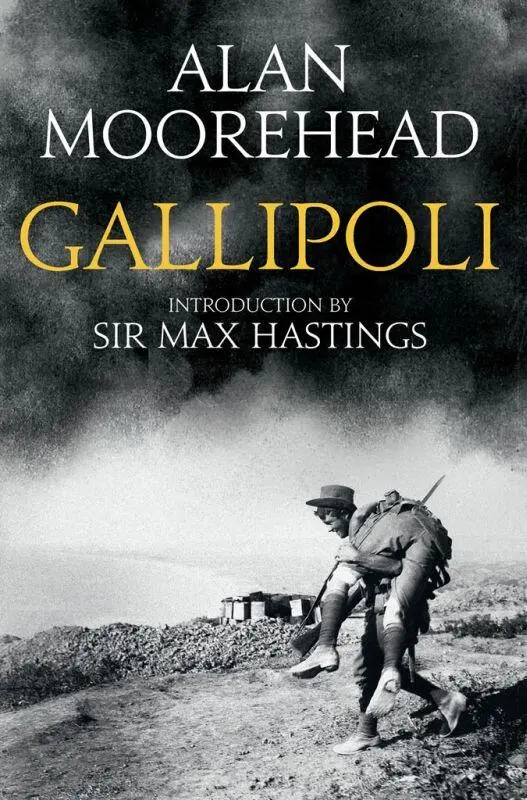
- Название:Gallipoli
- Автор:
- Издательство:Rockport Publishers
- Жанр:
- Год:0101
- ISBN:9781781314852
- Рейтинг книги:5 / 5. Голосов: 1
-
Избранное:Добавить в избранное
- Отзывы:
-
Ваша оценка:
Gallipoli: краткое содержание, описание и аннотация
Предлагаем к чтению аннотацию, описание, краткое содержание или предисловие (зависит от того, что написал сам автор книги «Gallipoli»). Если вы не нашли необходимую информацию о книге — напишите в комментариях, мы постараемся отыскать её.
Gallipoli — читать онлайн бесплатно полную книгу (весь текст) целиком
Ниже представлен текст книги, разбитый по страницам. Система сохранения места последней прочитанной страницы, позволяет с удобством читать онлайн бесплатно книгу «Gallipoli», без необходимости каждый раз заново искать на чём Вы остановились. Поставьте закладку, и сможете в любой момент перейти на страницу, на которой закончили чтение.
Интервал:
Закладка:
For a few minutes it looked as though they were going to catch the U 21. Air Commodore Samson was circling overhead, and he dropped his bombs on the U-boat through the clear water. But Hersing dived under the French battleship Henri IV , and when Samson picked him up again, steaming up the Dardanelles in the sunshine, all his bombs were gone. But he permitted himself a gesture: he swooped and emptied his rifle on to her hull. The U 21 was last seen moving into the Narrows, and at some point in the Sea of Marmara must have passed Nasmith returning from Constantinople.
Thus on this one day, May 25, almost in one hour, two submarines, the German U 21 and the British E 11, brought an entirely new element into the campaign, and it was almost as important as the twenty Turkish mines which had been sown so fortuitously in Eren Keui Bay when the Allied Fleet attacked in March.
Nasmith’s raid was, perhaps, the more telling of the two, for it caused the Turks to issue an immediate order that for the time being no further reinforcements were to be sent to the peninsula by sea. Instead of a short overnight voyage the soldiers were now faced with a roundabout train journey of 150 miles to Uzun Keupri on the Adrianople line. Thence a single road led down into the peninsula, another hundred miles away — a march of at least five days for the men, and of considerably more for the bullock carts and the camels that were now obliged to bring in their equipment. Other supplies had to be sent down the Sea of Marmara by small boats which hugged the coast and travelled only by night. All this meant a drastic slowing down of Liman’s line of supply. ‘Had the British managed to increase their undersea offensive,’ he says in the study of the campaign which he wrote after the war, ‘the Fifth Army would have starved.’ And the German naval historian adds: ‘The activity of the hostile submarines was a constant and heavy anxiety, and if communication by sea had been completely severed the Army would have been faced with catastrophe.’ At one point the Turks on the peninsula were down to 160 rounds of ammunition per man.
Liman is a little tart about the activities — or rather the lack of activity — of the German Navy. The story was spread in Germany, he says, that the Goeben and the German submarines carried the main burden of the defence at Gallipoli; but the Goeben never took part at all, and the U 21, having got safely through to Constantinople and been much fêted there, emerged only once again. She came out of the straits on July 4 and sank the French transport Carthage. Finding that his return route was blocked, Hersing turned west and steamed for the Adriatic, to be seen no more. Yet he had achieved his purpose. The mere threat of his presence off Gallipoli had scattered the Allied battle fleet, and his two sinkings were enough to keep it in harbour in the islands ever afterwards.
For the British submarines, however, the situation was rather more difficult; in order to make good the work that had already been done by Boyle and Nasmith they had to keep up the pressure in the Sea of Marmara and if possible increase it; and indeed, in all the records of the Royal Navy there is hardly anything that quite compares with the undersea offensive that now began. In a world that has since grown used to the unearthly courage of young men with fantastic machines it is still difficult to credit some of the things that happened. Six-pounder guns were fitted to the decks of the submarines to help them eke out their supply of torpedoes, and two new arrivals, the E 12 and the E 7, ran up to Constantinople, where they bombarded the powder mills, put a torpedo into the arsenal, cut the railway line and chased the trains along the shore. Soon the commanders learned to handle the changing density of the water, and they even turned it to advantage; by lying on top of the layer of heavier specific gravity when they wished to hide or rest they saved themselves the danger and difficulty of diving great depths to the ocean floor.
It was on Boyle’s third trip into the Marmara, on July 21, that a new hazard was discovered. As he passed through the Narrows he saw an obstruction under the water, and he reported this to Lieut.-Commander Cochrane in the E 7, when he met her in the Marmara next day. On July 24 Cochrane came out and he confirmed Boyle’s report: the Germans were building a net. He himself had been entangled in it for half an hour, ninety feet down.
This was a much more formidable obstacle than anything the submarines had encountered before. By the end of July it was completed — a vast steel mesh of two-and-a-half-inch wire stretching entirely across the straits, and reaching 220 feet down to the floor of the channel. A line of buoys painted alternately red and black supported it on the surface, and one end was secured on the peninsula about a mile north of Maidos, the other on a steamer anchored near Abydos on the Asiatic side. Turkish motorboats loaded with bombs patrolled the surface like spiders waiting at the edge of a web. Specially sited guns were set up on either bank.
There was a gate in the middle of the net, and unless the submarines were lucky enough to strike it their only way of getting through the wire was to ram it at full speed underwater and hope for the best. Boyle described this experience: ‘I missed the gate and hit the net. I was brought up from eighty feet to forty-five feet in three seconds, but luckily only thrown fifteen degrees off my course. There was a tremendous noise, scraping, banging, tearing and rumbling, and it sounded as if there were two distinct obstructions, as the noise nearly ceased and then came on again, and we were appreciably checked twice. It took about twenty seconds to get through.’
But Cochrane on his next trip did not get through. Hopelessly entangled, he fought the net for twelve hours on the bottom of the straits while bombs exploded about him, and it was only when the hull was leaking and the lights had failed that he burned his papers and rose to the surface to surrender.
Nasmith, Boyle and the others were not deterred; they continued to pass through, and by the end of the year the net was so damaged by their repeated rammings it had almost vanished altogether. Up to the last, however, the passage through the Narrows remained an ordeal of the most frightening kind, and perhaps from that very fact it acted as a psychological stimulus on the crews. One seems to have read the story in some boyhood book of sea adventure: the pirates’ cave with its treasure lies hidden in the cliffs, but one has to make a dangerous dive beneath the sea to reach it. And some get through and some get trapped halfway.
There is an almost dolphin-like air, a precise abandon, in the way the E-boats frisked about at times. On seeing a convoy, the commanders would deliberately surface and pretend to be in difficulties so as to entice the protective gunboats away. Then, diving deep, they would turn back and demolish the boats of the convoy one by one. They shot up the caravans of camels and bullock carts making their way down the Bulair isthmus with loads of barbed wire and ammunition. When they were short of fresh food they surfaced beside the Turkish trading caiques and provided themselves with fruit and vegetables. Wherever they could they saved their torpedoes and their ammunition by boarding enemy ships and simply opening the sea-cocks or placing a charge on the keel. Sometimes prisoners were carried around for days on end before they could be put ashore, and these were often very strange people — Arabs in their desert robes, sponge-divers and Turkish Imams, and once a German banker, wearing only a short pink vest, who complained that 5,000 marks in gold had just been sent to the bottom.
When more than one submarine was operating the commanders would make a rendezvous, and with their vessels tied up together far out in the Sea of Marmara they would exchange information for an hour or two, while their crews bathed in the sunshine; and then perhaps they would go off on a hunt together. Once there was a disaster. The French Turquoise ran aground and was captured. Enemy intelligence officers found in the captain’s notebook a reference to a meeting which he was to have at sea in a few days’ tine with the British E 20. It was a German U-boat that kept the rendezvous, and she torpedoed E 20 directly she came to the surface. Only the British commander and eight of the crew who were on deck survived.
Читать дальшеИнтервал:
Закладка:
Похожие книги на «Gallipoli»
Представляем Вашему вниманию похожие книги на «Gallipoli» списком для выбора. Мы отобрали схожую по названию и смыслу литературу в надежде предоставить читателям больше вариантов отыскать новые, интересные, ещё непрочитанные произведения.










Обсуждение, отзывы о книге «Gallipoli» и просто собственные мнения читателей. Оставьте ваши комментарии, напишите, что Вы думаете о произведении, его смысле или главных героях. Укажите что конкретно понравилось, а что нет, и почему Вы так считаете.