Олдос Хаксли - Antic Hay
Здесь есть возможность читать онлайн «Олдос Хаксли - Antic Hay» весь текст электронной книги совершенно бесплатно (целиком полную версию без сокращений). В некоторых случаях можно слушать аудио, скачать через торрент в формате fb2 и присутствует краткое содержание. Год выпуска: 2017, Издательство: epubBooks Classics, Жанр: Классическая проза, на английском языке. Описание произведения, (предисловие) а так же отзывы посетителей доступны на портале библиотеки ЛибКат.
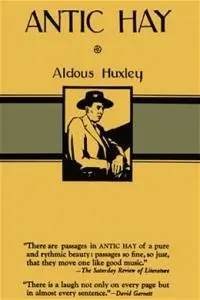
- Название:Antic Hay
- Автор:
- Издательство:epubBooks Classics
- Жанр:
- Год:2017
- ISBN:нет данных
- Рейтинг книги:5 / 5. Голосов: 1
-
Избранное:Добавить в избранное
- Отзывы:
-
Ваша оценка:
Antic Hay: краткое содержание, описание и аннотация
Предлагаем к чтению аннотацию, описание, краткое содержание или предисловие (зависит от того, что написал сам автор книги «Antic Hay»). Если вы не нашли необходимую информацию о книге — напишите в комментариях, мы постараемся отыскать её.
Antic Hay — читать онлайн бесплатно полную книгу (весь текст) целиком
Ниже представлен текст книги, разбитый по страницам. Система сохранения места последней прочитанной страницы, позволяет с удобством читать онлайн бесплатно книгу «Antic Hay», без необходимости каждый раз заново искать на чём Вы остановились. Поставьте закладку, и сможете в любой момент перейти на страницу, на которой закончили чтение.
Интервал:
Закладка:
'The critics would think it was a problem picture,' Lypiatt went on. 'And so it would be, by God, so it would be. You are a problem. You're the Sphinx. I wish I were Oedipus and could kill you.'
All this mythology! Mrs Viveash shook her head.
He made his way through the intervening litter and picked up a canvas that was leaning with averted face against the wall near the window. He held it out at arm's length and examined it, his head critically cocked on one side. 'Oh, it's good,' he said softly. 'It's good. Look at it.' And, stepping out once more into the open, he propped it up against the table so that Mrs Viveash could see it without moving from her chair.
It was a stormy vision of her; it was Myra seen, so to speak, through a tornado. He had distorted her in the portrait, had made her longer and thinner than she really was, had turned her arms into sleek tubes and put a bright, metallic polish on the curve of her cheek. The figure in the portrait seemed to be leaning backwards a little from the surface of the canvas, leaning sideways too, with the twist of an ivory statuette carved out of the curving tip of a great tusk. Only somehow in Lypiatt's portrait the curve seemed to lack grace, it was without point, it had no sense.
'You've made me look,' said Mrs Viveash at last, 'as though I were being blown out of shape by the wind.' All this show of violence—what was the point of it? She didn't like it, she didn't like it at all. But Casimir was delighted with her comment. He slapped his thighs and once more laughed his restless, sharp–featured face to pieces.
'Yes, by God,' he shouted, 'by God, that's right! Blown out of shape by the wind. That's it: you've said it.' He began stamping up and down the room again, gesticulating. 'The wind, the great wind that's in me.' He struck his forehead. 'The wind of life, the wild west wind. I feel it inside me, blowing, blowing. It carries me along with it; for though it's inside me, it's more than I am, it's a force that comes from somewhere else, it's Life itself, it's God. It blows me along in the teeth of opposing fate, it makes me work on, fight on.' He was like a man who walks along a sinister road at night and sings to keep up his own spirits, to emphasize and magnify his own existence. 'And when I paint, when I write or improvise my music, it bends the things I have in my mind, it pushes them in one direction, so that everything I do has the look of a tree that streams north–east with all its branches and all its trunk from the root upwards, as though it were trying to run from before the Atlantic gale.'
Lypiatt stretched out his two hands and, with fingers splayed out to the widest and trembling in the excessive tension of the muscles, moved them slowly upwards and sideways, as though he were running his palms up the stem of a little wind–wizened tree on a hilltop above the ocean.
Mrs Viveash continued to look at the unfinished portrait. It was as noisy and easy and immediately effective as a Vermouth advertisement in the streets of Padua. Cinzano, Bonomelli, Campari—illustrious names. Giotto and Mantegna mouldered meanwhile in their respective chapels.
'And look at this,' Lypiatt went on. He took down the canvas that was clamped to the easel and held it out for her inspection. It was one of Casimir's abstract paintings: a procession of machine–like forms rushing up diagonally from right to left across the canvas, with as it were a spray of energy blowing back from the crest of the wave towards the top right–hand corner. 'In this painting,' he said, 'I symbolize the Artist's conquering spirit—rushing on the universe, making it its own.' He began to declaim:
'Look down, Conquistador,
There on the valley's broad green floor,
There lies the lake, the jewelled cities gleam,
Chalco and Tlacopan
Await the coming Man;
Look down on Mexico, Conquistador,
Land of your golden dream.
Or the same idea in terms of music—' and Lypiatt dashed to the piano and evoked a distorted ghost of Scriabin. 'You see?' he asked feverishly, when the ghost was laid again and the sad cheap jangling had faded again into silence. 'You feel ? The artist rushes on the world, conquers it, gives it beauty, imposes a moral significance.' He returned to the picture. 'This will be fine when it's finished,' he said. 'Tremendous. You feel the wind blowing there, too.' And with a pointing finger he followed up the onrush of the forms. 'The great south–wester driving them on. "Like leaves from an enchanter fleeing." Only not chaotically, not in disorder. They're blown, so to speak in column of four—by a conscious wind.' He leaned the canvas against the table and was free again to march and brandish his conquering fists.
'Life,' he said, 'life—that's the great, essential thing. You've got to get life into your art, otherwise it's nothing. And life only comes out of life, out of passion and feeling; it can't come out of theories. That's the stupidity of all this chatter about art for art's sake and the æsthetic emotions and purely formal values and all that. It's only the formal relations that matter; one subject is just as good as another—that's the theory. You've only got to look at the pictures of the people who put it into practice to see that it won't do. Life comes out of life. You must paint with passion, and the passion will stimulate your intellect to create the right formal relations. And to paint with passion, you must paint things that passionately interest you, moving things, human things. Nobody, except a mystical pantheist, like Van Gogh, can seriously be as much interested in napkins, apples and bottles as in his lover's face, or the resurrection, or the destiny of man. Could Mantegna have devised his splendid compositions if he had painted arrangements of Chianti flasks and cheeses instead of Crucifixions, martyrs and triumphs of great men? Nobody but a fool could believe it. And could I have painted that portrait if I hadn't loved you, if you weren't killing me?'
Ah, Bonomelli and illustrious Cinzano!
'Passionately I paint passion. I draw life out of life. And I wish them joy of their bottles and their Canadian apples and their muddy table napkins with the beastly folds in them that look like loops of tripe.' Once more Lypiatt disintegrated himself with laughter; then was silent.
Mrs Viveash nodded, slowly and reflectively. 'I think you're right,' she said. Yes, he was surely right; there must be life, life was the important thing. That was precisely why his paintings were so bad—she saw now; there was no life in them. Plenty of noise there was, and gesticulation and a violent galvanized twitching; but no life, only the theatrical show of it. There was a flaw in the conduit; somewhere between the man and his work life leaked out. He protested too much. But it was no good; there was no disguising the deadness. Her portrait was a dancing mummy. He bored her now. Did she even positively dislike him? Behind her unchanging pale eyes Mrs Viveash wondered. But in any case, she reflected, one needn't always like the people with whom one associates. There are music–halls as well as confidential boudoirs; some people are admitted to the tea–party and the tête–à–tête , others, on a stage invisible, poor things! to themselves, do their little song–and–dance, roll out their characteristic patter, and having provided you with your entertainment are dismissed with their due share of applause. But then, what if they become boring?
'Well,' said Lypiatt at last—he had stood there, motionless, for a long time, biting his nails, 'I suppose we'd better begin our sitting.' He picked up the unfinished portrait and adjusted it on the easel. 'I've wasted a lot of time,' he said, 'and there isn't, after all, so much of it to waste.' He spoke gloomily, and his whole person had become, all of a sudden, curiously shrunken and deflated. 'There isn't so much of it,' he repeated, and sighed. 'I still think of myself as a young man, young and promising, don't you know. Casimir Lypiatt—it's a young, promising sort of name, isn't it? But I'm not young, I've passed the age of promise. Every now and then I realize it, and it's painful, it's depressing.'
Читать дальшеИнтервал:
Закладка:
Похожие книги на «Antic Hay»
Представляем Вашему вниманию похожие книги на «Antic Hay» списком для выбора. Мы отобрали схожую по названию и смыслу литературу в надежде предоставить читателям больше вариантов отыскать новые, интересные, ещё непрочитанные произведения.

![Олдос Хаксли - О дивный новый мир [Прекрасный новый мир]](/books/11834/oldos-haksli-o-divnyj-novyj-mir-prekrasnyj-novyj-thumb.webp)

Обсуждение, отзывы о книге «Antic Hay» и просто собственные мнения читателей. Оставьте ваши комментарии, напишите, что Вы думаете о произведении, его смысле или главных героях. Укажите что конкретно понравилось, а что нет, и почему Вы так считаете.