Олдос Хаксли - Antic Hay
Здесь есть возможность читать онлайн «Олдос Хаксли - Antic Hay» весь текст электронной книги совершенно бесплатно (целиком полную версию без сокращений). В некоторых случаях можно слушать аудио, скачать через торрент в формате fb2 и присутствует краткое содержание. Год выпуска: 2017, Издательство: epubBooks Classics, Жанр: Классическая проза, на английском языке. Описание произведения, (предисловие) а так же отзывы посетителей доступны на портале библиотеки ЛибКат.
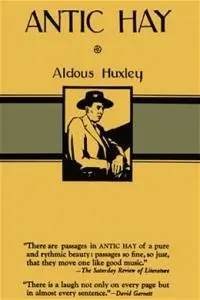
- Название:Antic Hay
- Автор:
- Издательство:epubBooks Classics
- Жанр:
- Год:2017
- ISBN:нет данных
- Рейтинг книги:5 / 5. Голосов: 1
-
Избранное:Добавить в избранное
- Отзывы:
-
Ваша оценка:
Antic Hay: краткое содержание, описание и аннотация
Предлагаем к чтению аннотацию, описание, краткое содержание или предисловие (зависит от того, что написал сам автор книги «Antic Hay»). Если вы не нашли необходимую информацию о книге — напишите в комментариях, мы постараемся отыскать её.
Antic Hay — читать онлайн бесплатно полную книгу (весь текст) целиком
Ниже представлен текст книги, разбитый по страницам. Система сохранения места последней прочитанной страницы, позволяет с удобством читать онлайн бесплатно книгу «Antic Hay», без необходимости каждый раз заново искать на чём Вы остановились. Поставьте закладку, и сможете в любой момент перейти на страницу, на которой закончили чтение.
Интервал:
Закладка:
Slowly the taxi–man unbuttoned his coat and put the coin away in an inner pocket. He watched her as she crossed the dirty street, placing her feet with a meticulous precision one after the other in the same straight line, as though she were treading a knife edge between goodness only knew what invisible gulfs. Floating she seemed to go, with a little spring at every step and the skirt of her summery dress—white it was, with a florid pattern printed in black all over it—blowing airily out around her swaying march. Decayed gentlewomen indeed! The driver started his machine with an unnecessary violence; he felt, for some reason, positively indignant.
Between the broad double–doors through which the horses passed to their fodder and repose were little narrow human doors—for the Yahoos, Lypiatt used to say in his large allusive way; and when he said it he laughed with the loud and bell–mouthed cynicism of one who sees himself as a misunderstood and embittered Prometheus. At one of these little Yahoo doors Mrs Viveash halted and rapped as loudly as a small and stiff–hinged knocker would permit. Patiently she waited; several small and dirty children collected to stare at her. She knocked again, and again waited. More children came running up from the farther end of the mews; two young girls of fifteen or sixteen appeared at a neighbouring doorway and immediately gave tongue in whoops of mirthless, hyena–like laughter.
'Have you ever read about the Pied Piper of Hamelin?' Mrs Viveash asked the nearest child. Terrified, it shrank away. 'I thought not,' she said, and knocked again.
There was a sound, at last, of heavy feet slowly descending steep stairs; the door opened.
'Welcome to the palazzo!' It was Lypiatt's heroic formula of hospitality.
'Welcome at last,' Mrs Viveash corrected, and followed him up a narrow, dark staircase that was as steep as a ladder. He was dressed in a velveteen jacket and linen trousers that should have been white, but needed washing. He was dishevelled and his hands were dirty.
'Did you knock more than once?' he asked, looking back over his shoulder.
'More than twenty times,' Mrs Viveash justifiably exaggerated.
'I'm infinitely sorry,' protested Lypiatt. 'I get so deeply absorbed in my work, you know. Did you wait long?'
'The children enjoyed it, at any rate.' Mrs Viveash was irritated by a suspicion, which was probably, after all, quite unjustified, that Casimir had been rather consciously absorbed in his work; that he had heard her first knock and plunged the more profoundly into those depths of absorption where the true artist always dwells, or at any rate ought to dwell; to rise at her third appeal with a slow, pained reluctance, cursing, perhaps, at the importunity of a world which thus noisily interrupted the flow of his inspiration. 'Queer, the way they stare at one,' she went on, with a note in her dying voice of a petulance that the children had not inspired. 'Does one look such a guy?'
Lypiatt threw open the door at the head of the stairs and stood there on the threshold, waiting for her. 'Queer?' he repeated. 'Not a bit.' And as she moved past him into the room, he laid his hand on her shoulder and fell into step with her, leaving the door to slam behind them. 'Merely an example of the mob's instinctive dislike of the aristocratic individual. That's all. "Oh, why was I born with a different face?" Thank God I was, though. And so were you. But the difference has its disadvantages; the children throw stones.'
'They didn't throw stones.' Mrs Viveash was too truthful, this time.
They halted in the middle of the studio. It was not a very large room and there were too many things in it. The easel stood near the centre of the studio; round it Lypiatt kept a space permanently cleared. There was a broad fairway leading to the door, and another, narrower and tortuously winding between boxes and piled–up furniture and tumbled books, gave access to his bed. There was a piano and a table permanently set with dirty plates and strewed with the relics of two or three meals. Bookshelves stood on either side of the fireplace, and lying on the floor were still more books, piles on dusty piles. Mrs Viveash stood looking at the picture on the easel (abstract again—she didn't like it), and Lypiatt, who had dropped his hand from her shoulder, and had stepped back the better to see her, stood earnestly looking at Mrs Viveash.
'May I kiss you?' he asked after a silence.
Mrs Viveash turned towards him, smiling agonizingly, her eyebrows ironically lifted, her eyes steady and calm and palely, brightly inexpressive. 'If it really gives you any pleasure,' she said. 'It won't, I may say, to me.'
'You make me suffer a great deal,' said Lypiatt, and said it so quietly and unaffectedly, that Myra was almost startled; she was accustomed, with Casimir, to noisier and more magniloquent protestations.
'I'm very sorry,' she said; and, really, she felt sorry. 'But I can't help it, can I?'
'I suppose you can't,' he said. 'You can't,' he repeated, and his voice had now become the voice of Prometheus in his bitterness. 'Nor can tigresses.' He had begun to pace up and down the unobstructed fairway between his easel and the door; Lypiatt liked pacing while he talked. 'You like playing with the victim,' he went on; 'he must die slowly.'
Reassured, Mrs Viveash faintly smiled. This was the familiar Casimir. So long as he could talk like this, could talk like an old–fashioned French novel, it was all right; he couldn't really be so very unhappy. She sat down on the nearest unencumbered chair. Lypiatt continued to walk back and forth, waving his arms as he walked.
'But perhaps it's good for one to suffer,' he went on, 'perhaps it's unavoidable and necessary. Perhaps I ought to thank you. Can an artist do anything if he's happy? Would he ever want to do anything? What is art, after all, but a protest against the horrible inclemency of life?' He halted in front of her, with arms extended in a questioning gesture. Mrs Viveash slightly shrugged her shoulders. She really didn't know; she couldn't answer. 'Ah, but that's all nonsense,' he burst out again, 'all rot. I want to be happy and contented and successful; and of course I should work better if I were. And I want, oh, above everything, everything, I want you: to possess you completely and exclusively and jealously and for ever. And the desire is like rust corroding my heart, it's like moth eating holes in the fabric of my mind. And you merely laugh.' He threw up his hands and let them limply fall again.
'But I don't laugh,' said Mrs Viveash. On the contrary, she was very sorry for him; and, what was more, he rather bored her. For a few days, once, she had thought she might be in love with him. His impetuosity had seemed a torrent strong enough to carry her away. She had found out her mistake very soon. After that he had rather amused her: and now he rather bored her. No, decidedly, she never laughed. She wondered why she still went on seeing him. Simply because one must see some one? or why? 'Are you going to go on with my portrait?' she asked.
Lypiatt sighed. 'Yes,' he said, 'I suppose I'd better be getting on with my work. Work—it's the only thing. "Portrait of a Tigress".' The cynical Titan spoke again. 'Or shall I call it, "Portrait of a Woman who has never been in Love"?'
'That would be a very stupid title,' said Mrs Viveash.
'Or, "Portrait of the Artist's Heart Disease"? That would be good, that would be damned good!' Lypiatt laughed very loudly and slapped his thighs. He looked, Mrs Viveash thought, peculiarly ugly when he laughed. His face seemed to go all to pieces; not a corner of it but was wrinkled and distorted by the violent grimace of mirth. Even the forehead was ruined when he laughed. Foreheads are generally the human part of people's faces. Let the nose twitch and the mouth grin and the eyes twinkle as monkeyishly as you like; the forehead can still be calm and serene, the forehead still knows how to be human. But when Casimir laughed, his forehead joined in the general disintegrating grimace. And sometimes even when he wasn't laughing, when he was just vivaciously talking, his forehead seemed to lose its calm and would twitch and wrinkle itself in a dreadful kind of agitation. 'Portrait of the Artist's Heart Disease'—she didn't find it so very funny.
Читать дальшеИнтервал:
Закладка:
Похожие книги на «Antic Hay»
Представляем Вашему вниманию похожие книги на «Antic Hay» списком для выбора. Мы отобрали схожую по названию и смыслу литературу в надежде предоставить читателям больше вариантов отыскать новые, интересные, ещё непрочитанные произведения.

![Олдос Хаксли - О дивный новый мир [Прекрасный новый мир]](/books/11834/oldos-haksli-o-divnyj-novyj-mir-prekrasnyj-novyj-thumb.webp)

Обсуждение, отзывы о книге «Antic Hay» и просто собственные мнения читателей. Оставьте ваши комментарии, напишите, что Вы думаете о произведении, его смысле или главных героях. Укажите что конкретно понравилось, а что нет, и почему Вы так считаете.