Олдос Хаксли - Antic Hay
Здесь есть возможность читать онлайн «Олдос Хаксли - Antic Hay» весь текст электронной книги совершенно бесплатно (целиком полную версию без сокращений). В некоторых случаях можно слушать аудио, скачать через торрент в формате fb2 и присутствует краткое содержание. Год выпуска: 2017, Издательство: epubBooks Classics, Жанр: Классическая проза, на английском языке. Описание произведения, (предисловие) а так же отзывы посетителей доступны на портале библиотеки ЛибКат.
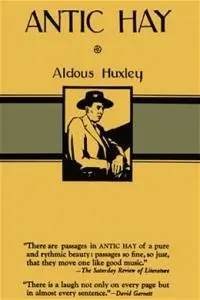
- Название:Antic Hay
- Автор:
- Издательство:epubBooks Classics
- Жанр:
- Год:2017
- ISBN:нет данных
- Рейтинг книги:5 / 5. Голосов: 1
-
Избранное:Добавить в избранное
- Отзывы:
-
Ваша оценка:
Antic Hay: краткое содержание, описание и аннотация
Предлагаем к чтению аннотацию, описание, краткое содержание или предисловие (зависит от того, что написал сам автор книги «Antic Hay»). Если вы не нашли необходимую информацию о книге — напишите в комментариях, мы постараемся отыскать её.
Antic Hay — читать онлайн бесплатно полную книгу (весь текст) целиком
Ниже представлен текст книги, разбитый по страницам. Система сохранения места последней прочитанной страницы, позволяет с удобством читать онлайн бесплатно книгу «Antic Hay», без необходимости каждый раз заново искать на чём Вы остановились. Поставьте закладку, и сможете в любой момент перейти на страницу, на которой закончили чтение.
Интервал:
Закладка:
Impasto, impasto —the young assistant sidled off unobtrusively to the desk and made a note of it. He would look the word up in Grubb's Dictionary of Art and Artists later on. He made his way back, circuitously, and as though by accident, into Mr Clew's neighbourhood.
Mr Clew was one of those rare people who have a real passion for art. He loved painting, all painting, indiscriminately. In a picture–gallery he was like a Turk in a harem; he adored them all. He loved Memling as much as Raphael, he loved Grünewald and Michelangelo, Holman Hunt and Manet, Romney and Tintoretto; how happy he could be with all of them! Sometimes, it is true, he hated; but that was only when familiarity had not yet bred love. At the first Post–Impressionist Exhibition, for example, in 1911, he had taken a very firm stand. 'This is an obscene farce,' he had written then. Now, however, there was no more passionate admirer of Matisse's genius. As a connoisseur and kunstforscher , Mr Clew was much esteemed. People would bring him dirty old pictures to look at, and he would exclaim at once: Why, it's an El Greco, a Piazzetta, or some other suitable name. Asked how he knew, he would shrug his shoulders and say: But it's signed all over. His certainty and his enthusiasm were infectious. Since the coming of El Greco into fashion, he had discovered dozens of early works by that great artist. For Lord Petersfield's collection alone he had found four early El Grecos, all by pupils of Bassano. Lord Petersfield's confidence in Mr Clew was unbounded; not even that affair of the Primitives had shaken it. It was a sad affair: Lord Petersfield's Duccio had shown signs of cracking; the estate carpenter was sent for to take a look at the panel; he had looked. 'A worse–seasoned piece of Illinois hickory,' he said, 'I've never seen.' After that he looked at the Simone Martini; for that, on the contrary, he was full of praise. Smooth–grained, well–seasoned—it wouldn't crack, no, not in a hundred years. 'A nicer slice of board never came out of America.' He had a hyperbolical way of speaking. Lord Petersfield was extremely angry; he dismissed the estate carpenter on the spot. After that he told Mr Clew that he wanted a Giorgione, and Mr Clew went out and found him one which was signed all over.
'I like this very much,' said Mr Clew, pointing to one of the thoughts with which Lypiatt had prefaced his catalogue. '"Genius,"' he adjusted his spectacles and began to read aloud, '"is life. Genius is a force of nature. In art, nothing else counts. The modern impotents, who are afraid of genius and who are envious of it, have invented in self–defence the notion of the Artist. The Artist with his sense of form, his style, his devotion to pure beauty, et cetera, et cetera. But Genius includes the Artist; every Genius has, among very many others, the qualities attributed by the impotents to the Artist. The Artist without genius is a carver of fountains through which no water flows." Very true,' said Mr Clew, 'very true indeed.' He marked the passage with his pencil.
Mr Albemarle produced the password. 'Very strongly put,' he said.
'I have always felt that myself,' said Mr Clew. 'El Greco, for example…'
'Good morning. What about El Greco?' said a voice, all in one breath. The thin, long, skin–covered skeleton of Mr Mallard hung over them like a guilty conscience. Mr Mallard wrote every week in the Hebdomadal Digest . He had an immense knowledge of art, and a sincere dislike of all that was beautiful. The only modern painter whom he really admired was Hodler. All others were treated by him with a merciless savagery; he tore them to pieces in his weekly articles with all the holy gusto of a Calvinist iconoclast smashing images of the Virgin.
'What about El Greco?' he repeated. He had a peculiarly passionate loathing of El Greco.
Mr Clew smiled up at him propitiatingly; he was afraid of Mr Mallard. His enthusiasms were no match for Mr Mallard's erudite and logical disgusts. 'I was merely quoting him as an example,' he said.
'An example, I hope, of incompetent drawing, baroque composition, disgusting forms, garish colouring and hysterical subject–matter.' Mr Mallard showed his old ivory teeth in a menacing smile. 'Those are the only things which El Greco's work exemplifies.'
Mr Clew gave a nervous little laugh. 'What do you think of these?' he asked, pointing to Lypiatt's canvases.
'They look to me very ordinarily bad,' answered Mr Mallard.
The young assistant listened appalled. In a business like this, how was it possible to make good?
'All the same,' said Mr Clew courageously, 'I like that bowl of roses in the window with the landscape behind. Number twenty–nine.' He looked in the catalogue. 'And there's a really charming little verse about it:
"O beauty of the rose,
Goodness as well as perfume exhaling!
Who gazes on these flowers,
On this blue hill and ripening field—he knows
Where duty leads and that the nameless Powers
In a rose can speak their will."
Really charming!' Mr Clew made another mark with his pencil.
'But commonplace, commonplace.' Mr Mallard shook his head. 'And in any case a verse can't justify a bad picture. What an unsubtle harmony of colour! And how uninteresting the composition is! That receding diagonal—it's been worked to death.' He too made a mark in his catalogue—a cross and a little circle, arranged like the skull and cross–bones on a pirate's flag. Mr Mallard's catalogues were always covered with these little marks: they were his symbols of condemnation.
Mr Albemarle, meanwhile, had moved away to greet the new arrivals. To the critic of the Daily Cinema he had to explain that there were no portraits of celebrities. The reporter from the Evening Planet had to be told which were the best pictures.
'Mr Lypiatt,' he dictated, 'is a poet and philosopher as well as a painter. His catalogue is a—h'm—declaration of faith.'
The reporter took it down in shorthand. 'And very nice too,' he said. 'I'm most grateful to you, sir, most grateful.' And he hurried away, to get to the Cattle Show before the King should arrive. Mr Albemarle affably addressed himself to the critic of the Morning Globe .
'I al ways regard this gallery,' said a loud and cheerful voice, full of bulls and canaries in chorus, 'as positively a mauvais lieu . Such exhibitions!' And Mr Mercaptan shrugged his shoulders expressively. He halted to wait for his companion.
Mrs Viveash had lagged behind, reading the catalogue as she slowly walked along. 'It's a complete book,' she said, 'full of poems and essays and short stories even, so far as I can see.'
'Oh, the usual cracker mottoes.' Mr Mercaptan laughed. 'I know the sort of thing. "Look after the past and the future will look after itself." "God squared minus Man squared equals Art–plus–life times Art–minus–Life." "The Higher the Art the fewer the morals"—only that's too nearly good sense to have been invented by Lypiatt. But I know the sort of thing. I could go on like that for ever.' Mr Mercaptan was delighted with himself.
'I'll read you one of them,' said Mrs Viveash. '"A picture is a chemical combination of plastic form and spiritual significance."'
'Crikey!' said Mr Mercaptan.
'"Those who think that a picture is a matter of nothing but plastic form are like those who imagine that water is made of nothing but hydrogen."'
Mr Mercaptan made a grimace. 'What writing!' he exclaimed; ' le style c'est l'homme . Lypiatt hasn't got a style. Argal—inexorable conclusion—Lypiatt doesn't exist. My word, though. Look at those horrible great nudes there. Like Caraccis with cubical muscles.'
'Samson and Delilah,' said Mrs Viveash. 'Would you like me to read about them?'
Читать дальшеИнтервал:
Закладка:
Похожие книги на «Antic Hay»
Представляем Вашему вниманию похожие книги на «Antic Hay» списком для выбора. Мы отобрали схожую по названию и смыслу литературу в надежде предоставить читателям больше вариантов отыскать новые, интересные, ещё непрочитанные произведения.

![Олдос Хаксли - О дивный новый мир [Прекрасный новый мир]](/books/11834/oldos-haksli-o-divnyj-novyj-mir-prekrasnyj-novyj-thumb.webp)

Обсуждение, отзывы о книге «Antic Hay» и просто собственные мнения читателей. Оставьте ваши комментарии, напишите, что Вы думаете о произведении, его смысле или главных героях. Укажите что конкретно понравилось, а что нет, и почему Вы так считаете.