Олдос Хаксли - Antic Hay
Здесь есть возможность читать онлайн «Олдос Хаксли - Antic Hay» весь текст электронной книги совершенно бесплатно (целиком полную версию без сокращений). В некоторых случаях можно слушать аудио, скачать через торрент в формате fb2 и присутствует краткое содержание. Год выпуска: 2017, Издательство: epubBooks Classics, Жанр: Классическая проза, на английском языке. Описание произведения, (предисловие) а так же отзывы посетителей доступны на портале библиотеки ЛибКат.
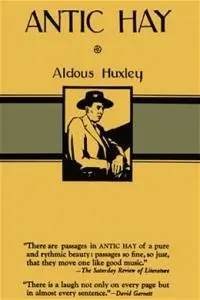
- Название:Antic Hay
- Автор:
- Издательство:epubBooks Classics
- Жанр:
- Год:2017
- ISBN:нет данных
- Рейтинг книги:5 / 5. Голосов: 1
-
Избранное:Добавить в избранное
- Отзывы:
-
Ваша оценка:
Antic Hay: краткое содержание, описание и аннотация
Предлагаем к чтению аннотацию, описание, краткое содержание или предисловие (зависит от того, что написал сам автор книги «Antic Hay»). Если вы не нашли необходимую информацию о книге — напишите в комментариях, мы постараемся отыскать её.
Antic Hay — читать онлайн бесплатно полную книгу (весь текст) целиком
Ниже представлен текст книги, разбитый по страницам. Система сохранения места последней прочитанной страницы, позволяет с удобством читать онлайн бесплатно книгу «Antic Hay», без необходимости каждый раз заново искать на чём Вы остановились. Поставьте закладку, и сможете в любой момент перейти на страницу, на которой закончили чтение.
Интервал:
Закладка:
But unaccompanied he did not mean to remain for long. These warm, bright May days were wonderful days for being in love on. And to be alone on such days was like a malady. It was a malady from which the Mild and Melancholy Man suffered all too frequently. And yet there were millions of superfluous women in the country; millions of them. Every day, in the streets, one saw thousands of them passing; and some were exquisite, were ravishing, the only possible soul–mates. Thousands of unique soul–mates every day. The Mild and Melancholy one allowed them to pass—for ever. But to–day—to–day he was the complete and Rabelaisian man; he was bearded to the teeth; the imbecile game was at its height; there would be opportunities, and the Complete Man could know how to take them. No, he would not be unaccompanied for long.
Outside in the square the fourteen plane–trees glowed in their young, unsullied green. At the end of every street the golden muslin of the haze hung in an unwrinkled curtain that thinned away above the sky's gauzy horizon to transparent nothing against the intenser blue. The dim, conch–like murmur that in a city is silence seemed hazily to identify itself with the golden mistiness of summer, and against this dim, wide background the yells of the playing children detached themselves, distinct and piercing. 'Beaver,' they shouted, 'beaver!' and, 'Is it cold up there?' Full of playful menace, the Complete Man shook at them his borrowed Malacca. He accepted their prompt hail as the most favourable of omens.
At the first tobacconist's Gumbril bought the longest cigar he could find, and trailing behind him expiring blue wreaths of Cuban smoke, he made his way slowly and with an ample swagger towards the park. It was there, under the elms, on the shores of the ornamental waters, that he expected to find his opportunity, that he intended—how confidently behind his Gargantuan mask!—to take it.
The opportunity offered itself sooner than he expected.
He had just turned into the Queen's Road and was sauntering past Whiteley's with the air of one who knows that he has a right to a good place, to two or three good places even, in the sun, when he noticed just in front of him, peering intently at the New Season's Models, a young woman whom in his mild and melancholy days he would have only hopelessly admired, but who now, to the Complete Man, seemed a destined and accessible prey. She was fairly tall, but seemed taller than she actually was, by reason of her remarkable slenderness. Not that she looked disagreeably thin, far from it. It was a rounded slenderness. The Complete Man decided to consider her as tubular—flexible and tubular, like a section of boa constrictor, should one say? She was dressed in clothes that emphasized this serpentine slimness: in a close–fitting grey jacket that buttoned up to the neck and a long, narrow grey skirt that came down to her ankles. On her head was a small, sleek black hat, that looked almost as though it were made of metal. It was trimmed on one side with a bunch of dull golden foliage.
Those golden leaves were the only touch of ornament in all the severe smoothness and unbroken tubularity of her person. As for her face, that was neither strictly beautiful nor strictly ugly, but combined elements of both beauty and ugliness into a whole that was unexpected, that was oddly and somehow unnaturally attractive.
Pretending, he too, to take an interest in the New Season's Models, Gumbril made, squinting sideways over the burning tip of his cigar, an inventory of her features. The forehead, that was mostly hidden by her hat; it might be pensively and serenely high, it might be of that degree of lowness which in men is villainous, but in women is only another—a rather rustic one perhaps, rather canaille even, but definitely another—attraction. There was no telling. As for her eyes, they were green, and limpid; set wide apart in her head, they looked out from under heavy lids and through openings that slanted up towards the outer corners. Her nose was slightly aquiline. Her mouth was full–lipped, but straight and unexpectedly wide. Her chin was small, round and firm. She had a pale skin, a little flushed over the cheek–bones, which were prominent.
On the left cheek, close under the corner of the slanting eye, she had a brown mole. Such hair as Gumbril could see beneath her hat was pale and inconspicuously blond. When she had finished looking at the New Season's Models she moved slowly on, halting for a moment before the travelling–trunks and the fitted picnic–baskets; dwelling for a full minute over the corsets, passing the hats, for some reason, rather contemptuously, but pausing, which seemed strange, for a long pensive look at the cigars and wine. As for the tennis rackets and cricket bats, the school outfits and the gentleman's hosiery—she hadn't so much as a look for one of them. But how lovingly she lingered before the boots and shoes! Her own feet, the Complete Man noticed with satisfaction, had an elegance of florid curves. And while other folk walked on neat's leather she was content to be shod with nothing coarser than mottled serpent's skin.
Slowly they drifted up Queen's Road, lingering before every jeweller's, every antiquarian's, every milliner's on the way. The stranger gave him no opportunity, and indeed, Gumbril reflected, how should she? For the imbecile game on which he was relying is a travelling piquet for two players, not a game of patience. No sane human being could play it in solitude. He would have to make the opportunity himself.
All that was mild in him, all that was melancholy, shrank with a sickened reluctance from the task of breaking—with what consequences delicious and perilous in the future or, in the case of the deserved snub, immediately humiliating?—a silence which, by the tenth or twelfth shop window, had become quite unbearably significant. The Mild and Melancholy one would have drifted to the top of the road, sharing, with that community of tastes which is the basis of every happy union, her enthusiasm for brass candlesticks and toasting–forks, imitation Chippendale furniture, gold watch–bracelets and low–waisted summer frocks; would have drifted to the top of the road and watched her, dumbly, disappearing for ever into the green park or along the blank pavements of the Bayswater Road; would have watched her for ever disappear and then, if the pubs had happened to be open, would have gone and ordered a glass of port, and sitting at the bar would have savoured, still dumbly, among the other drinkers, the muddy grapes of the Douro, and his own unique loneliness.
That was what the Mild and Melancholy one would have done. But the sight, as he gazed earnestly into an antiquary's window, of his own powerful bearded face reflected in a sham Heppelwhite mirror, reminded him that the Mild and Melancholy one was temporarily extinct, and that it was the Complete Man who now dawdled, smoking his long cigar, up the Queen's Road towards the Abbey of Thelema.
He squared his shoulders; in that loose toga of Mr Bojanus's he looked as copious as François Premier. The time, he decided, had come.
It was at this moment that the reflection of the stranger's face joined itself in the little mirror, as she made a little movement away from the Old Welsh dresser in the corner, to that of his own. She looked at the spurious Heppelwhite. Their eyes met in the hospitable glass. Gumbril smiled. The corners of the stranger's wide mouth seemed faintly to move; like petals of the magnolia, her eyelids came slowly down over her slanting eyes. Gumbril turned from the reflection to the reality.
'If you want to say Beaver,' he said, 'you may.'
The Complete Man had made his first speech.
'I want to say nothing,' said the stranger. She spoke with a charming precision and distinctness, lingering with a pretty emphasis on the n of nothing. 'N—n—nothing'—it sounded rather final. She turned away, she moved on.
Читать дальшеИнтервал:
Закладка:
Похожие книги на «Antic Hay»
Представляем Вашему вниманию похожие книги на «Antic Hay» списком для выбора. Мы отобрали схожую по названию и смыслу литературу в надежде предоставить читателям больше вариантов отыскать новые, интересные, ещё непрочитанные произведения.

![Олдос Хаксли - О дивный новый мир [Прекрасный новый мир]](/books/11834/oldos-haksli-o-divnyj-novyj-mir-prekrasnyj-novyj-thumb.webp)




Обсуждение, отзывы о книге «Antic Hay» и просто собственные мнения читателей. Оставьте ваши комментарии, напишите, что Вы думаете о произведении, его смысле или главных героях. Укажите что конкретно понравилось, а что нет, и почему Вы так считаете.