Олдос Хаксли - Antic Hay
Здесь есть возможность читать онлайн «Олдос Хаксли - Antic Hay» весь текст электронной книги совершенно бесплатно (целиком полную версию без сокращений). В некоторых случаях можно слушать аудио, скачать через торрент в формате fb2 и присутствует краткое содержание. Год выпуска: 2017, Издательство: epubBooks Classics, Жанр: Классическая проза, на английском языке. Описание произведения, (предисловие) а так же отзывы посетителей доступны на портале библиотеки ЛибКат.
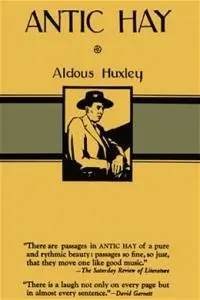
- Название:Antic Hay
- Автор:
- Издательство:epubBooks Classics
- Жанр:
- Год:2017
- ISBN:нет данных
- Рейтинг книги:5 / 5. Голосов: 1
-
Избранное:Добавить в избранное
- Отзывы:
-
Ваша оценка:
Antic Hay: краткое содержание, описание и аннотация
Предлагаем к чтению аннотацию, описание, краткое содержание или предисловие (зависит от того, что написал сам автор книги «Antic Hay»). Если вы не нашли необходимую информацию о книге — напишите в комментариях, мы постараемся отыскать её.
Antic Hay — читать онлайн бесплатно полную книгу (весь текст) целиком
Ниже представлен текст книги, разбитый по страницам. Система сохранения места последней прочитанной страницы, позволяет с удобством читать онлайн бесплатно книгу «Antic Hay», без необходимости каждый раз заново искать на чём Вы остановились. Поставьте закладку, и сможете в любой момент перейти на страницу, на которой закончили чтение.
Интервал:
Закладка:
'What one has to put up with in furnished flats!' The lady made a grimace as she ushered him into the sitting–room. And while she spoke the words, she really managed to persuade herself that the furniture wasn't theirs, that they had found all this sordid stuff cluttering up the rooms, not chosen it, oh and with pains! themselves, not doggedly paid for it, month by month.
'Our own things,' she murmured vaguely, 'are stored. In the Riviera.' It was there, under the palms, among the gaudy melon flowers and the croupiers that the fastidious lady had last held her salon of young poets. In the Riviera—that would explain, now she came to think of it, a lot of things, if explanation ever became necessary.
The Complete Man nodded sympathetically. 'Other people's tastes,' he held up his hands, they both laughed. 'But why do we think of other people?' he added. And coming forward with a conquering impulsiveness, he took both her long, fine hands in his and raised them to his bearded mouth.
She looked at him for a second, then dropped her eyelids, took back her hands. 'I must go and make the tea,' she said. 'The servants'—the plural was a pardonable exaggeration—'are out.'
Gallantly, the Complete Man offered to come and help her. These scenes of intimate life had a charm all their own. But she would not allow it. 'No, no,' she was very firm, 'I simply forbid you. You must stay here. I won't be a moment,' and she was gone, closing the door carefully behind her.
Left to himself, Gumbril sat down and filed his nails.
As for the young lady, she hurried along to her dingy little kitchen, lit the gas, put the kettle on, set out the teapot and the cups on a tray, and from the biscuit–box, where it was stored, took out the remains of a chocolate cake, which had already seen service at the day–before–yesterday's tea–party. When all was ready here, she tip–toed across to her bedroom and sitting down at her dressing–table, began with hands that trembled a little with excitement to powder her nose and heighten the colour of her cheeks. Even after the last touch had been given, she still sat there, looking at her image in the glass.
The lady and the poet, she was thinking, the grande dame and the brilliant young man of genius. She liked young men with beards. But he was not an artist, in spite of the beard, in spite of the hat. He was a writer of sorts. So she gathered; but he was reticent, he was delightfully mysterious. She too, for that matter. The great lady slips out, masked, into the street; touches the young man's sleeve: Come with me. She chooses, does not let herself passively be chosen. The young poet falls at her feet; she lifts him up. One is accustomed to this sort of thing.
She opened her jewel–box, took out all her rings—there were not many of them, alas!—and put them on. Two or three of them, on second thoughts, she took off again; they were a little, she suspected with a sudden qualm, in other people's taste.
He was very clever, very artistic—only that seemed to be the wrong word to use; he seemed to know all the new things, all the interesting people. Perhaps he would introduce her to some of them. And he was so much at ease behind his knowledge, so well assured. But for her part, she felt pretty certain, she had made no stupid mistakes. She too had been, had looked at any rate—which was the important thing—very much at ease.
She liked young men with beards. They looked SO Russian. Catherine of Russia had been one of the great ladies with caprices. Masked in the streets. Young poet, come with me. Or even, Young butcher's boy. But that, no, that was going too far, too low. Still, life, life—it was there to be lived—life—to be enjoyed. And now, and now? She was still wondering what would happen next, when the kettle, which was one of those funny ones which whistle when they come to the boil, began, fitfully at first, then, under full steam, unflaggingly, to sound its mournful, other–worldly note. She sighed and bestirred herself to attend to it.
'Let me help you.' Gumbril jumped up as she came into the room. 'What can I do?' He hovered rather ineptly round her.
The lady put down her tray on the little table. 'N—nothing,' she said.
'N—nothing?' he imitated her with a playful mockery. 'Am I good for n—nothing at all?' He took one of her hands and kissed it.
'Nothing that's of the l—least importance.' She sat down and began to pour out the tea.
The Complete Man also sat down. 'So to adore at first sight,' he asked, 'is not of the l—least importance?'
She shook her head, smiled, raised and lowered her eyelids. One was so well accustomed to this sort of thing; it had no importance. 'Sugar?' she asked. The young poet was safely there, sparkling across the tea–table. He offered love and she, with the easy heartlessness of one who is so well accustomed to this sort of thing, offered him sugar.
He nodded. 'Please. But if it's of no importance to you,' he went on, 'then I'll go away at once.'
The lady laughed her section of a descending chromatic scale. 'Oh, no, you won't,' she said. 'You can't.' And she felt that the grande dame had made a very fine stroke.
'Quite right,' the Complete Man replied; 'I couldn't.' He stirred his tea. 'But who are you,' he looked up at her suddenly, 'you devilish female?' He was genuinely anxious to know; and besides, he was paying her a very pretty compliment. 'What do you do with your dangerous existence?'
'I enjoy life,' she said. 'I think one ought to enjoy life. Don't you? I think it's one's first duty.' She became quite grave. 'One ought to enjoy every moment of it,' she said. 'Oh, passionately, adventurously, newly, excitingly, uniquely.'
The Complete Man laughed. 'A conscientious hedonist. I see.'
She felt uncomfortably that the fastidious lady had not quite lived up to her character. She had spoken more like a young woman who finds life too dull and daily, and would like to get on to the cinema. 'I am very conscientious,' she said, making significant play with the magnolia petals and smiling her riddling smile. She must retrieve the Great Catherine's reputation.
'I could see that from the first,' mocked the Complete Man with a triumphant insolence. 'Conscience doth make cowards of us all.'
The fastidious lady only contemptuously smiled. 'Have a little chocolate cake,' she suggested. Her heart was beating. She wondered, she wondered.
There was a long silence. Gumbril finished his chocolate cake, gloomily drank his tea and did not speak. He found, all at once, that he had nothing to say. His jovial confidence seemed, for the moment, to have deserted him. He was only the Mild and Melancholy one foolishly disguised as a Complete Man; a sheep in beaver's clothing. He entrenched himself behind his formidable silence and waited; waited, at first, sitting in his chair, then, when this total inactivity became unbearable, striding about the room.
She looked at him, for all her air of serene composure, with a certain disquiet. What on earth was he up to now? What could he be thinking about? Frowning like that, he looked like a young Jupiter, bearded and burly (though not, she noticed, quite so burly as he had appeared in his overcoat), making ready to throw a thunderbolt. Perhaps he was thinking of her—suspecting her, seeing through the fastidious lady and feeling angry at her attempted deception. Or perhaps he was bored with her, perhaps he was wanting to go away. Well, let him go; she didn't mind. Or perhaps he was just made like that—a moody young poet; that seemed, on the whole, the most likely explanation; it was also the most pleasing and romantic. She waited. They both waited.
Gumbril looked at her and was put to shame by the spectacle of her quiet serenity. He must do something, he told himself; he must recover the Complete Man's lost morale. Desperately he came to a halt in front of the one decent picture hanging on the walls. It was an eighteenth–century engraving of Raphael's 'Transfiguration'—better, he always thought, in black and white than in its bleakly–coloured original.
Читать дальшеИнтервал:
Закладка:
Похожие книги на «Antic Hay»
Представляем Вашему вниманию похожие книги на «Antic Hay» списком для выбора. Мы отобрали схожую по названию и смыслу литературу в надежде предоставить читателям больше вариантов отыскать новые, интересные, ещё непрочитанные произведения.

![Олдос Хаксли - О дивный новый мир [Прекрасный новый мир]](/books/11834/oldos-haksli-o-divnyj-novyj-mir-prekrasnyj-novyj-thumb.webp)





Обсуждение, отзывы о книге «Antic Hay» и просто собственные мнения читателей. Оставьте ваши комментарии, напишите, что Вы думаете о произведении, его смысле или главных героях. Укажите что конкретно понравилось, а что нет, и почему Вы так считаете.