Олдос Хаксли - Antic Hay
Здесь есть возможность читать онлайн «Олдос Хаксли - Antic Hay» весь текст электронной книги совершенно бесплатно (целиком полную версию без сокращений). В некоторых случаях можно слушать аудио, скачать через торрент в формате fb2 и присутствует краткое содержание. Год выпуска: 2017, Издательство: epubBooks Classics, Жанр: Классическая проза, на английском языке. Описание произведения, (предисловие) а так же отзывы посетителей доступны на портале библиотеки ЛибКат.
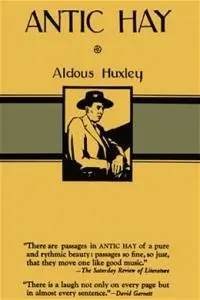
- Название:Antic Hay
- Автор:
- Издательство:epubBooks Classics
- Жанр:
- Год:2017
- ISBN:нет данных
- Рейтинг книги:5 / 5. Голосов: 1
-
Избранное:Добавить в избранное
- Отзывы:
-
Ваша оценка:
Antic Hay: краткое содержание, описание и аннотация
Предлагаем к чтению аннотацию, описание, краткое содержание или предисловие (зависит от того, что написал сам автор книги «Antic Hay»). Если вы не нашли необходимую информацию о книге — напишите в комментариях, мы постараемся отыскать её.
Antic Hay — читать онлайн бесплатно полную книгу (весь текст) целиком
Ниже представлен текст книги, разбитый по страницам. Система сохранения места последней прочитанной страницы, позволяет с удобством читать онлайн бесплатно книгу «Antic Hay», без необходимости каждый раз заново искать на чём Вы остановились. Поставьте закладку, и сможете в любой момент перейти на страницу, на которой закончили чтение.
Интервал:
Закладка:
At their first luncheon he had asked Gumbril to tell him all about modern painting. Gumbril had given him a brief lecture; before the savoury had appeared on the table, Mr Boldero was talking with perfect familiarity of Picasso and Derain. He almost made it understood that he had a fine collection of their works in his drawing–room at home. Being a trifle deaf, however, he was not very good at names, and Gumbril's all–too–tactful corrections were lost on him. He could not be induced to abandon his Bacosso in favour of any other version of the Spaniard's name. Bacosso—why, he had known all about Bacosso since he was a schoolboy! Bacosso was an old master, already.
Mr Boldero was very severe with the waiters and knew so well how things ought to be done at a good restaurant, that Gumbril felt sure he must recently have lunched with some meticulous gormandizer of the old school. And when the waiter made as though to serve them with brandy in small glasses, Mr Boldero was so passionately indignant that he sent for the manager.
'Do you mean to tell me,' he shouted in a perfect frenzy of righteous anger, 'that you don't yet know how brandy ought to be drunk?'
Perhaps it was only last week that he himself, Gumbril reflected, had learned to aerate his cognac in Gargantuan beakers.
Meanwhile, of course, the Patent Small–Clothes were not neglected. As soon as he had been told about the things, Mr Boldero began speaking of them with a perfect and practised familiarity. They were already his, mentally his. And it was only Mr Boldero's generosity that prevented him from making the Small–Clothes more effectively his own.
'If it weren't for the friendship and respect which I feel for your father, Mr Gumbril,' he said, twinkling genially over the brandy, 'I'd just annex your Small–Clothes. Bag and baggage. Just annex them.'
'Ah, but they're my patent,' said Gumbril. 'Or at least they're in process of being patented. The agents are at work.'
Mr Boldero laughed. 'Do you suppose that would trouble me if I wanted to be unscrupulous? I'd just take the idea and manufacture the article. You'd bring an action. I'd have it defended with all the professional erudition that could be brought. You'd find yourself let in for a case that might cost thousands. And how would you pay for it? You'd be forced to come to an agreement out of court, Mr Gumbril. That's what you'd have to do. And a damned bad agreement it would be for you, I can tell you.' Mr Boldero laughed very cheerfully at the thought of the badness of this agreement. 'But don't be alarmed,' he said. 'I shan't do it, you know.'
Gumbril was not wholly reassured. Tactfully, he tried to find out what terms Mr Boldero was prepared to offer. Mr Boldero was nebulously vague.
They met again in Gumbril's rooms. The contemporary drawings on the walls reminded Mr Boldero that he was now an art expert. He told Gumbril all about it—in Gumbril's own words. Every now and then, it was true, Mr Boldero made a little slip. Bacosso, for example, remained unshakably Bacosso. But on the whole the performance was most impressive. It made Gumbril feel very uncomfortable, however, while it lasted. For he recognized in this characteristic of Mr Boldero a horrible caricature of himself. He too was an assimilator; more discriminating, no doubt, more tactful, knowing better than Mr Boldero how to turn the assimilated experience into something new and truly his own; but still a caterpillar, definitely a caterpillar. He began studying Mr Boldero with a close and disgustful attention, as one might pore over some repulsive memento mori .
It was a relief when Mr Boldero stopped talking art and consented to get down to business. Gumbril was wearing for the occasion the sample pair of Small–Clothes which Mr Bojanus had made for him. For Mr Boldero's benefit he put them, so to speak, through their paces. He allowed himself to drop with a bump on to the floor—arriving there bruiseless and unjarred. He sat in complete comfort for minutes at a stretch on the edge of the ornamental iron fender. In the intervals he paraded up and down before Mr Boldero like a mannequin. 'A trifle bulgy,' said Mr Boldero. 'But still…' He was, taking it all round, favourably impressed. It was time, he said, to begin thinking of details. They would have to begin by making experiments with the bladders to discover a model combining, as Mr Boldero put it, 'maximum efficiency with minimum bulge'. When they had found the right thing, they would have it made in suitable quantities by any good rubber firm. As for the trousers themselves, they could rely for those on sweated female labour in the East End. 'Cheap and good,' said Mr Boldero.
'It sounds ideal,' said Gumbril.
'And then,' said Mr Boldero, 'there's our advertising campaign. On that I may say,' he went on with a certain solemnity, 'will depend the failure or success of our enterprise. I consider it of the first importance.'
'Quite,' said Gumbril, nodding importantly and with intelligence.
'We must set to work,' said Mr Boldero, 'sci—en—tifically.'
Gumbril nodded again.
'We have to appeal,' Mr Boldero went on so glibly that Gumbril felt sure he must be quoting somebody else's words, 'to the great instincts and feelings of humanity…. They are the sources of action. They spend the money, if I may put it like that.'
'That's all very well,' said Gumbril. 'But how do you propose to appeal to the most important of the instincts? I refer, as you may well imagine, to sex.'
'I was just going to come to that,' said Mr Boldero, raising his hand as though to ask for a patient hearing. 'Alas! we can't. I don't see any way of hanging our Small–Clothes on the sexual peg.'
'Then we are undone,' said Gumbril, too dramatically.
'No, no,' Mr Boldero was reassuring. 'You make the error of the Viennese. You exaggerate the importance of sex. After all, my dear Mr Gumbril, there is also the instinct of self–preservation; there is also,' he leaned forward, wagging his finger, 'the social instinct, the instinct of the herd.'
'True.'
'Both of them as powerful as sex. What are the Professor's famous Censors but forbidding suggestions from the herd without, made powerful and entrenched by the social instinct within?'
Gumbril had no answer; Mr Boldero continued, smiling:
'So that we shall be all right if we stick to self–preservation and the herd. Rub in the comfort and the utility, the hygienic virtues of our Small–Clothes; that will catch their self–preservatory feelings. Aim at their dread of public opinion, at their ambition to be one better than their fellows and their terror of being different—at all the ludicrous weaknesses a well–developed social instinct exposes them to. We shall get them, if we set to work scientifically.' Mr Boldero's bird–like eyes twinkled very brightly. 'We shall get them,' he repeated, and he laughed a happy little laugh, full of such a childlike diabolism, such an innocent gay malignity, that it seemed as though a little leprechaun had suddenly taken the financier's place in Gumbril's best arm–chair.
Gumbril laughed too; for this leprechaunish mirth was infectious. 'We shall get them,' he echoed. 'Oh, I'm sure we shall, if you set about it, Mr Boldero.'
Mr Boldero acknowledged the compliment with a smile that expressed no false humility. It was his due, and he knew it.
'I'll give you some of my ideas about the advertising campaign,' he said. 'Just to give you a notion. You can think them over, quietly, and make suggestions.'
'Yes, yes,' said Gumbril, nodding.
Mr Boldero cleared his throat. 'We shall begin,' he said, 'by making the most simple elementary appeal to their instinct of self–preservation: we shall point out that the Patent Small–Clothes are comfortable; that to wear them is to avoid pain. A few striking slogans about comfort—that's all we want. Very simple indeed. It doesn't take much to persuade a man that it's pleasanter to sit on air than on wood. But while we're on the subject of hard seats we shall have to glide off subtly at a tangent to make a flank attack on the social instincts.' And joining the tip of his forefinger to the tip of his thumb, Mr Boldero moved his hand delicately sideways, as though he were sliding it along a smooth brass rail. 'We shall have to speak about the glories and the trials of sedentary labour. We must exalt its spiritual dignity and at the same time condemn its physical discomforts. "The seat of honour", don't you know. We could talk about that. "The Seats of the Mighty." "The seat that rules the office rocks the world." All those lines might be made something of. And then we could have little historical chats about thrones; how dignified, but how uncomfortable they've been. We must make the bank clerk and the civil servant feel proud of being what they are and at the same time feel ashamed that, being such splendid people, they should have to submit to the indignity of having blistered hind–quarters. In modern advertising you must flatter your public—not in the oily, abject, tradesman–like style of the old advertisers, crawling before clients who were their social superiors; that's all over now. It's we who are the social superiors—because we've got more money than the bank clerks and the civil servants. Our modern flattery must be manly, straight–forward, sincere, the admiration of equal for equal—all the more flattering as we aren't equals.' Mr Boldero laid a finger to his nose. 'They're dirt and we're capitalists….' He laughed.
Читать дальшеИнтервал:
Закладка:
Похожие книги на «Antic Hay»
Представляем Вашему вниманию похожие книги на «Antic Hay» списком для выбора. Мы отобрали схожую по названию и смыслу литературу в надежде предоставить читателям больше вариантов отыскать новые, интересные, ещё непрочитанные произведения.

![Олдос Хаксли - О дивный новый мир [Прекрасный новый мир]](/books/11834/oldos-haksli-o-divnyj-novyj-mir-prekrasnyj-novyj-thumb.webp)



Обсуждение, отзывы о книге «Antic Hay» и просто собственные мнения читателей. Оставьте ваши комментарии, напишите, что Вы думаете о произведении, его смысле или главных героях. Укажите что конкретно понравилось, а что нет, и почему Вы так считаете.