Олдос Хаксли - Antic Hay
Здесь есть возможность читать онлайн «Олдос Хаксли - Antic Hay» весь текст электронной книги совершенно бесплатно (целиком полную версию без сокращений). В некоторых случаях можно слушать аудио, скачать через торрент в формате fb2 и присутствует краткое содержание. Год выпуска: 2017, Издательство: epubBooks Classics, Жанр: Классическая проза, на английском языке. Описание произведения, (предисловие) а так же отзывы посетителей доступны на портале библиотеки ЛибКат.
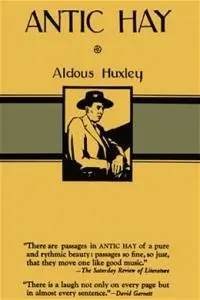
- Название:Antic Hay
- Автор:
- Издательство:epubBooks Classics
- Жанр:
- Год:2017
- ISBN:нет данных
- Рейтинг книги:5 / 5. Голосов: 1
-
Избранное:Добавить в избранное
- Отзывы:
-
Ваша оценка:
Antic Hay: краткое содержание, описание и аннотация
Предлагаем к чтению аннотацию, описание, краткое содержание или предисловие (зависит от того, что написал сам автор книги «Antic Hay»). Если вы не нашли необходимую информацию о книге — напишите в комментариях, мы постараемся отыскать её.
Antic Hay — читать онлайн бесплатно полную книгу (весь текст) целиком
Ниже представлен текст книги, разбитый по страницам. Система сохранения места последней прочитанной страницы, позволяет с удобством читать онлайн бесплатно книгу «Antic Hay», без необходимости каждый раз заново искать на чём Вы остановились. Поставьте закладку, и сможете в любой момент перейти на страницу, на которой закончили чтение.
Интервал:
Закладка:
Gumbril laughed too. It was the first time that he had ever thought of himself as a capitalist, and the thought was exhilarating.
'We flatter them,' went on Mr Boldero. 'We say that honest work is glorious and ennobling—which it isn't; it's merely dull and cretinizing. And then we go on to suggest that it would be finer still, more ennobling, because less uncomfortable, if they wore Gumbril's Patent Small–Clothes. You see the line?'
Gumbril saw the line.
'After that,' said Mr Boldero, 'we get on to the medical side of the matter. The medical side, Mr Gumbril—that's most important. Nobody feels really well nowadays—at any rate, nobody who lives in a big town and does the kind of loathsome work that the people we're catering for does. Keeping this fact before our eyes, we have to make it clear that only those can expect to be healthy who wear pneumatic trousers.'
'That will be a little difficult, won't it?' questioned Gumbril.
'Not a bit of it!' Mr Boldero laughed with an infectious confidence. 'All we have to do is to talk about the great nerve–centres of the spine: the shocks they get when you sit down too hard; the wearing exhaustion to which long–protracted sitting on unpadded seats subjects them. We'll have to talk very scientifically about the great lumbar ganglia—if there are such things, which I really don't pretend to know. We'll even talk almost mystically about the ganglia. You know that sort of ganglion philosophy?'
Mr Boldero went on parenthetically. 'Very interesting it is, sometimes, I think. We could put in a lot about the dark, powerful sense–life, sex–life, instinct–life which is controlled by the lumbar ganglion. How important it is that that shouldn't be damaged. That already our modern conditions of civilization tend unduly to develop the intellect and the thoracic ganglia controlling the higher emotions. That we're wearing out, growing feeble, losing our balance in consequence. And that the only cure—if we are to continue our present mode of civilized life—is to be found in Gumbril's Patent Small–Clothes.' Mr Boldero brought his hand with an emphatic smack on to the table as he spoke, as he fairly shouted these last words.
'Magnificent,' said Gumbril, with genuine admiration.
'This sort of medical and philosophical dope,' Mr Boldero went on, 'is always very effective, if it's properly used. The public to whom we are making our appeal is, of course, almost absolutely ignorant on these, or, indeed, on almost all other subjects. It is therefore very much impressed by the unfamiliar words; particularly if they have such a good juicy sound as the word "ganglia".'
'There was a young man of East Anglia, whose loins were a tangle of ganglia,' murmured Gumbril, improvvisatore .
'Precisely,' said Mr Boldero. 'Precisely. You see how juicy it is? Well, as I say, they're impressed. And they're also grateful. They're grateful to us for having given them a piece of abstruse, unlikely information which they can pass on to their wives, or to such friends as they know don't read the paper in which our advertisement appears—can pass on airily, don't you know, with easy erudition, as though they'd known all about ganglia from their childhood. And they'll feel such a flow of superiority as they hand on the metaphysics and the pathology, that they'll always think of us with affection. They'll buy our breeks and they'll get other people to buy. That's why,' Mr Boldero went off again on an instructive tangent, 'that's why the day of secret patent medicines is really over. It's no good saying you have rediscovered some secret known only, in the past, to the Egyptians. People don't know anything about Egyptology; but they have an inkling that such a science exists. And that if it does exist, it's unlikely that patent–medicine makers should have found out facts unknown to the professors at the universities. And it's much the same even with secrets that don't come from Egypt. People know there's such a thing as medical science and they again feel it's improbable that manufacturers should know things ignored by the doctors. The modern democratic advertiser is entirely above–board. He tells you all about it. He explains that the digestive juices acting on bismuth give rise to a disinfectant acid. He points out that lactic ferment gets destroyed before it reaches the large intestine, so that Metchnikoff's cure generally won't work. And he goes on to explain that the only way of getting the ferment there is to mix it with starch and paraffin: starch to feed the ferment on, paraffin to prevent the starch being digested before it gets to the intestine. And, in consequence, he convinces you that a mixture of starch, paraffin and ferment is the only thing that's any good at all. Consequently you buy it; which you would never have done without the explanation. In the same way, Mr Gumbril, we mustn't ask people to take our trousers on trust. We must explain scientifically why these trousers will be good for their health. And by means of the ganglia, as I've pointed out, we can even show that the trousers will be good for their souls and the whole human race at large. And as you probably know, Mr Gumbril, there's nothing like a spiritual message to make things go. Combine spirituality with practicality and you've fairly got them. Got them, I may say, on toast. And that's what we can do with our trousers; we can put a message into them, a big, spiritual message. Decidedly,' he concluded, 'we shall have to work those ganglia all we can.'
'I'll undertake to do that,' said Gumbril, who felt very buoyant and self–assured. Mr Boldero's hydrogenous conversation had blown him up like a balloon.
'And I'm sure you'll do it well,' said Mr Boldero encouragingly. 'There is no better training for modern commerce than a literary education. As a practical business man, I always uphold the ancient universities, especially in their teaching of the Humanities.'
Gumbril was much flattered. At the moment, it seemed supremely satisfying to be told that he was likely to make a good business man. The business man took on a radiance, began to glow, as it were, with a phosphorescent splendour.
'Then it's very important,' continued Mr Boldero, 'to play on their snobbism; to exploit that painful sense of inferiority which the ignorant and ingenuous always feel in the presence of the knowing. We've got to make our trousers the Thing—socially right as well as merely personally comfortable. We've got to imply somehow that it's bad form not to wear them. We've got to make those who don't wear them feel rather uncomfortable. Like that film of Charlie Chaplin's, where he's the absent–minded young man about town who dresses for dinner immaculately, from the waist up—white waistcoat, tail coat, stiff shirt, top–hat—and only discovers, when he gets down into the hall of the hotel, that he's forgotten to put on his trousers. We've got to make them feel like that. That's always very successful. You know those excellent American advertisements about young ladies whose engagements are broken off because they perspire too freely or have an unpleasant breath? How horribly uncomfortable those make you feel! We've got to do something of the same sort for our trousers. Or more immediately applicable would be those tailor's advertisements about correct clothes. "Good clothes make you feel good." You know the sort of line. And then those grave warning sentences in which you're told that a correctly cut suit may make the difference between an appointment gained and an appointment lost, an interview granted and an interview refused. But the most masterly examples I can think of,' Mr Boldero went on with growing enthusiasm, 'are those American advertisements of spectacles, in which the manufacturers first assume the existence of a social law about goggles, and then proceed to invoke all the sanctions which fall on the head of the committer of a solecism upon those who break it. It's masterly. For sport or relaxation, they tell you, as though it was a social axiom, you must wear spectacles of pure tortoiseshell. For business, tortoiseshell rims and nickel ear–pieces lend incisive poise—incisive poise, we must remember that for our ads, Mr Gumbril. "Gumbril's Patent Small–Clothes lend incisive poise to business men." For semi–evening dress, shell rims with gold ear–pieces and gold nose–bridge. And for full dress, gold–mounted rimless pince–nez are refinement itself, and absolutely correct. Thus we see, a social law has been created, according to which every self–respecting myope or astigmat must have four distinct pairs of glasses. Think if he should wear the all–shell sports model with full dress! Revolting solecism! The people who read advertisements like that begin to feel uncomfortable; they have only one pair of glasses, they are afraid of being laughed at, thought low–class and ignorant and suburban. And since there are few who would not rather be taken in adultery than in provincialism, they rush out to buy four new pairs of spectacles. And the manufacturer gets rich, Mr Gumbril. Now, we must do something of the kind with our trousers. Imply somehow that they're correct, that you're undressed without, that your fiancée would break off the engagement if she saw you sitting down to dinner on anything but air.' Mr Boldero shrugged his shoulders, vaguely waved his hand.
Читать дальшеИнтервал:
Закладка:
Похожие книги на «Antic Hay»
Представляем Вашему вниманию похожие книги на «Antic Hay» списком для выбора. Мы отобрали схожую по названию и смыслу литературу в надежде предоставить читателям больше вариантов отыскать новые, интересные, ещё непрочитанные произведения.

![Олдос Хаксли - О дивный новый мир [Прекрасный новый мир]](/books/11834/oldos-haksli-o-divnyj-novyj-mir-prekrasnyj-novyj-thumb.webp)




Обсуждение, отзывы о книге «Antic Hay» и просто собственные мнения читателей. Оставьте ваши комментарии, напишите, что Вы думаете о произведении, его смысле или главных героях. Укажите что конкретно понравилось, а что нет, и почему Вы так считаете.