Олдос Хаксли - Antic Hay
Здесь есть возможность читать онлайн «Олдос Хаксли - Antic Hay» весь текст электронной книги совершенно бесплатно (целиком полную версию без сокращений). В некоторых случаях можно слушать аудио, скачать через торрент в формате fb2 и присутствует краткое содержание. Год выпуска: 2017, Издательство: epubBooks Classics, Жанр: Классическая проза, на английском языке. Описание произведения, (предисловие) а так же отзывы посетителей доступны на портале библиотеки ЛибКат.
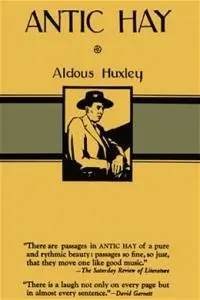
- Название:Antic Hay
- Автор:
- Издательство:epubBooks Classics
- Жанр:
- Год:2017
- ISBN:нет данных
- Рейтинг книги:5 / 5. Голосов: 1
-
Избранное:Добавить в избранное
- Отзывы:
-
Ваша оценка:
Antic Hay: краткое содержание, описание и аннотация
Предлагаем к чтению аннотацию, описание, краткое содержание или предисловие (зависит от того, что написал сам автор книги «Antic Hay»). Если вы не нашли необходимую информацию о книге — напишите в комментариях, мы постараемся отыскать её.
Antic Hay — читать онлайн бесплатно полную книгу (весь текст) целиком
Ниже представлен текст книги, разбитый по страницам. Система сохранения места последней прочитанной страницы, позволяет с удобством читать онлайн бесплатно книгу «Antic Hay», без необходимости каждый раз заново искать на чём Вы остановились. Поставьте закладку, и сможете в любой момент перейти на страницу, на которой закончили чтение.
Интервал:
Закладка:
But the Complete Man was not one to be put off by a mere ultimatum. 'There,' he said, falling into step with her, 'now I've had it—the deserved snub. Honour is saved, prestige duly upheld. Now we can get on with our conversation.'
The Mild and Melancholy one stood by, gasping with astonished admiration.
'You are v—very impertinent,' said the stranger, smiling and looking up from under the magnolia petals.
'It is in my character,' said the Complete Man. 'You mustn't blame me. One cannot escape from one's heredity; that's one's share of original sin.'
'There is always grace,' said the stranger.
Gumbril caressed his beard. 'True,' he replied.
'I advise you to pr—ray for it.'
His prayer, the Mild and Melancholy one reflected, had already been answered. The original sin in him had been self–corrected.
'Here is another antique shop,' said Gumbril. 'Shall we stop and have a look at it?'
The stranger glanced at him doubtfully. But he looked quite serious. They stopped.
'How revolting this sham cottage furniture is,' Gumbril remarked. The shop, he noticed, was called 'Ye Olde Farme House.'
The stranger, who had been on the point of saying how much she liked those lovely Old Welsh dressers, gave him her heartiest agreement. 'So v—vulgar.'
'So horribly refined. So refined and artistic.'
She laughed on a descending chromatic scale. This was excitingly new. Poor Aunt Aggie with her Arts and Crafts, and her old English furniture. And to think she had taken them so seriously! She saw in a flash the fastidious lady that she now was—with Louis whatever–it–was furniture at home, and jewels, and young poets to tea, and real artists. In the past, when she had imagined herself entertaining real artists, it had always been among really artistic furniture. Aunt Aggie's furniture. But now—no, oh no. This man was probably an artist. His beard; and that big black hat. But not poor; very well dressed.
'Yes, it's funny to think that there are people who call that sort of thing artistic. One's quite s—sorry for them,' she added, with a little hiss.
'You have a kind heart,' said Gumbril. 'I'm glad to see that.'
'Not v—very kind, I'm af—fraid.' She looked at him sideways, and significantly as the fastidious lady would have looked at one of the poets.
'Well, kind enough, I hope,' said the Complete Man. He was delighted with his new acquaintance.
Together they disembogued into the Bayswater Road. It was here, Gumbril reflected, that the Mild and Melancholy one would dumbly have slunk away to his glass of port and his loneliness among the alien topers at the bar. But the Complete Man took his new friend by the elbow, and steered her into the traffic. Together they crossed the road, together entered the park.
'I still think you are v—very impertinent,' said the lady. 'What induced you to follow me?'
With a single comprehensive gesture, Gumbril indicated the sun, the sky, the green trees airily glittering, the grass, the emerald lights and violet shadows of the rustic distance. 'On a day like this,' he said, 'how could I help it?'
'Original sin?'
'Oh,' the Complete Man modestly shook his head, 'I lay no claim to originality in this.'
The stranger laughed. This was nearly as good as a young poet at the tea–table. She was very glad that she'd decided, after all, to put on her best suit this afternoon, even if it was a little stuffy for the warmth of the day. He, too, she noticed, was wearing a great–coat; which seemed rather odd.
'Is it original,' he went on, 'to go and tumble stupidly like an elephant into a pitfall, head over ears, at first sight…?'
She looked at him sideways, then closed down the magnolia petals, and smiled. This was going to be the real thing—one of those long, those interminable, or, at any rate, indefinitely renewable conversations about love; witty, subtle, penetrating and bold, like the conversations in books, like the conversations across the tea–table between brilliant young poets and ladies of quality, grown fastidious through an excessive experience, fastidious and a little weary, but still, in their subtle way, insatiably curious.
'Suppose we sit down,' suggested Gumbril, and he pointed to a couple of green iron chairs, standing isolated in the middle of the grass close together and with their fronts slanting inwards a little towards one another in a position that suggested a confidential intimacy. At the prospect of the conversation that, inevitably, was about to unroll itself, he felt decidedly less elated than did his new friend. If there was anything he disliked it was conversations about love. It bored him, oh, it bored him most horribly, this minute analysis of the passion that young women always seemed to expect one, at some point or other in one's relation with them, to make. How love alters the character for both good and bad; how physical passion need not be incompatible with the spiritual; how a hateful and tyrannous possessiveness can be allied in love with the most unselfish solicitude for the other party—oh, he knew all this and much more, so well, so well. And whether one can be in love with more than one person at a time, whether love can exist without jealousy, whether pity, affection, desire can in any way replace the full and genuine passion—how often he had had to thrash out these dreary questions!
And all the philosophic speculations were equally familiar, all the physiological and anthropological and psychological facts. In the theory of the subject he had ceased to take any interest. Unhappily, a discussion of the theory always seemed to be an essential preliminary to the practice of it. He sighed a little wearily as he took his seat on the green iron chair. But then, recollecting that he was now the Complete Man, and that the Complete Man must do everything with a flourish and a high hand, he leaned forward and, smiling with a charming insolence through his beard, began:
'Tiresias, you may remember, was granted the singular privilege of living both as a man and a woman.'
Ah, this was the genuine young poet. Supporting an elbow on the back of her chair and leaning her cheek against her hand, she disposed herself to listen and, where necessary, brilliantly to interpellate; it was through half–closed eyes that she looked at him, and she smiled faintly in a manner which she knew, from experience, to be enigmatic, and though a shade haughty, though a tiny bit mocking and ironical, exceedingly attractive.
An hour and a half later they were driving towards an address in Bloxam Gardens, Maida Vale. The name seemed vaguely familiar to Gumbril. Bloxam Gardens—perhaps one of his aunts had lived there once?
'It's a dr—dreadful little maisonnette,' she explained. 'Full of awful things. We had to take it furnished. It's so impossible to find anything now.'
Gumbril leaned back in his corner, wondering, as he studied that averted profile, who or what this young woman could be. She seemed to be in the obvious movement, to like the sort of things one would expect people to like; she seemed to be as highly civilized, in Mr Mercaptan's rather technical sense of the term, as free of all prejudices as the great exponent of civilization himself.
She seemed, from her coolly dropped hints, to possess all the dangerous experience, all the assurance and easy ruthlessness of a great lady whose whole life is occupied in the interminable affairs of the heart, the senses and the head. But, by a strange contradiction, she seemed to find her life narrow and uninteresting. She had complained in so many words that her husband misunderstood and neglected her, had complained, by implication, that she knew very few interesting people.
The maisonnette in Bloxam Gardens was certainly not very splendid—six rooms on the second and third floors of a peeling stucco house. And the furniture—decidedly Hire Purchase. And the curtains and cretonnes—brightly 'modern', positively 'futurist'.
Читать дальшеИнтервал:
Закладка:
Похожие книги на «Antic Hay»
Представляем Вашему вниманию похожие книги на «Antic Hay» списком для выбора. Мы отобрали схожую по названию и смыслу литературу в надежде предоставить читателям больше вариантов отыскать новые, интересные, ещё непрочитанные произведения.

![Олдос Хаксли - О дивный новый мир [Прекрасный новый мир]](/books/11834/oldos-haksli-o-divnyj-novyj-mir-prekrasnyj-novyj-thumb.webp)





Обсуждение, отзывы о книге «Antic Hay» и просто собственные мнения читателей. Оставьте ваши комментарии, напишите, что Вы думаете о произведении, его смысле или главных героях. Укажите что конкретно понравилось, а что нет, и почему Вы так считаете.