Олдос Хаксли - Antic Hay
Здесь есть возможность читать онлайн «Олдос Хаксли - Antic Hay» весь текст электронной книги совершенно бесплатно (целиком полную версию без сокращений). В некоторых случаях можно слушать аудио, скачать через торрент в формате fb2 и присутствует краткое содержание. Год выпуска: 2017, Издательство: epubBooks Classics, Жанр: Классическая проза, на английском языке. Описание произведения, (предисловие) а так же отзывы посетителей доступны на портале библиотеки ЛибКат.
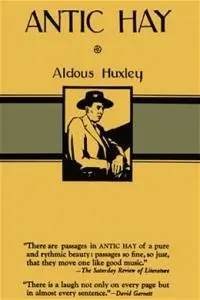
- Название:Antic Hay
- Автор:
- Издательство:epubBooks Classics
- Жанр:
- Год:2017
- ISBN:нет данных
- Рейтинг книги:5 / 5. Голосов: 1
-
Избранное:Добавить в избранное
- Отзывы:
-
Ваша оценка:
Antic Hay: краткое содержание, описание и аннотация
Предлагаем к чтению аннотацию, описание, краткое содержание или предисловие (зависит от того, что написал сам автор книги «Antic Hay»). Если вы не нашли необходимую информацию о книге — напишите в комментариях, мы постараемся отыскать её.
Antic Hay — читать онлайн бесплатно полную книгу (весь текст) целиком
Ниже представлен текст книги, разбитый по страницам. Система сохранения места последней прочитанной страницы, позволяет с удобством читать онлайн бесплатно книгу «Antic Hay», без необходимости каждый раз заново искать на чём Вы остановились. Поставьте закладку, и сможете в любой момент перейти на страницу, на которой закончили чтение.
Интервал:
Закладка:
Mrs Viveash stepped up on to the model's dais and took her seat. 'Is that right?' she asked.
Lypiatt looked first at her, then at his picture. Her beauty, his passion—were they only to meet on the canvas? Opps was her lover. Time was passing; he felt tired. 'That'll do,' he said, and began painting. 'How young are you?' he asked after a moment.
'Twenty–five, I should imagine,' said Mrs Viveash.
'Twenty–five? Good Lord, it's nearly fifteen years since I was twenty–five. Fifteen years, fighting all the time. God, how I hate people sometimes! Everybody. It's not their malignity I mind; I can give them back as good as they give me. It's their power of silence and indifference, it's their capacity for making themselves deaf. Here am I with something to say to them, something important and essential. And I've been saying it for more than fifteen years, I've been shouting it. They pay no attention. I bring them my head and heart on a charger, and they don't even notice that the things are there. I sometimes wonder how much longer I can manage to go on.' His voice had become very low, and it trembled. 'One's nearly forty, you know….' The voice faded huskily away into silence. Languidly and as though the business exhausted him, he began mixing colours on his palette.
Mrs Viveash looked at him. No, he wasn't young; at the moment, indeed, he seemed to have become much older than he really was. An old man was standing there, peaked and sharp and worn. He had failed, he was unhappy. But the world would have been unjuster, less discriminating if it had given him success.
'Some people believe in you,' she said; there was nothing else for her to say.
Lypiatt looked up at her. 'You?' he asked.
Mrs Viveash nodded, deliberately. It was a lie. But was it possible to tell the truth? 'And then there is the future,' she reassured him, and her faint death–bed voice seemed to prophesy with a perfect certainty. 'You're not forty yet; you've got twenty, thirty years of work in front of you. And there were others, after all, who had to wait—a long time—sometimes till after they were dead. Great men; Blake, for instance….' She felt positively ashamed; it was like a little talk by Doctor Frank Crane. But she felt still more ashamed when she saw that Casimir had begun to cry, and that the tears were rolling, one after another, slowly down his face.
He put down his palette, he stepped on to the dais, he came and knelt at Mrs Viveash's feet. He took one of her hands between his own and he bent over it, pressing it to his forehead, as though it were a charm against unhappy thoughts, sometimes kissing it; soon it was wet with tears. He wept almost in silence.
'It's all right,' Mrs Viveash kept repeating, 'it's all right,' and she laid her free hand on his bowed head, she patted it comfortingly as one might pat the head of a large dog that comes and thrusts its muzzle between one's knees. She felt, even as she made it, how meaningless and unintimate the gesture was. If she had liked him, she would have run her fingers through his hair; but somehow his hair rather disgusted her. 'It's all right, all right.' But, of course, it wasn't all right; and she was comforting him under false pretences and he was kneeling at the feet of somebody who simply wasn't there—so utterly detached, so far away she was from all this scene and all his misery.
'You're the only person,' he said at last, 'who cares or understands.'
Mrs Viveash could almost have laughed.
He began once more to kiss her hand.
'Beautiful and enchanting Myra—you were always that. But now you're good and dear as well, now I know you're kind.'
'Poor Casimir!' she said. Why was it that people always got involved in one's life? If only one could manage things on the principle of the railways! Parallel tracks—that was the thing. For a few miles you'd be running at the same speed. There'd be delightful conversation out of the windows; you'd exchange the omelette in your restaurant car for the vol–au–vent in theirs. And when you'd said all there was to say, you'd put on a little more steam, wave your hand, blow a kiss and away you'd go, forging ahead along the smooth, polished rails. But instead of that, there were these dreadful accidents; the points were wrongly set, the trains came crashing together; or people jumped on as you were passing through the stations and made a nuisance of themselves and wouldn't allow themselves to be turned off. Poor Casimir! But he irritated her, he was a horrible bore. She ought to have stopped seeing him.
'You can't wholly dislike me, then?'
'But of course not, my poor Casimir!'
'If you knew how horribly I loved you!' He looked up at her despairingly.
'But what's the good?' said Mrs Viveash.
'Have you ever known what it's like to love some one so much that you feel you could die of it? So that it hurts all the time. As though there were a wound. Have you ever known that?'
Mrs Viveash smiled her agonizing smile, nodded slowly and said, 'Perhaps. And one doesn't die, you know. One doesn't die.'
Lypiatt was leaning back, staring fixedly up at her. The tears were dry on his face, his cheeks were flushed. 'Do you know what it is,' he asked, 'to love so much that you begin to long for the anodyne of physical pain to quench the pain in the soul? You don't know that.' And suddenly, with his clenched fist, he began to bang the wooden dais on which he was kneeling, blow after blow, with all his strength.
Mrs Viveash leant forward and tried to arrest his hand. 'You're mad, Casimir,' she said. 'You're mad. Don't do that.' She spoke with anger.
Lypiatt laughed till his face was all broken up with the grimace, and proffered for her inspection his bleeding knuckles. The skin hung in little white tags and tatters, and from below the blood was slowly oozing up to the surface. 'Look,' he said, and laughed again. Then suddenly, with an extraordinary agility, he jumped to his feet, bounded from the dais and began once more to stride up and down the fairway between his easel and the door.
'By God,' he kept repeating, 'by God, by God. I feel it in me. I can face the whole lot of you; the whole damned lot. Yes, and I shall get the better of you yet. An Artist'—he called up that traditional ghost and it comforted him; he wrapped himself with a protective gesture within the ample folds of its bright mantle—'an Artist doesn't fail under unhappiness. He gets new strength from it. The torture makes him sweat new masterpieces….'
He began to talk about his books, his poems and pictures; all the great things in his head, the things he had already done. He talked about his exhibition—ah, by God, that would astonish them, that would bowl them over, this time. The blood mounted to his face; there was a flush over the high projecting cheek–bones. He could feel the warm blood behind his eyes. He laughed aloud; he was a laughing lion. He stretched out his arms; he was enormous, his arms reached out like the branches of a cedar. The Artist walked across the world and the mangy dogs ran yelping and snapping behind him. The great wind blew and blew, driving him on; it lifted him and he began to fly.
Mrs Viveash listened. It didn't look as though he would get much further with the portrait.
Chapter VII
It was Press Day. The critics had begun to arrive; Mr Albemarle circulated among them with a ducal amiability. The young assistant hovered vaguely about, straining to hear what the great men had to say and trying to pretend that he wasn't eavesdropping. Lypiatt's pictures hung on the walls, and Lypiatt's catalogue, thick with its preface and its explanatory notes, was in all hands.
'Very strong,' Mr Albemarle kept repeating, 'very strong indeed!' It was his password for the day.
Little Mr Clew, who represented the Daily Post , was inclined to be enthusiastic. 'How well he writes!' he said to Mr Albemarle, looking up from the catalogue. 'And how well he paints! What impasto !'
Читать дальшеИнтервал:
Закладка:
Похожие книги на «Antic Hay»
Представляем Вашему вниманию похожие книги на «Antic Hay» списком для выбора. Мы отобрали схожую по названию и смыслу литературу в надежде предоставить читателям больше вариантов отыскать новые, интересные, ещё непрочитанные произведения.

![Олдос Хаксли - О дивный новый мир [Прекрасный новый мир]](/books/11834/oldos-haksli-o-divnyj-novyj-mir-prekrasnyj-novyj-thumb.webp)

Обсуждение, отзывы о книге «Antic Hay» и просто собственные мнения читателей. Оставьте ваши комментарии, напишите, что Вы думаете о произведении, его смысле или главных героях. Укажите что конкретно понравилось, а что нет, и почему Вы так считаете.